Knowing how to monitor baby breathing and heart rate at home is one of the most practical things a new parent can do. Normal newborn breathing looks nothing like adult breathing, and heart rates vary widely by age. This guide walks you through what is normal, how to check your baby manually, which devices work best, and when to call your pediatrician, so you have the knowledge to act fast and rest easy.
Why Do Parents Monitor Baby Breathing and Heart Rate at Home
New parents spend a lot of time watching their baby sleep, and that instinct makes sense. Newborns spend most of their time sleeping, and their breathing and heart rate can shift quickly.
The First Few Months Feel the Most Intense
The first three months carry the most adjustment for new parents wanting peace of mind during nighttime sleep. Most parents feel the urge to check on their baby constantly. A reliable monitoring routine, whether done manually or with a device, can reduce that anxiety without replacing safe sleep habits.
What Monitoring Actually Gives You
Consistent monitoring helps parents build a clear picture of their baby's normal baseline, which everyday nursery check-ins much calmer. Over time, that record of normal sleep patterns becomes a useful insight into their daily routine.
What Are Normal Baby Breathing and Heart Rate Ranges
Before you start monitoring, you need to know what normal looks like. These numbers change quickly as your baby grows, so having the right benchmarks by age is the foundation of everything else in this guide.
Normal Breathing Rate by Age (at Rest)
| Age |
Normal Breathing Rate (breaths per minute) |
| Newborn (0–1 month) |
40–60 |
| 1–6 months |
30–60 |
| 6–12 months |
25–40 |
| 1–3 years |
20–30 |
Babies breathe much faster than adults. A resting rate consistently above 60 breaths per minute in a newborn is worth a call to your doctor.
Normal Resting Heart Rate by Age (at Rest)
| Age |
Normal Resting Heart Rate (beats per minute) |
| Newborn |
100–160 |
| 1–6 months |
90–150 |
| 6–12 months |
80–140 |
| 1–3 years |
75–130 |
Heart rate naturally slows as your baby grows. During deep sleep, the rate will sit toward the lower end of its normal range, which is expected and healthy.
What Can Affect Breathing and Heart Rate Readings
Now that you know the normal ranges, it helps to know what can temporarily push numbers outside those ranges without anything being wrong. Understanding these factors prevents unnecessary panic when a reading looks unusual.
| Factor |
How It Affects Readings |
| Crying or activity |
Raises both heart rate and breathing rate quickly |
| Sleep stage |
Heart rate drops in deep sleep, rises slightly in light sleep |
| Fever |
A rise of 1°F (0.56°C) above normal can increase heart rate by about 10 beats per minute |
| Room temperature |
A very warm or cold room can push breathing rate temporarily outside the typical range |
| Feeding |
Breathing often becomes irregular during or right after a feed, especially in newborns |
Always wait until your baby is calm and at rest before treating any reading as a reliable baseline.
How Do You Check Your Baby's Breathing and Heart Rate at Home
You do not need a device to check your baby's vitals. Both checks are simple to do manually, and learning them gives you a useful skill you will use throughout the first year.
How to Check Breathing
- Place your baby on their back on a firm, flat surface.
- Watch their chest and belly rise and fall.
- Count the number of breaths for 60 seconds. One full rise-and-fall counts as one breath.
- Compare the count to the normal range for your baby's age.
Short pauses of up to 10 seconds between breaths are common in newborns. This pause-and-restart pattern is called periodic breathing, and it is a normal part of how newborn lungs develop. Belly movement is also more visible than chest movement in young babies, because babies breathe more from their belly than their chest. Occasional sighs or brief clusters of rapid breaths are normal and often follow a stretch or position change.
How to Check Heart Rate
- Press two fingers gently on the inside of your baby's upper arm, or place them on the left side of the chest just below the nipple.
- Wait a moment to feel for a pulse. It may take a few seconds to locate.
- Count the beats for 60 seconds, or count for 15 seconds and multiply by 4.
- Compare the result to the normal range for your baby's age.
Always check when your baby is calm and at rest. If you cannot find a pulse on the first try, move to the other arm or the chest placement before worrying.
What Types of At-Home Baby Monitors Help Track Sleep and Dynamics
Once you are comfortable with manual checks, a monitor can add a layer of continuous, overnight visibility that manual checks simply cannot provide. The market has several options, and each works differently.
| Monitor Type |
How It Works |
Pros |
Cons |
| Audio/Video Monitor |
Streams audio and video to a parent unit or phone |
Affordable, simple setup |
No vital sign data |
| Wearable Sensor |
Sensor worn on the baby (clip, sock, or patch) |
Tracks movement and oxygen |
Can slip off, needs charging |
| Under-Mattress Sensor |
Sensor placed beneath the mattress |
No wearable required |
Less accurate with thick mattresses |
| Contact-Free Radar Monitor |
mmWave radar detects chest movement remotely |
No wearables, continuous tracking |
Requires correct placement |
Contact-free radar monitors are the newest category and the least disruptive option for babies and parents alike.
The Momcozy Contact-Free Smart Baby Monitor
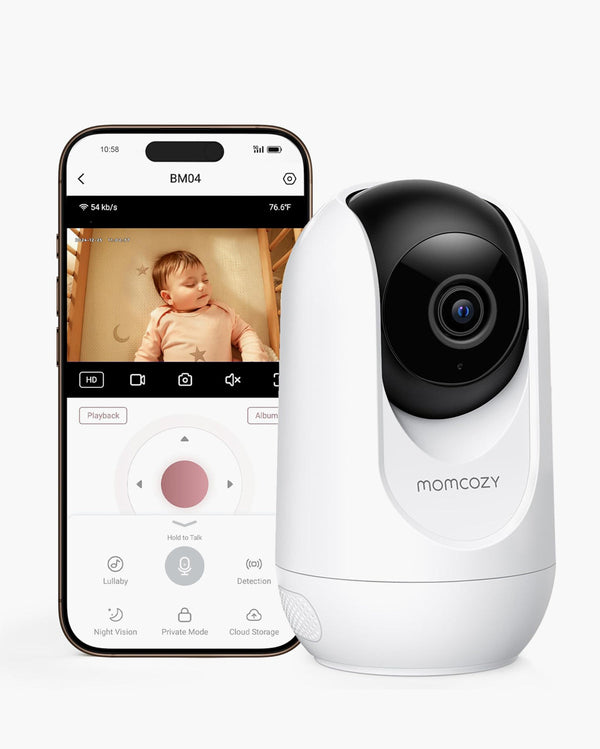
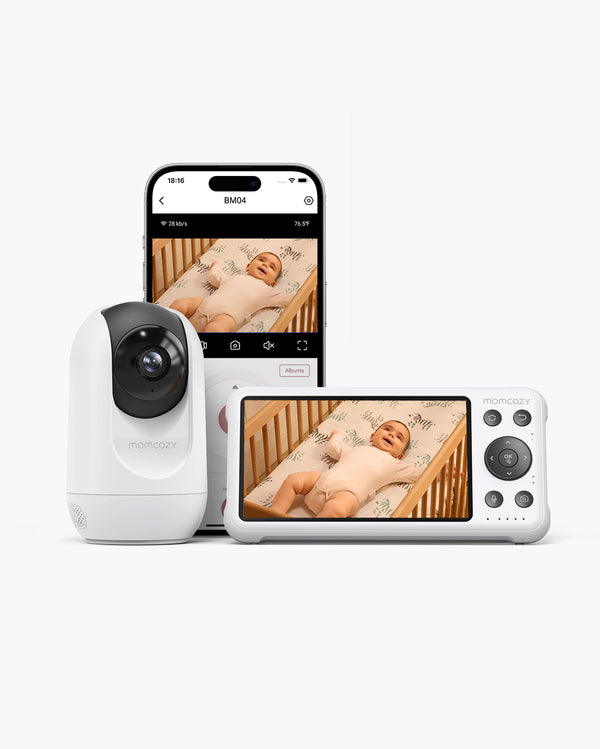
The Momcozy Contact-Free Smart Baby Monitor uses millimeter-wave (mmWave) radar technology to provide summaries into your baby's breathing dynamics, heart dynamics, and sleep stages without any wearables or physical contact. The radar detects the subtle movements caused by breathing and heartbeats and sends continuous data straight to the Momcozy app.
Key features that set it apart:
-
Contact-free monitoring support: No sock, clip, or patch needed. Your baby sleeps without any device attached to their body, which removes concerns like skin irritation or the device slipping off during sleep.
-
2K HD video with 940nm infrared night vision: See your baby clearly in total darkness. The 940nm invisible infrared light produces no visible glow, so your baby's sleep goes undisturbed.
-
AI-powered face-covering detection: The monitor sends a real-time smart notification if something covers your baby's face or if an unsafe sleep position is detected.
-
Smart cry detection with auto-soothing: The AI tells the difference between real crying and background noise. When crying is detected, the monitor can automatically play built-in lullabies to help your baby settle before you even leave your room.
-
Dual-band 2.4/5 GHz Wi-Fi plus Bluetooth: Bluetooth handles the initial pairing process so setup is quick and straightforward, while dual-band Wi-Fi keeps alerts timely whether you are in the next room or out in the backyard.
-
No subscription fees: All smart features, including sleep stage tracking, smart notifications, and daily summaries, are available through the Momcozy app with no monthly cost.
For best results, Momcozy recommends placing the floor stand approximately 3.3 ft (1 m) above your baby's chest beside the crib or bassinet. The monitor also includes a compact foldable travel stand, so it works just as well in a hotel room or at a relative's home.
When Is a Baby Monitor Recommended
Most pediatricians do not routinely recommend a home monitor for healthy, full-term babies. That said, certain situations make one a genuinely sensible addition to your setup.
A monitor tends to be most valuable for premature babies or babies with a history of breathing irregularities observed in the NICU. Families who want extra peace of mind during nighttime sleep also often find data-backed monitoring truly reassuring. Babies with a diagnosed condition affecting breathing or oxygen levels may need a monitor if their doctor specifically recommends home tracking. Always speak with your pediatrician before using any monitor as a medical tool or making care decisions based on its readings.
What Are the Benefits and Limitations of Home Baby Monitors
Both sides of the picture deserve equal attention.
Benefits That Make a Real Difference
Building a baseline over time lets you learn what your baby's normal actually looks like, which makes genuine changes easier to recognize. Sleep stage tracking shows how many times your baby truly wakes overnight and how long deep sleep lasts, which helps you build better routines. Reliable smart notifications also reduce the urge to check in person throughout the night, meaning more rest for you and less disturbance for your baby. Account-sharing features let both parents and even grandparents or caregivers stay informed without everyone crowding around a single screen.
Limitations Every Parent Should Know
No consumer monitor can replace a doctor's diagnosis or a clinical evaluation. Thick bedding, incorrect positioning, and baby movement can all affect the accuracy of readings. Frequent false notifications can raise anxiety rather than reduce it, especially with devices that lack smart filtering. Safe sleep practices remain the single most important tool for supporting a safe sleep environment. Monitoring does not replace placing your baby on their back, on a firm flat surface, in a sleep-safe environment.
What Warning Signs Should Parents Watch For
Some changes in breathing or heart rate need immediate attention, and recognizing them quickly matters. If your baby shows any of the following, call 911 or go to the emergency room right away.
- Breathing rate consistently above 60 breaths per minute while calm and at rest.
- Breathing pauses that last longer than 20 seconds.
- Blue or pale lips, fingernails, or face (called cyanosis).
- Grunting, flaring nostrils, or visible chest retractions with each breath.
- Heart rate that stays very high or very low outside the normal range with no clear cause like fever or crying.
Do not wait to see if the situation improves on its own. Act immediately.
Safe Use Tips for Your Baby Monitor
Setting up a monitor correctly makes a real difference in both safety and accuracy. Follow these steps with any device you bring into the nursery.
- Keep all cords at least 3 ft (91 cm) away from the crib and completely out of your baby's reach.
- Follow the manufacturer's placement guidelines carefully. For the Momcozy Contact-Free Smart Baby Monitor, position the floor stand approximately 3.3 ft (1 m) above your baby's chest for accurate radar detection.
- Use a strong, unique password for any Wi-Fi-connected monitor, and look for devices with AES-256 encryption to protect your family's video and audio data.
- Reset the monitor's position each time you move it to a new room or a travel location.
- Treat safe sleep practices as non-negotiable. Back-sleeping on a firm, clutter-free surface always comes before any monitoring tool.
When Should You Call a Doctor
Call your pediatrician right away if your baby's breathing or heart rate falls outside the normal range for their age at rest, or if you notice any of the warning signs listed above. The same applies if your monitor gives a consistent alert pattern that does not match your baby's visible condition. Trust your instincts. A quick call to your pediatrician costs nothing and is always the right move when you are unsure.
Monitor Baby Breathing and Heart Rate at Home with Confidence
Knowing how to monitor baby breathing and heart rate at home puts you one step ahead from day one. Learn the normal ranges, practice the manual checks, and choose a monitoring device that fits your family's needs. Pair smart tools with safe sleep habits, and you have everything you need for calmer nights and genuine peace of mind. If you are ready to find the right device, browse the Momcozy Baby Monitors to compare options for every stage and budget.
Application ou unité parentale
Alerte de zone de danger
Stockage pris en charge
Mode Vox
FAQs About Monitoring Baby Breathing and Heart Rate at Home
Q1. Is BM08 a medical baby monitor?
No. BM08 is designed for everyday home baby monitoring support. It is not a medical device and should not be used for diagnosis, treatment, prevention, or clinical monitoring. It does not replace professional medical advice or adult supervision.
Q2. Can a Baby Monitor Detect Low Oxygen Levels at Home?
Most consumer baby monitors, including video and radar-based options, do not measure blood oxygen (SpO2) directly. Devices that measure oxygen levels typically use a small clip-style sensor worn on the baby's foot or hand. If oxygen monitoring is a medical priority for your baby, talk to your pediatrician about which type of device is appropriate.
Q3. Why Does My Baby Monitor Keep Giving False Alarms?
An unstable Wi-Fi signal is the most common overlooked cause. Baby movement and thick sleep sacks can also trigger these notifications. If false alarms persist after repositioning the device, check your router signal strength and consider switching to the 5 GHz band for a more stable connection.
Q4. At What Age Can I Ease Up on Closely Monitoring My Baby's Breathing?
Most parents scale back close nighttime monitoring after their baby reaches 6 months, as babies develop stronger sleep routines and physical control after this point. There is no single rule that applies to every family. Babies with a medical history related to breathing or prematurity may benefit from longer monitoring, so your pediatrician is the best person to guide that decision.
Q5. Is It Safe to Leave a Baby Monitor on All Night, Every Night?
Yes. Consumer baby monitors emit wireless signal energy comparable to everyday household devices like a Wi-Fi router. Current evidence does not indicate risk from normal overnight use. If you have concerns, placing the monitor at the recommended distance of 3.3 ft (1 m) from your baby further reduces any exposure.