


For petite moms, slip-free babywearing comes down to two things: choosing a truly adjustable carrier and setting it high, snug, and balanced every time.
Does your carrier slide down within minutes, leaving your shoulders burning while your baby sinks lower and lower? Hospital guidance and real parent testing show the same pattern: slipping is usually a setup issue, not a body-size failure. You can fix it with a clear fit method that keeps your baby secure, comfortable, and close.
Start With the Non-Negotiables
A safe carry keeps your baby close enough to kiss, high on your chest, and supported so their body does not slump as you move. If your baby starts near your sternum and drifts toward your belly button during a short walk, the fit is not locked in yet.

No-slip fit is also a breathing safety issue, because keeping your baby’s face uncovered and chin off the chest matters more than any model name. In practice, you should be able to glance down and clearly see your baby’s nose and mouth without moving fabric or repositioning your baby.
Choose a Carrier Type That Matches a Petite Frame
The Momcozy Baby Carrier Adjustable Buckle Carrier offers a breathable design and adjustable buckles for newborns to toddlers (7-45 lbs), with 6 carrying positions, including hip seat.
The Momcozy Baby Carrier Wrap uses soft, stretchy fabric that adjusts for petite moms (4'11"-5'5"), supporting newborns to 35 lbs with breathable, hands-free carrying.

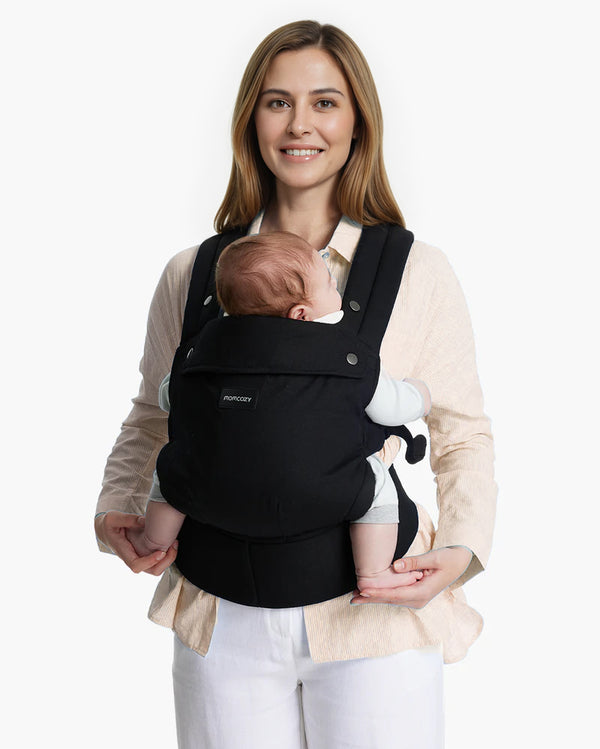


Carrier choice matters, but fit points matter more than brand for petite bodies. If you have a shorter torso, narrower shoulders, or a smaller waist, your best match is usually the style that lets you remove slack in multiple places.

Carrier Types, Pros, and Tradeoffs
|
Carrier type |
How it helps petite moms |
Main advantage |
Main tradeoff |
|
Wrap |
Highly customizable around short torsos and narrow shoulders |
Best fine-tuning in the newborn stage |
Learning curve and extra fabric management |
|
Ring sling |
Fast up/down adjustments and compact carry |
Great for quick transitions |
One-shoulder load can fatigue neck and back on long wears |
|
Soft-structured (buckle) |
Fast daily use with more structure and support |
Easier to put on and share |
Some models still do not tighten enough for very small frames |
|
Mei Tai |
Hybrid fit with tied straps and a structured panel |
More adjustability than many buckle designs |
Takes practice to tie evenly |
An older babywearing overview describes buckle carriers as less adjustable than wraps and slings.
More recent parent-led testing across many carriers shows that some newer buckle designs have much broader fit ranges. Both can be true, because model design has changed over time, and not all buckle carriers are built the same.
How to Adjust for a Petite Body So It Stays Put
Set the Waistband First, and Set It Higher Than You Think
Use a snug, stable base, because a firm waistband keeps the rest of the fit from drifting. For many petite moms, that means starting the waistband near the natural waist instead of low on the hips, then tightening until the belt does not rotate when you lightly tug the front.

A simple real-world check helps: after fastening, hold your baby, walk 10 steps, and recheck the belt position. If the belt has dropped by even 1 inch, retighten it before adjusting the shoulder straps.
Tighten Shoulder Straps Evenly and Keep Webbing Flat
The same snug, flat, untwisted straps principle used in infant restraint safety also improves carrier stability. On a petite frame, even a small strap asymmetry can pull your baby off-center and set the slide in motion.
After tightening both sides, reach behind and remove hidden slack near your mid-back. When both straps feel equal, your baby should feel centered, not heavier on one side.
Match Seat Width and Panel Height to Baby’s Current Size
Your baby’s hips should stay supported in a natural seat, not dangling or forced too wide, and younger infants may need more support, including cases where a newborn insert is needed. If the seat is too wide for a very small baby, slumping and forward folding become more likely.
A quick visual cue works well: knees should sit higher than the bottom, forming a soft “M,” and the back panel should support without covering the face. Recheck this after growth spurts, because last month’s settings often stop working.

Do a 30-Second Check Before Every Wear
Before you leave the house, do one short loop around the room, then confirm your baby is still high, face visible, chin lifted, and seat deep. This takes less than a minute and catches most fit drift before it turns into shoulder pain or a mid-errand readjustment.
Postpartum Comfort Matters Just as Much as Safety
Babywearing is linked with caregiver confidence and bonding, and that emotional ease matters in postpartum recovery. When the fit is right, you spend less energy fighting the carrier and more energy responding to your baby.
If your back or hips are sensitive, reduce wear time at first and build up with short sessions while your body adapts. Even a 12 lb baby carried for 20 minutes feels very different when the weight sits on a snug waistband instead of pulling from your shoulders.
Buying Decisions That Prevent Regret
Your shortlist should reflect your stage, daily routine, and fit for both baby and caregiver, not just social media popularity. If you want one carrier from newborn through toddler, check the minimum and maximum weight limits and make sure the carrier offers enough seat and panel adjustment to grow with your baby.

Think in terms of your real week: if you wear your baby for long walks, prioritize waistband support and shoulder comfort; if you mostly do short errands, lighter and faster may win. A carrier that works for your friend can still slip on your body, so your own fit test is the final decision point.
You are not too small for babywearing, and you are not failing if a popular carrier slides. The right model, paired with a consistent adjustment routine, can keep your baby secure and your body supported without the constant tug-and-retighten cycle.
Disclaimer
The content in "How to Choose and Adjust a Baby Carrier for Petite Moms No Slipping" is general education only and should be applied with professional judgment based on your own health status, your baby's condition, and your specific equipment setup.
Petite-fit adjustments vary by torso length, shoulder width, and carrier geometry; anti-slip tips may not transfer across all brands or body types. Overtightening to prevent slipping can also create pressure discomfort.
Any mention of carrier products, brands, or accessories is informational only. Outcomes differ by body type, carry method, baby size, and correct adjustment/maintenance, and no product can guarantee identical results.
If you cannot achieve secure high-and-tight positioning without pain, stop and seek a professional fit check before continued use.
Reliance on this material is solely your responsibility. To the fullest extent permitted by law, Momcozy and related parties are not responsible for outcomes resulting from the interpretation or application of the guidance provided.








