


Having a baby entails a thousand decisions, with the most crucial one being the baby's transport. Are you confused over the question of “what is a pram?” when scanning the market for baby equipment? This article will educate you on the definition of a pram and the distinctions between a pram, a stroller, and a pushchair. Such information will help you make the right baby decisions.
Key Takeaways
- Prams provide essential flat-lying positions for newborns (0-6 months), supporting healthy spine development and safe breathing
- Strollers offer versatile, reclining seating for babies 6+ months through toddlerhood with adjustable positions
- Pushchairs deliver lightweight portability for older babies and toddlers who can sit independently
- The right choice depends on your baby's age, your lifestyle, and whether you need single or multi-child transport

What Is a Pram?
A pram, short for perambulator, is a specialized baby carriage designed exclusively for newborns and young infants. What is a pram's defining characteristic? Its completely flat sleeping surface allows babies to lie horizontally, supporting proper spinal development and unrestricted breathing during their first months of life.
Traditional prams feature a bassinet-style carriage mounted on a wheeled frame, with the baby facing the parent. The design promotes bonding and allows caregivers to continuously monitor their newborn.
Features
- Flat Lying Position: The hallmark of a pram is a completely horizontal surface that supports newborn skeletal development and ensures optimal breathing.
- Parent-Facing Design: Babies lie facing their caregiver, facilitating eye contact, emotional connection, and easy monitoring.
- Robust Construction: Prams typically feature sturdy frames, large wheels, and excellent suspension systems for smooth rides over various terrains.
- Spacious Bassinet: Generous sleeping space allows babies to stretch comfortably and accommodates blankets and padding.
- Weather Protection: Most prams include hoods, covers, and rain shields to protect infants from environmental elements.
Pros and Cons
Pros:
- Optimal for newborn health with medically recommended flat-lying position
- Superior comfort for extended naps and longer outings
- Excellent suspension provides smooth, gentle rides
- Strong parent-infant bonding through face-to-face interaction
Cons:
- Limited usability period (typically 0-6 months only)
- Bulkier and heavier than other options, challenging for small spaces
- More expensive initial investment
- Difficult to maneuver in tight spaces or crowded areas
What Is a Stroller?
A stroller is a versatile baby transport system featuring a reclining seat suitable for babies who have developed adequate head and neck control. Unlike the flat-only design, when considering what is a pram, strollers offer adjustable seating positions from fully reclined to upright. Strollers bridge the gap between prams and pushchairs, accommodating babies from approximately 6 months through toddlerhood.
Features
- Adjustable Recline: Multiple seating positions accommodate sleeping, resting, and active observation.
- Reversible or Fixed Seats: Many strollers offer both parent-facing and forward-facing configurations.
- Compact Folding: Most strollers feature folding mechanisms for convenient storage and transport.
- Five-Point Harness: Comprehensive safety restraints keep active babies secure.
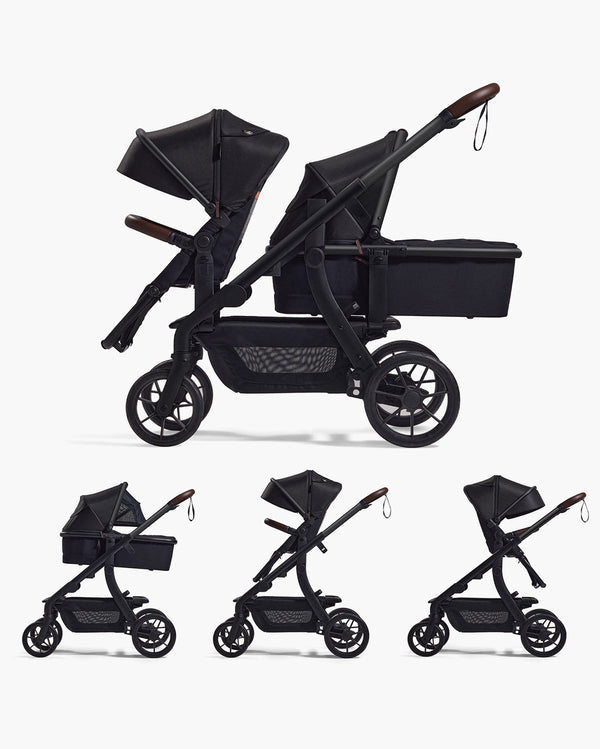
The Momcozy Baby Stroller Collection features innovative designs that combine comfort, safety, and convenience for growing families. For parents seeking versatility, the Momcozy ChangeGo Baby Stroller exemplifies modern stroller design with its reversible seat, multiple recline positions, and adaptable features that grow with your baby from infancy through toddlerhood.

Pros and Cons
Pros:
- Extended usability from infancy through toddlerhood
- Versatile positioning options suit different activities and ages
- More compact and maneuverable than traditional prams
- Better value with longer usability period
Cons:
- Not ideal for newborns unless fully reclinable with proper support
- May lack the superior suspension of dedicated prams
- Smaller bassinet space compared to traditional prams

What Is a Pushchair?
A pushchair is a lightweight, forward-facing baby transport designed for older babies and toddlers who sit independently. Pushchairs emphasize portability and ease of use for quick trips and active families. The term "pushchair" is more commonly used in British English, while Americans typically call these "umbrella strollers" or "lightweight strollers."
Features
- Forward-Facing Design: Babies face outward, engaging with their environment and satisfying natural curiosity.
- Lightweight Frame: Typically weighing 15-20 pounds, making them easy to lift and carry.
- Simple Folding: Quick, one-handed folding mechanisms ideal for busy parents.
- Minimal Recline: Limited recline positions, primarily upright seating for active toddlers.
Pros and Cons
Pros:
- Ultra-lightweight and portable for travel and public transportation
- Extremely maneuverable in crowded spaces
- Quick folding for convenience
- Budget-friendly option
Cons:
- Unsuitable for babies under 6 months who cannot sit independently
- Limited comfort for extended outings
- Basic suspension may feel rough on uneven surfaces
- Minimal storage capacity

Key Differences Between Pram, Stroller, and Pushchair
When deciding between a pram, stroller, or pushchair, three critical factors distinguish these baby transport options: age appropriateness, safety features, and practical handling.
| Comparison Factor | Pram | Stroller | Pushchair |
| Age Limits & Developmental Milestones | Newborn to 6 months (pre-sitting stage); requires full flat-lying position for spinal development and breathing | 6 months to 3-4 years; suitable once baby has head/neck control; can sit independently | 6 months to 3-4 years; only for babies who can sit upright without support |
| Safety Standards |
|
|
|
| Maneuverability | Excellent on smooth paths and parks; large wheels handle uneven terrain well; struggles in tight spaces, crowded stores, and narrow aisles due to bulk | Balanced performance across environments; handles varied terrain reasonably; moderate maneuverability in tight spaces; suitable for most daily activities | Superior in crowded spaces, narrow aisles, public transport; swivel wheels for tight corners; struggles on rough or uneven surfaces |
The table above illustrates how each option serves distinct needs based on your baby's development and your daily routines.
Choosing the Right Option
The best option for you depends on your lifestyle and your baby's age. Consider how often you'll be using the transport, where you'll be going, and how much storage space you have. For newborns, a traditional pram might be ideal. For older babies, a stroller or travel system might be more practical.
Below is a comparison to help guide your decision:
| Feature | Pram | Stroller | Pushchair |
| Design | Traditional, carrycot-style with lie-flat position | Compact and streamlined design for easy maneuverability | Sturdy frame, can include reversible and reclining seat |
| Usage Age | Newborns (0-6 months) | Typically 6 months+ | From birth (if fully reclining) to toddler years |
| Terrain | Smooth ride, ideal for pavements and longer outings | Best for short trips and smooth surfaces | All-terrain models available for urban and off-road use |
| Portability | Bulky, not ideal for travel | Highly portable and easy to fold | Foldable with moderate weight depending on model |
| Features | Lie-flat carrycot, sun canopy, storage basket | Padded seat, sun canopy, peek-a-boo window, travel-friendly | Adjustable handles, recline options, storage space |
| Usage | Daily walks, naps on the go | Running errands, public transport, air travel | Everyday use, versatile for city and countryside |
Remember, there's no single "right" answer. The most important thing is to choose a safe and comfortable option that works for you and your little one.
For families wanting maximum flexibility, consider convertible systems that transform from pram to stroller, or invest in both a pram for the newborn stage and a lightweight pushchair for toddlerhood. The Momcozy ClickGo Lightweight Stroller provides excellent portability for quick trips and travel, while the Momcozy Baby Carrier Collection offers supplementary options for close-contact carrying when wheeled transport isn't practical.
FAQs
Q1. Which Is Better, the Stroller or a Pram?
Both are not always "better." Your lifestyle and the age of your child will determine the best option. Because of its flat-lying position, which promotes healthy development, a pram is medically superior for newborns under six months. A stroller provides more adaptability and longer usability for infants six months of age and up. For many families, the best of both worlds can be achieved by starting with a pram or convertible system and switching to a lightweight stroller as their child grows.
Q2. Can I Put My 4-Month-Old in a Pushchair?
No, a 4-month-old shouldn't use a conventional pushchair. Babies this age usually can't sit up on their own and need sufficient support for their neck and spine. Until your baby can sit up on their own (typically around 6 to 8 months), pushchairs that are meant for sitting up are not safe. Use a stroller or a pram that can be fully reclined so that your infant may lie flat instead. Before switching from flat-lying to seated positions, always get your pediatrician's approval.
Q3. How Long Should a Baby Lie Flat in a Pram?
The baby should always be laid flat whenever placed in a pram until they are able to sit alone, aged around 6 months. The baby can be laid flat for a total of 2 to 3 hours per outing, but it is advised to take a rest to feed, change, and play with the baby. The baby, nonetheless, shouldn’t spend the whole day inside a pram because they need floor time to develop motor skills and tummy time to gain strength.
Find Your Perfect Baby Transport Solution
Now that you understand what constitutes a pram and the difference between prams, strollers, and pushchairs, you are ready to make an informed decision for your family. Whether you value the baby safety of a conventional pram, the versatility of an all-purpose stroller, or the ease of mobility of a pushchair, the perfect pram for you is waiting. Your baby’s age, your lifestyle, and your routines will guide you towards finding the perfect transport solution. Explore the Baby Stroller today to discover premium options designed with your family's comfort and safety in mind.








