


A pregnancy ball or birthing ball is a highly recommended support device used in pregnancy; it is also known as an exercise ball. It is used by many expectant mothers to help ease the back pain, improve posture, remain mellow in movement, and feel more comfortable when their bodies change. But in order to get all the advantages of this kind of product, it is crucial to select the size properly.
In case you are asking what size exercise ball for pregnancy, then most of it will depend on your height, position, and the manner in which the ball is inflated. This emphasis can be divided into size matters, ball choice, assurance of a good fit, and safety and comfort during pregnancy; this guide is all about it.
Why Size Matters
The dimensions of your exercise ball also determine the position of your pelvis, spine and legs when seated or moving on it. The right-sized ball enables the positioning of the body in an upright and steady position that minimizes the load of lower back and hips.
Your hips must be slightly elevated more than your knees when sitting in position. This position is responsible for assisting in the natural curve of spine and helps in improvement of pelvic positioning. It also enables your core and pelvic floor muscles to work without any strain, which can aid in stability generally in the course of pregnancy.
When the ball is small, your knees will be higher than hips causing pressure on pelvic and lower back. This may aggravate pain and decrease the effectiveness of the ball. When it is too big, then your feet cannot rest flat on the floor and it becomes harder to balance, which is necessary especially during pregnancy when there is a greater flexibility of the joints thanks to the hormonal changes.
The right size helps to enhance comfort, confidence, and usability in the long run.

What Size Exercise Ball for Pregnancy
Height is the most dependable and most popular point of starting when deciding on the size exercise ball to use during pregnancy. The idea is to select a ball that helps you to sit in a safe and upright position, and have your pelvis in a mobile and relaxed state. An exercise ball of the appropriate size is supposed to make you feel stable, supported, and comfortable as opposed to stretched and unbalanced.
According to a general guideline on maternity best practice:
- When you are between 1.73 m (5ft 8in) tall, the standard size exercise ball is a 65 cm ball, which is generally most suitable. The size enables the majority of pregnant women to sit down with their feet flat on the floor, with hips being slightly lifted as compared to their knees.
- A bigger exercise ball, 75 cm (2.5 ft 8 in), will provide more support in case you are over 1.73 m (5 ft 8 in), since a smaller one will make the knees lift excessively and strain the pelvis and lower back unnecessarily.
These are the size suggestions, based on the assumption that the ball is inflated appropriately and completely. Your hips would raise slightly above the level of your knees when sitting on the ball of the right size, your thighs would tilt downwards gently, and your spine would be in an upright position without any strain. Such alignment encourages an improved posture, less tension on the lower back and easy movement of the pelvis like a gentle rocking or swaying.
It is also worth mentioning that the level of inflation is capable of making a ball slightly different in terms of its feel. A few females, particularly those at the lower end of a height range, might choose to inflate a ball to a level slightly below that which is recommended, whereas the taller users might want to inflate the ball to the fullest recommended height. The trick here is that the hips-above-knees posture is important, and not the printed size.

How to Check if Your Ball Fits
The feet should be flat on the floor and spaced approximately 60 cm (45 inches) apart in order to be stable on the center of the ball. Knees should be a little bit lowered than the hips. Assuming that your knees are the same height as or taller than your hips, then the ball might be underinflated or excessively.
When barely in touch with the floor or when unsteady in your feet, then the ball is either bigger than normal or overinflated.
The ball must be firm but when pressed it should be able to give a little. An over inflated ball can be hard to control and an under inflated ball may fail to help hold your posture properly.
Due to the fact that the balls of exercises lose air with time, it is normal to resort to the occasional replenishment to ensure the appropriate height and comfort.

What to Consider When Choosing an Exercise Ball for Pregnancy
One of the things to do when selecting a proper pregnancy exercise ball is its size. The role is also performed by safety, the quality of materials, and design.
- Anti-burst technology is an important feature. An anti-burst ball is one that will gradually deflate when it is punctured as opposed to deflating instantly thus the risk of falling or being injured is minimal. This is particularly critical in pregnancy where there can be an undue influence of balance.
- Quality of materials is also important. PVC as a material is used on most pregnancy exercise balls and they are latex free, which is significant to individuals with latex sensitivities. Find BPA-free, eco-friendly materials which can be used on a regular basis.
- Stability may be greatly influenced by surface texture. A non-slip surface that is lightly textured will save the ball on smooth floors, allowing you to have a greater level of confidence in sitting or moving.
- Weight capacity is also to be taken into account. The exercise balls of high quality are pressure-tested to allow a large variety of body weights to be safely supported.
The Momcozy BirthEase Maternity Exercise Ball Set is planned with these in consideration. It consists of high quality, BPA-free PVC, anti-burst construction, a textured anti-slip surface and a reinforced base which stands 330 lb. An inflatable ball can be inflated at home gradually and precisely with the provided foot pump.
$199.99 USD

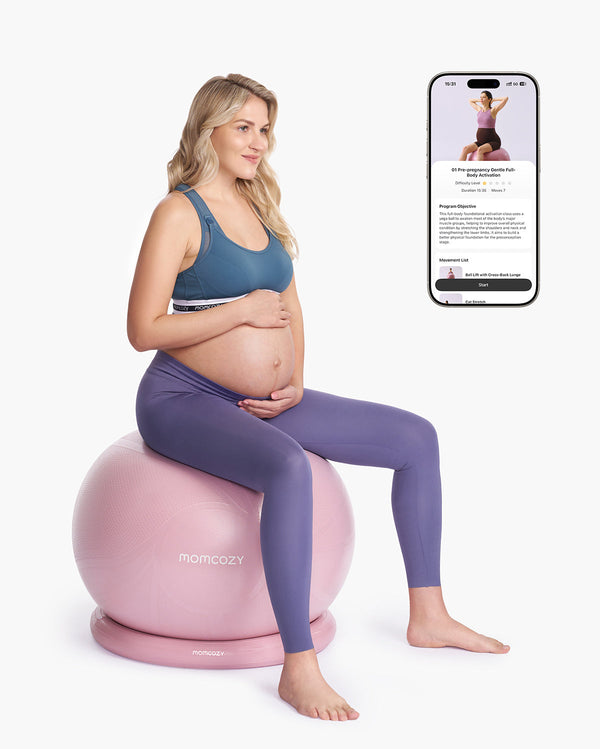


Moreover, the Momcozy App also includes a series of guided classes on prenatal comfort, movement, and postnatal recovery in stages with videos that can guide moms on how to use the ball and the proper technique.

Benefits of Using a Birth Ball During Pregnancy
The exercise ball has a lot of physical and emotional advantages when pregnant women exercise on it regularly.
Pain in the lower back and the pelvic region is one of the most frequently used excuses that expectant women have to use a ball to alleviate. The body should be moved around gently by rocking or swaying which relieves tension, improves circulation and reduces stiffness associated with sitting too long.
Also, exercise balls promote sitting up and this may enhance good posture and lessen the strain on the spine. Sitting on a ball also feels more comfortable than sitting on a chair or sofa to many women, especially in later pregnancy as they find it more difficult to stand up and sit down.
The other advantage is soft muscle activity. Sitting on a ball exercises the abdominal, back and pelvic muscles, giving one a low-impact alternative to standard exercise.
Relaxation can also be facilitated with regular use. Rhythmic motions would minimize the stress and anxiety creating physical and mental relaxation throughout the pregnancy.
Tips for Using an Exercise Ball Properly During Pregnancy
When using the exercise ball is the first time, place it on a carpeted or non-slip floor as opposed to a smooth floor to enhance stability. During later pregnancy, it is a good idea to have somebody around you whenever you are sitting down which will make you feel safer.
Wearing of shoes with non-slip is advisable, or the feet should go bare in order to have good grip. Socks should not be used on smooth floors because it can cause one to slip.
Begin with slow and controlled movements. Slight pelvis rocking on the right or left side or back and forth usually suffices to ease the pain. You can only make any further advance unless you feel secure and firm.
Always listen to your body. Stop when experiencing dizziness, pain or discomfort and take breaks when necessary. Ensure that you put away any obstacles in the vicinity of the area around you, particularly when you are using the ball to move and not sit in the same location.
Conclusion
The choice of pregnancy size exercise ball is a minor matter, which can produce significant effects on the comfort, posture, and even the overall well being in a pregnant woman. The correct size will help you to be oriented, lessen discomfort and to move safely and confidently as your body adjusts.
The properly developed product, such as Momcozy BirthEase Maternity Exercise Ball Set, can be proposed that combines the ergonomic size, superior stability, and the high safety level with the stage-based assistance provided with the help of the Momcozy App. An exercise ball can be made one of the most convenient and helpful devices during and after pregnancy, when appropriately sized and used regularly and consistently.








