


MEDICALLY REVIEWED BY

Una Qian, Registered Nurse, IBCLC
I am a Registered Nurse and International Board Certified Lactation Consultant (IBCLC) based in Beijing, China. With 16 years of experience in obstetrics and gynecology, I currently provide clinical breastfeeding support. Over the past few years, I have obtained the Level II Certification in the French WAFF Perinatal Rehabilitation Method and the BFE Level I Certification in Pelvic Floor Rehabilitation (European Level I), which qualifies me to guide both prenatal and postpartum mothers in appropriate exercise programs and provide evidence-based postpartum rehabilitation.
For a newly 6-month-old baby, the Federal Register’s “Safety Standard for High Chairs” says the goal is simple: place the footrest so the feet are fully supported, the knees and hips stay close to a 90-degree angle, and the baby can sit upright without sliding. A well-set footrest helps improve posture, stability, and feeding comfort during early meals.
If you’ve ever watched your baby slump, push backward, or dangle their legs while trying to eat, you already know why this matters. In studies and safety guidance, supported sitting is tied to better posture and steadier feeding behavior, and the footrest is part of what makes that setup work.
Why the footrest matters at 6 months
A footrest is not just a comfort feature. In a high chair, it helps create a stable lower-body base so your baby can focus on eating instead of balancing their whole body. For a 6-month-old who has just started sitting independently, that usually means feet flat, knees bent, and the pelvis kept in a neutral position.

When the feet are left dangling, babies are more likely to slump, slide, squirm, or lose postural control. Feeding guidance for this age group consistently points to the same setup goal: a grounded base through the feet, not a hanging lower body.
What “correct” looks like
The easiest way to think about it is the 90-90-90 idea: hips, knees, and ankles each roughly at a 90-degree angle, with the soles of the feet flat on the footrest. That position supports upright sitting and helps the baby stay centered in the chair.
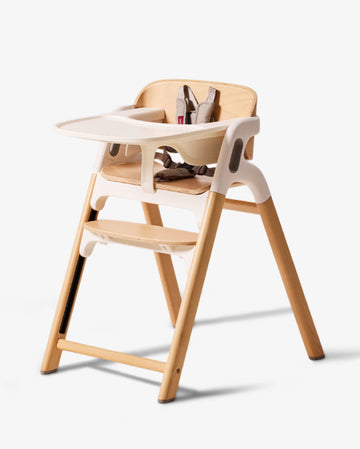
You also want the tray or table surface positioned so your baby can lean slightly forward to reach food without collapsing backward. An adjustable high chair like the Momcozy DinerPal High Chair can help you fine-tune seat and tray position while you set the footrest so the baby sits upright with feet supported.
How to set the footrest height step by step
Start by putting your baby in the chair with the harness secured snugly. Then adjust the footrest so the whole foot rests flat, from heel to toe, without the legs dangling or the baby perching on the edge of the seat.

If the chair has an adjustable footrest, the safest starting point for a 6-month-old is usually the highest setting that still allows a comfortable knee bend around 90 degrees. As your baby grows, you can lower it gradually—often by about 1/2 to 3/4 inch every 1 to 2 weeks during a fast growth phase, if the chair design allows that kind of fine adjustment.
A simple setup sequence
- Place the baby upright in the high chair with shoulders stacked over hips.
- Fasten the harness snugly so it holds the child in the seat without slack.
- Raise or lower the footrest until both feet can rest flat.
- Check that the knees are bent comfortably and not pushed too high.
- Make sure the tray does not force the baby to lean back or slide forward.
If your high chair does not have an adjustable footrest, some feeding guidance suggests using a stable makeshift option, such as a taped or strapped box, block, or similar support, as long as it is secure and the baby’s weight cannot tip it.
How to know the footrest is in the right spot
The clearest sign is that your baby looks stable and relaxed without collapsing into the seat. Feet should stay flat, the back should stay mostly upright, and the baby should not be constantly pushing backward, slumping down, or trying to stand in the chair.

Another good check is the knees. If the knees are much higher than the hips, the footrest is probably too high. If the feet barely touch or hang off the surface, the footrest is probably too low.
Good signs
- Feet stay flat on the footrest
- Legs look supported instead of dangling
- Hips and knees stay near a 90-degree angle
- Baby can lean forward to eat without sliding down
- Trunk stays upright with less squirming
Signs the setup needs an adjustment
- Baby slumps forward or sideways
- Feet cannot reach the footrest
- Baby pushes against the tray or seat to stand
- Harness looks loose because the body is sliding
- The baby seems fussy because they cannot settle into the seat
Common footrest mistakes to avoid
The biggest mistake is leaving the footrest too low. That often leads to dangling legs, a tilted pelvis, and more sliding in the seat. The second mistake is setting it too high, which can push the knees up and tip the pelvis backward or forward.
You also want the footrest to be locked securely in place. Safety guidance notes that adjustable footrests should have locked positions, and the footrest should not interfere with the harness or create dangerous gaps near the tray or seat.
Watch for these fit problems
- The feet only touch with the toes instead of the full sole
- The baby’s knees are rising above the hips
- The footrest shifts when weight is placed on it
- The harness straps stop fitting correctly after adjustment
- The chair feels unstable on the floor
If the chair cannot be adjusted enough to support flat feet and a stable upright posture, it is better to change the setup than to keep forcing the fit. Safety guidance also notes that if the feet cannot reach the footrest even at the lowest setting, or if the baby keeps sliding forward, the chair should be reevaluated and alternative positioning considered.
Adjusting for growth over the next few weeks
A baby who has just turned 6 months can change quickly, so this is not a one-time setup. Recheck the footrest every couple of weeks, especially if you notice new slumping, shorter meal tolerance, or feet that suddenly start hanging again.

The adjustment rule is straightforward: keep the feet fully supported and the knees and hips close to that stable 90-degree position. If your baby suddenly looks more cramped or starts sliding, move the footrest rather than assuming they will “grow into it.”
Growth-friendly tuning tips
- Recheck the fit every 2 to 3 weeks during rapid growth
- Move the footrest in small increments instead of large jumps
- Keep the harness snug after every adjustment
- Make sure the footrest stays locked after repositioning
- Confirm the tray still allows a slight forward lean for eating
Safety checks that matter every time
The footrest should never compromise the harness, the chair’s stability, or the baby’s ability to sit upright safely. HeadStart.gov notes that traditional high chairs should be used with the straps, not the tray, as the restraint system.
For a 6-month-old, the baby also needs to be developmentally ready for this setup. That means enough trunk and head control to sit upright with support, without tilting, leaning, or slouching out of position.
Stop and adjust if you notice
- The feet cannot rest flat
- The baby keeps sliding forward
- The harness no longer fits correctly
- The footrest moves or slips under pressure
- The chair becomes unstable on the floor
Key Takeaways
For a baby who just turned 6 months old, the footrest should usually be set so the feet are flat, the knees and hips are near 90 degrees, and the baby can sit upright without slumping or sliding. That setup supports posture, feeding comfort, and safer mealtime positioning.
If the fit is off, adjust the footrest before you try to compensate with the tray, the harness, or extra padding. If you cannot get a stable setup with the chair you have, it is worth pausing and choosing a different positioning option rather than forcing the fit.








