


MEDICALLY REVIEWED BY

Zola Zhang, MD, IBCLC, Breast Surgeon, Mother
Breast Surgeon | International Board Certified Lactation Consultant | Mother
As a dedicated Breast Surgeon and International Board Certified Lactation Consultant (IBCLC) with 21 years of clinical experience, my work is rooted in both medical expertise and the lived reality of motherhood—because I’m not just a clinician, but also a mother who exclusively breastfed my own child for two years. This dual perspective shapes every interaction, allowing me to blend scientific rigor with deep empathy for the joys and challenges of breastfeeding.
No. A baby swing with an overhead toy bar should not be used for unsupervised time, routine naps, or “just a few minutes” out of sight.
You know that moment when your baby finally settles into the swing, stares up at the little toys, and you wonder if you can run upstairs, fold laundry, or close your eyes for a minute? The safer benchmark is simple: swings are for short, awake, supervised soothing sessions, often around 20-30 minutes, not sleep or unattended containment. Here’s how to use one more confidently while knowing exactly where the hard safety lines are.
The Short Answer: The Toy Bar Does Not Make the Swing Safe Unattended
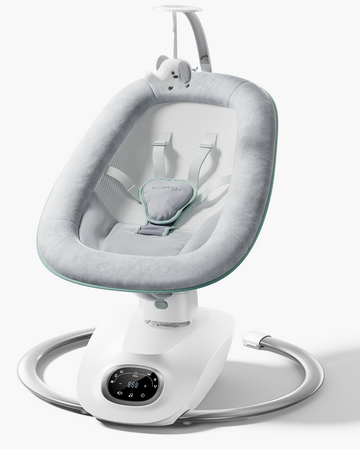
An overhead toy bar is meant to give your baby something to look at, reach for, or bat during awake time. It does not turn a swing into a safe sleep space, and it does not replace an adult watching the baby. Even a securely attached toy bar can add things to monitor, like clearance near the baby’s face, dangling toys, detachable pieces, and whether the baby is getting overstimulated.
Baby swings are regulated products, and the federal infant swing standard includes safety requirements for issues like sharp edges, small parts, pinching hazards, locking mechanisms, openings, restraints, stability, and toy accessories. That matters, but it does not mean a swing is safe for every use parents might be tempted to try. Standards reduce risk; they do not make unattended use risk-free.
What “Supervised” Really Means
Supervision means your baby is close enough that you can see their position, breathing comfort, harness fit, and overall body posture. A baby monitor can be helpful if you step a few feet away, but it should not turn swing time into alone time in another room. If you would not be able to respond quickly to slumping, fussing, spitting up, or a loose strap, the baby is not truly supervised.
In real life, this usually means placing the swing on a hard, flat floor in the same room while you make coffee, pump, eat lunch, or sit nearby with an older child. It does not mean putting the baby in the swing while you shower, nap, go outside, or leave the floor of the house.
Why Swing Naps Are the Bigger Concern
The biggest mistake many tired parents make is letting the swing become a nap spot. It is understandable, especially when a fussy baby finally relaxes with motion. But safe infant sleep guidance is very clear that babies should sleep on a firm, flat surface, such as a crib, bassinet, portable crib, or play yard that meets federal safety standards.
A swing holds a baby at an angle. When a young baby’s head tips forward or their body slumps to the side, their airway may become partly blocked. This is one reason sitting devices, including swings, are not recommended for routine sleep.

If Your Baby Falls Asleep in the Swing
If your baby dozes off, move them to a crib or bassinet as soon as it is safe and practical. I know that can feel painful when you finally got five quiet minutes, but the habit is worth building early. Think of the swing as a soothing tool before sleep, not the place where sleep happens.
A practical rhythm many parents use is: feed, burp, a short supervised swing session if baby is unsettled, then transfer to a flat sleep surface once drowsy or asleep. Keep the crib or bassinet ready nearby so the transfer feels less like a whole production.
The Main Risks to Watch For
Overhead toy bars can make a swing more engaging, but they also add another part of the product that needs checking. The concern is not just whether the bar looks cute or keeps the baby busy. The real question is whether anything attached to it could loosen, hang too low, touch the baby’s face, or encourage reaching and twisting before the baby has the control to do that safely.
Federal safety regulators have flagged swing safety topics including suffocation hazards, fall hazards, strangulation hazards, test methods, marking, and labeling in updates to the infant and cradle swing standard. That is a good reminder that swing safety is not about one feature. It is about the whole setup: frame, seat angle, restraints, toy bar, labels, batteries, and how the baby is using it that day.
Positional Asphyxia and Slumping
Newborns and young infants do not have strong head and neck control. If they slump forward, chin-to-chest, or lean hard to one side, they may not be able to correct their position well. This is why babies under 4 months need extra watching in any seated device.
For supervised awake time, use the recline position recommended by the manufacturer for your baby’s age and development. If your baby’s head keeps falling forward, their chin presses into their chest, or they look curled into the harness, take them out and use a flat surface instead.
Falls and Harness Problems
A swing’s harness is not optional. A snug harness helps keep your baby from sliding down, leaning sideways, or working into an unsafe position. Many parent safety guides recommend a harness fit where you can slide about two fingers between the strap and the baby’s chest, which is snug without digging in.
A safe swing setup starts with assembling it exactly as instructed, checking locks and bolts, and placing it on a flat, hard floor away from stairs, edges, cords, curtains, and furniture. Do not put a swing on a bed, couch, counter, table, or thick rug. A low, stable setup is one of the simplest ways to reduce fall risk.

Loose Toys, Batteries, and Small Parts
Toy bars should be checked often for loose clips, cracked plastic, torn fabric, and toys that can detach. Avoid adding extra toys, pacifier clips, blankets, pillows, or stroller toys to the swing unless the manufacturer clearly allows that exact use. Extra items can create choking, entanglement, or suffocation risks.
Battery-operated remotes deserve attention too. In 2025, federal safety regulators warned parents to stop using certain infant swings because their remotes contained lithium coin batteries and lacked required warnings; swallowed button cell or coin batteries can cause serious internal injuries. If your swing has a remote, make sure the battery compartment is secure and keep the remote out of your baby’s reach.
How to Use a Baby Swing More Safely
A baby swing can still be useful. It can give you a safe place to set your awake baby while you sit nearby, sip coffee, pump, answer a quick message, or take a short reset. The goal is not to avoid swings completely; it is to use them within their limits.
A good rule of thumb is to keep swing sessions short, usually around 20-30 minutes, and balance them with floor time, tummy time, cuddling, feeding, and interaction. Babies need chances to stretch, turn their heads freely, kick, and build strength outside of baby gear.
Before Each Use
Do a quick scan before you buckle your baby in. This takes less than a minute once you get used to it.
- Check that the swing is on a hard, flat floor.
- Make sure the frame is fully open and locked.
- Confirm the seat fabric is attached correctly.
- Tug gently on the toy bar to make sure it is secure.
- Look for loose toys, cracked plastic, frayed straps, or missing parts.
- Check that cords, curtains, blankets, and older siblings’ toys are out of reach.
- Make sure the harness is flat, snug, and fastened correctly.
The infant swing safety standard has been updated over time as standards organizations and federal safety regulators revise requirements, including the 2022 update that incorporated an updated infant swing standard. For parents, the practical takeaway is simple: use a current, properly labeled product, keep the instructions, and do not ignore warnings or recalls.
During Swing Time
Start with the lowest speed, especially for a newborn or a baby who has not used the swing before. Watch your baby’s face and body, not just whether they are quiet. Quiet can mean content, but it can also mean sleepy or poorly positioned.
Look for signs that swing time is no longer helping: hiccuping, gagging, slumping, turning red, arching, fussing, staring away from the toy bar, or getting drowsy. If your baby seems overstimulated, turn off the motion, remove them, and try a calmer option like holding, feeding, burping, or a flat play mat.
What to Look For in a Safer Swing With a Toy Bar
When you are choosing or checking a swing, focus less on fancy features and more on the basics. You want a stable frame, clear labeling, secure restraint system, appropriate recline options, and a toy bar that feels sturdy without crowding your baby’s face.
Federal safety guidance notes that infant and cradle swings are covered under 16 C.F.R. part 1223, and toy accessories on swings must meet applicable toy requirements. That is helpful when shopping, but it should sit alongside your own hands-on check at home. A product can meet rules and still be unsafe if it is assembled wrong, damaged, too old, or used outside the instructions.
Features That Help With Supervised Use
A safer swing for supervised awake time usually has a wide, stable base; clear age and weight limits; easy-to-adjust straps; and a toy bar that either locks firmly or removes completely. If the toy bar pops off too easily, hangs low, or makes it hard to place the baby in and out without bumping their face, that is worth taking seriously.
A 5-point harness is often more secure than a simple lap belt, especially for younger babies who slump or wiggle. The recline should match your baby’s stage, and the seat should support them without letting them curl deeply into a C-shape.
Features That Deserve Extra Caution
Be careful with swings marketed or described as sleep spaces. In 2025, federal safety regulators warned consumers to stop using one infant swing that was marketed for sleep and had an incline greater than 10 degrees, creating a suffocation hazard. That is exactly the kind of detail parents can miss when a product looks cozy and baby seems peaceful.

Also be cautious with secondhand swings. If you do not have the manual, model number, manufacture date, and all original parts, it is harder to know whether the toy bar, harness, seat pad, and frame are correct. Missing labels are not just annoying; they can mean you do not have the information needed to use the swing safely.
When to Stop Using the Swing
Do not rely only on the weight limit printed on the product. Developmental milestones matter just as much. If your baby can roll, sit independently, push up strongly, twist out of position, or try to climb out, the swing may no longer be appropriate even if they are still under the listed weight limit.
Many infant swings are intended for early infancy, and some parent-facing guidance suggests stopping once a baby can roll, sit independently, or attempt to climb out, even before common 25-30 lb limits are reached. The key is behavior: a baby who is actively trying to escape the seat has outgrown the way the swing is meant to be used.
A Simple Stop-Use Checklist
Stop using the swing, or pause until you can check the manual, if:
- Your baby is trying to roll, sit up, or climb out in the swing.
- The harness no longer fits snugly and comfortably.
- The toy bar is loose, cracked, or missing pieces.
- The frame rocks, folds, squeaks, or feels unstable.
- Your baby regularly falls asleep in it and transfer is becoming difficult.
- The swing has missing labels, missing parts, or no clear model information.
- You find a recall or federal safety warning for the model.
If you are not sure whether your baby has outgrown it, choose the more conservative option and switch to a flat floor mat, play yard, crib, or supervised tummy time setup.
Practical Next Steps
If you already have a swing with an overhead toy bar, you do not need to panic. You do need to treat it as a short-term, supervised, awake-time tool. Keep it in the room with you, buckle the harness every time, check the toy bar regularly, and move your baby to a firm, flat sleep surface if they fall asleep.
Before your next swing session, do three quick things: read the label for age and weight limits, inspect the harness and toy bar, and choose a spot on a hard, flat floor where you can see your baby the whole time. That small routine makes swing time much calmer because you are not guessing.
The plain answer is this: a toy bar can make a baby swing more entertaining, but it does not make it safe for unsupervised use. Use the swing for brief soothing while your baby is awake and watched, and save sleep for the crib, bassinet, portable crib, or play yard.








