


Key Takeaways
- Begin with the support gap, not the largest pillow. Note if your stomach, knees, back, or any other part of your body need more support.
- A pillow between the knees is usually the easiest place to begin. It keeps your top leg from falling forward while you lie on your side.
- Belly and back support work as a front-and-back system. Gentle support on both sides can fill gaps without forcing your body into one position.
- Regular pillows can be enough for one support need. Pregnancy pillows become more useful when several support points need to stay in place.
- More pillow isn't automatically more comfortable. If your setup makes turning, getting up, or settling into bed harder, simplify it and adjust one support point at a time.
A pregnancy pillow is a comfort and positioning tool, not medical treatment. Start by noticing where you feel the discomfort and which support point may be missing.
To use a pregnancy pillow for back discomfort, start by supporting the three places that influence a side-sleeping setup: under the belly, between the knees, and lightly behind the lower back. The goal is not to force one “perfect” position. It is to fill the gaps that make your body twist or leave one area unsupported, then adjust one point at a time. If you are still comparing support styles, explore Momcozy pregnancy pillows before choosing between targeted and multi-point coverage.
This guide focuses specifically on back-support positioning. For general U-, C-, J- or wedge placement, use the pregnancy-pillow setup guide. A pillow is a comfort and support tool, not a treatment; contact a qualified healthcare professional when pain is severe, persistent, or accompanied by other concerning symptoms.

Why Does Back Pain Happen So Often During Pregnancy?
Back pain is common in pregnancy as your body changes with a growing belly. When your belly moves forward, your center of gravity moves, which can alter your posture and how you stand and walk. Pregnancy hormones like relaxin also relax ligaments and joints, which can influence how well supported you feel in your lower back. The changes can make your back work harder, particularly as your pregnancy advances.
You don’t need to solve every cause before adjusting your sleep setup. For this guide, the more useful question is where your body needs support and how a pillow can fill that gap.
Where Is the Discomfort and Which Support Point Is Missing?
“My back hurts” does not always tell you which part of your setup needs changing. Before adding another pillow, notice where your body feels unsupported while you’re on your side. The goal isn’t to figure out what is causing the pain medically. It’s to find a support gap you can test.
|
What you notice |
What to test |
|
Your lower back feels unsupported, or your torso keeps twisting. |
Add light support behind your lower back to fill the gap without pushing your body forward. |
|
Your belly seems to pull you forward. |
Try a small amount of support under your belly. It should fill the space without lifting or pressing into your stomach. |
|
Your knees collapse together or your top leg falls forward. |
Raise the support between your knees. If your lower leg still feels unsupported, extend the support toward your ankles. |
|
Pressure builds on the bottom-side hip. |
Don't keep adding back support to solve a different problem. If hip pressure is the main issue, see the pregnancy pillow guide for hip pain for more targeted guidance. |
If you notice several gaps at once, a setup with support at multiple points may be easier to maintain than several separate pillows. From here, start with the three-point setup: belly, knees, and lower back.
The Three-Point Support Setup: Belly, Knees, and Lower Back
When you’re dealing with multiple pillows, it can be tricky to know what goes where. Rather than stacking up a pile around your body, think of three points of support that keep you comfortably side-lying: between the knees, under the belly, and behind the lower back.
Between the knees
Start here. Place support between your knees so your top leg doesn’t fall sharply forward. Keep your legs in a relaxed position, not forced apart.
Under the belly
Then gently fill in the gap between your belly and the mattress. The pillow should fill the space without pushing the belly up, or making you feel like you're being lifted.
Behind the lower back
Add a pillow or the back section of a pregnancy pillow behind you. It should create a light surface to lean against while you remain on your side. You should feel supported, not pushed forward.
Your head and neck should also stay at a comfortable, neutral height. Continue to use your normal pillow unless the instructions on your pregnancy pillow suggest otherwise.
After everything is in place, wait about 10 minutes before you add anything else. Let your body adjust first. If you still feel a direct gap or pressure point, you can always try to adjust that spot instead of just reaching for another pillow.
How to Position a Pregnancy Pillow for Lower-Back Support
Comfortable positioning doesn’t have to be complicated. Begin on your side, establish support from your knees to the top of your legs, then see if the pillow is filling the space without moving your body out of alignment.

Step 1. Start on the side that feels comfortable.
Settle onto either side and let your body find a relaxed position. You don't need to force yourself onto one particular side just to use a pregnancy pillow.
Step 2. Bend your knees and place support between them.
Keep your knees comfortably bent and place the pillow between your legs. The support should keep your top leg from dropping too far forward rather than forcing your knees apart.
Step 3. Fill the gap under your belly.
If your belly pulls forward or creates a gap between your body and the mattress, provide light support under it. Apply only enough to fill the void without lifting, pushing, or squeezing your abdomen.
Step 4. Add light support behind your lower back.
Gently lean back until the lower part of the pillow is touching your lower back. The pillow should fill the gap behind you without pushing your torso forward or making you feel trapped.
Step 5. Turn once and check the whole setup.
Before you go to sleep, rotate to your other side and sit up as you usually do. See if the pillow remains in the correct position and if you can still get comfortable or get out of bed without it being impractical. If you feel that something is not right, you should adjust that part of the support instead of adding more pillows.
For shape-specific placement, see Momcozy's guide to how to use a pregnancy pillow.
Why Support Between the Knees Matters
A pillow behind your back can only do so much if your top leg keeps dropping forward. Supportive cushioning between the knees helps to fill that gap and provides a spot for the top leg to rest as you lie on your side.
A few things to check:
- Keep it small. When only the space between your knees is unsupported, a standard pillow or small knee pillow may be all you need. Comfort is the goal, not pushing your knees so far apart.
- Let the support follow your leg. If your top leg still falls forward, try support that extends farther down toward the ankles. This can help keep the lower part of the leg from hanging off the support.
- Notice where pressure remains. If you still feel pressure on the hip you’re lying on, adding a bigger pillow behind your back may not solve it. You may need a more specific hip-support setup instead. See Momcozy’s guide to pregnancy pillow for hip pain for more targeted guidance.
After you settle in, turn to the other side and check the setup again. A position that works on one side may need a small adjustment on the other.
Should You Support the Belly and Back at the Same Time?
Sometimes the missing support is on both sides. Your belly may leave a gap in front while your back feels like it has nothing to lean against. In that case, supporting both areas can make the setup feel more settled without packing pillows tightly around you.
Think of it as two light contact points:
Under the belly: Fill the space between your belly and the mattress. The support should feel present without pushing the belly upward.
Behind the lower back: Give your back something soft to lean against, but leave enough room to move. You shouldn’t feel locked into one position or pushed forward.
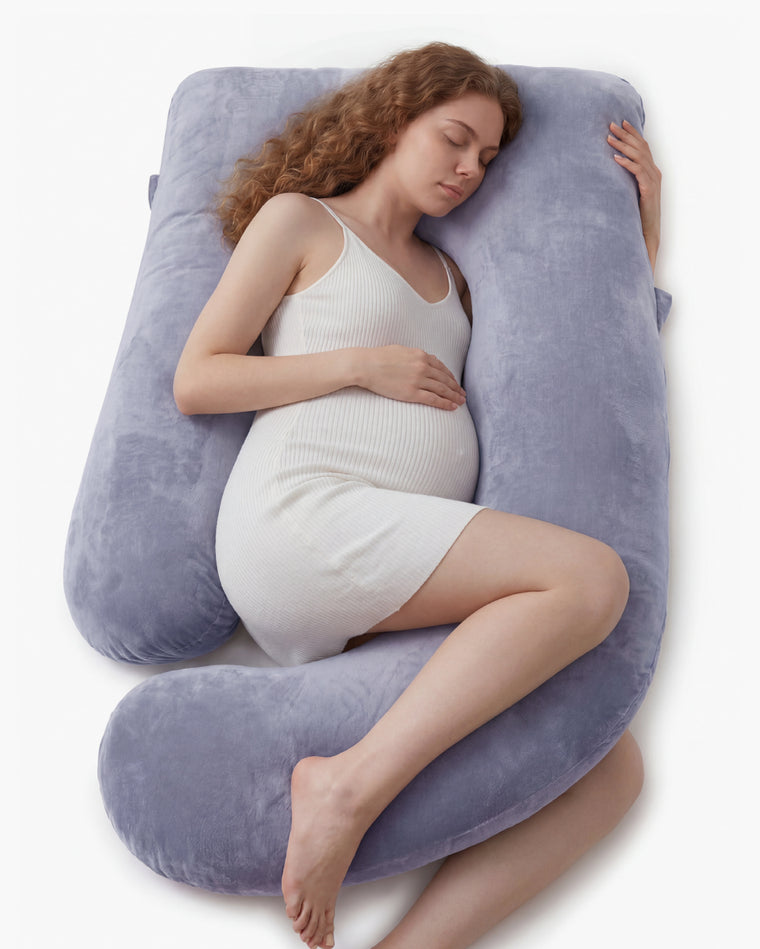
A wedge can handle one specific gap, while a U-shaped or other multi-area pregnancy pillow can cover several support points without having to rebuild the arrangement each time you turn. Whichever setup you use, test it on both sides. The goal is to find a position you can actually settle into, not create as much contact as possible.
Regular Pillows vs. a Pregnancy Pillow: When Is an Upgrade Worth It?
You don’t need a dedicated pregnancy pillow just because you’re pregnant. If a regular pillow gives you the support you need and stays comfortable through the night, there’s no reason to change it.
The difference comes down to how many support points you need and how often your setup needs rebuilding:
|
Decision |
Regular pillows |
Targeted pillow |
Multi-point pregnancy pillow |
|
Best fit |
One support point that stays in place |
One belly, knee, or back gap |
Several support points or repeated shifting |
|
Main advantage |
Familiar, flexible, and easy to replace |
Compact placement with less surrounding material |
Continuous coverage with fewer separate pieces |
|
Main trade-off |
Several pillows may move after turning |
Limited coverage; may need repositioning |
Uses more bed space and may feel warmer or more restrictive |
|
Upgrade trigger |
No upgrade if the setup remains comfortable |
Choose when only one gap needs filling |
Choose when belly, knees, and back all need stable support |
The simplest setup that stays comfortable is often the one worth keeping. If you’re constantly reaching for another pillow or rebuilding everything after you turn, a dedicated pregnancy pillow may make the routine easier.
Why Your Back May Still Hurt: Five Setup Mistakes
A pregnancy pillow may feel unhelpful—or make your setup feel less comfortable—when one support point is doing all the work. Before adding another pillow, look at how the pieces are working together.

1. Supporting only your back
A pillow behind you can help create something to lean against, but it may not address the space under your belly.
Try this: Add light support under the belly to fill the gap. It should support the space without lifting or pressing upward.
2. Using knee support that is too thin or too short
Your knees may be supported while the rest of your top leg still falls forward. That can leave the setup feeling uneven.
Try this: Use enough support to keep the top leg comfortable, extending it farther toward the ankles if the lower leg still drops.
3. Packing the back section too tightly
More back contact is not necessarily better. A pillow that holds you too firmly can make turning harder and leave you feeling stuck in one position.
Try this: Loosen or reduce the support until you can still lean against it while turning comfortably.
4. Changing your head and neck height
Adding or removing pillows around your body can tempt you to change your usual head pillow too. A different height may simply make the whole setup feel less comfortable.
Try this: Keep your usual head pillow unless the pregnancy pillow’s instructions call for something different, then check whether your head and neck still feel comfortably supported.
5. Assuming every symptom is a pillow problem
Not every ache or change in comfort comes from how the pillows are arranged. Severe, persistent, or unusual symptoms deserve attention beyond another round of pillow adjustments.
Try this: Stop changing the setup and seek professional advice when the discomfort is severe, persistent, or unusual. For ordinary setup troubleshooting, change one variable at a time, then give your new position about 10–15 minutes before deciding whether it helps.
Targeted or Multi-Point Support: Wedge, Small Pillow, or U-Shaped?
Once you know where support is missing, choosing a pillow becomes less about its shape and more about how much of your setup needs to stay supported. You may only need one movable pillow, or you may prefer something that covers several points without rebuilding the setup each time you turn.
|
Support type |
When it fits |
What to keep in mind |
|
Small or knee pillow |
You need support in one specific spot, such as between the knees. |
Easy to move and takes up little bed space, but may need repositioning after you turn. |
|
Wedge |
You want targeted support under the belly or light contact behind the back. |
Useful for filling one gap without surrounding your whole body. |
|
U-shaped pillow |
Your belly, knees, and back all need support, or several separate pillows keep shifting. |
Gives more coverage on both sides, but takes up more bed space and puts more material around you. |
Once you know which areas need support, choose based on how much coverage you need. A small or knee pillow works for one support point, while a wedge gives more targeted belly or back support without taking up much space.
A U-shaped pregnancy pillow provides wider, two-sided support for the belly, knees, and back. The Momcozy U-Shaped Pregnancy Pillow is designed for full-body support while still allowing you to use your usual head pillow. Consider your available bed space, how often you turn, and how many support points need to stay in place.
How Heat, Bed Space, and Turning Change the Setup
A pillow can feel great when you first lie down and still become annoying at 2 a.m. Before settling on a setup, give it a quick real-night test:
Heat
Check the fabric and filling, not just the pillow’s shape. Cool-to-touch fabric may feel different from a more breathable fill, while a pillow that covers more of your body can still feel warmer overall.
Bed space
Measure the pillow against your mattress width and consider how much room your partner needs. A full-body setup may not be practical if it leaves little space to move.
Turning
Change sides once. If the pillow shifts so much that you have to rebuild the whole setup each time, try fewer or smaller support pieces.
Getting up
Sit up and get out of bed once. You should be able to do it without wrestling with the pillow or moving half the bed.
If you like the coverage of a U-shaped pillow but are concerned about how warm it may feel, the Momcozy Cooling U-Shaped Pregnancy Pillow is an option to check. Review its current fabric and filling specifications before choosing it.

A setup that feels comfortable when you first lie down may need to be adjusted once you start turning or getting out of bed. Keep the support only where it continues to help.
When a Pillow Is Not Enough
A pregnancy pillow can help with positioning and comfort, but it cannot determine why your back hurts or treat an underlying condition. If the discomfort remains persistent, becomes severe, or feels concerning, stop relying on repeated pillow adjustments and speak with your maternity or healthcare professional for individualized guidance. Follow the pillow’s instructions, and don’t force a position that makes you feel worse. If your clinician has given you specific movement or sleep advice, follow it as directed.
FAQs
Do pregnancy pillows help with back pain?
They can make side sleeping more comfortable by supporting the areas that tend to leave gaps, such as the knees, belly, and lower back. The key is finding the support your body actually needs rather than simply adding more pillow.
Where should I place a pregnancy pillow for lower-back support?
Place the back section behind your lower back so you have something soft to lean against without being pushed forward. Start with support between your knees and under your belly, then adjust the back section until everything feels settled.
Can a pregnancy pillow make back discomfort feel worse?
It can, especially when the pillow is too high, too tight, or supporting the wrong spot. Before adding more cushioning, try removing or repositioning one piece and give your new setup a few minutes to settle.
Is a pillow between the knees enough?
Sometimes. A regular pillow can be all you need when the gap between your knees is the main issue. If your top leg still falls forward or your belly and lower back feel unsupported, those areas may need a little attention too.
Should I support my belly and back at the same time?
You can when both areas feel unsupported. Keep the belly support gentle and let the back pillow provide light contact rather than holding you firmly in place. You should still be able to turn comfortably.
Is a wedge or U-shaped pillow better for back support?
It depends on how much support you need. A wedge works well for filling one specific gap, while a U-shaped pillow provides more coverage when your belly, knees, and back all need support.
Can I use regular pillows instead?
Absolutely. Regular pillows can work well when you only need one or two support points and they stay where you put them. A pregnancy pillow may be more convenient when several pillows keep shifting or need to be rearranged every time you turn.
What if I wake up on my back?
Don’t worry about getting your setup perfect all night. If you wake up on your back, simply reposition yourself in whatever side-lying position feels comfortable and adjust your pillows as needed.
Conclusion: Embrace Comfort and Sleep Well During Pregnancy
Start with the support your body seems to be missing. Set up your pillow so it supports under the belly, between the knees, and lightly behind the lower back, then settle in and change one thing at a time. You may not need a pregnancy pillow at all—a regular pillow can work well when it gives you the support you need and stays in place.
If you still need more coverage or your pillows keep shifting, that’s when it makes sense to compare options based on the support you need and the space your bed allows. You can explore the Momcozy pregnancy pillow collection as part of that comparison. A pillow can support comfort and positioning, but persistent, severe, or concerning pain should be discussed with your maternity or healthcare professional.








