


MEDICALLY REVIEWED BY

Shelly Umstot, BSN, RN
Shelly Umstot is a BSN and has been a registered nurse for over 35 years. She lives in North East Ohio and is a freelance health content writer. Her passion is bringing understanding to those with questions and concerns regarding health issues and helping them obtain and maintain their optimal health. She loves being with her family and has two lovely granddaughters who have stolen her heart. Assisting new parents in finding the information they need to face the joys and challenges of caring for their children is a gratifying experience for her as a professional, parent, and grandparent herself.
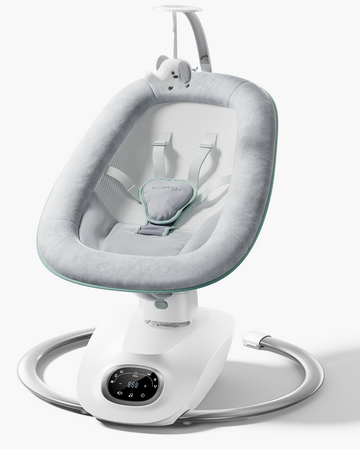
For an under-500-square-foot home, do not choose a baby swing from “compact” or “folding” labels alone. The available product information does not verify complete deployed footprints, folded dimensions, storage orientation, or operating clearances for the models discussed here. Start with the current manual, then test both the intended use zone and the storage spot with a tape measure. See Momcozy’s current swing collection and product information.
A swing can be useful only if it fits without turning a doorway, kitchen route, sleeping area, or sofa-side passage into a daily obstacle. In a small apartment, the question is not simply, “Will the base fit?” It is, “Can this be used, supervised, and put away without disrupting the home?”
Measure the use zone—not just the product base
Before comparing features, draw a quick floor plan of the room where the swing would actually live. Mark walls, doors, furniture, the baby’s separate sleep space, and the path people use most often.

Then request or find the current manufacturer specifications and manual for the exact model and version you are considering. Measure four separate things:
- Assembled dimensions: Record the manufacturer’s stated length, width, and height.
- Operating space: Check the manual for any placement or clearance instructions. Do not invent a universal clearance allowance; requirements may differ by model.
- Access routes: Open nearby doors fully and walk the usual route around the swing. A base that technically fits may still block a closet, bathroom, kitchen, or exit path.
- Caregiver access: Make sure an adult can approach the seat, use the controls as directed, and lift the baby in and out without reaching awkwardly over furniture.
A practical test is to tape the assembled dimensions onto the floor. Leave the outline in place for a day, including during meal preparation, nighttime bathroom trips, and door opening. If the taped zone already causes frustration, the actual swing is unlikely to improve the layout.

A simple placement decision
A location may work if:
- the full assembled swing fits according to the current manual;
- nearby doors can open normally;
- essential walking routes remain usable;
- there is room for direct caregiver access;
- the chosen spot supports active supervision; and
- any required power arrangement can be managed according to the manual.
Treat the location as a no-go if it requires squeezing past the swing, partially blocking an exit or door, moving furniture every time it is used, or placing the baby out of practical view.
“Folding” needs proof, not a hopeful closet plan
A removable cover, detachable toy bar, or compact-looking seat does not mean a swing folds away. For apartment living, a fold-and-store design is only useful if it works in the storage space you actually have.
One small-space roundup presents the Graco Slim Spaces Compact Baby Swing as a model that folds for storage. However, the available information does not verify its folded dimensions, folded orientation, or manufacturer instructions for storage. The same roundup describes the Graco Simple Sway LX as not folding down; a size listed alongside that description is not clearly identified as assembled or packaged dimensions, so it should not be used as a real-world footprint comparison.
Before buying any purported fold-away swing, verify these details in the current manufacturer manual:
What to verify |
Why it matters in a small apartment |
The exact folding action |
Confirms whether the frame truly folds or only parts detach. |
Folded length × width × height |
Determines whether it fits in a closet, beside furniture, or under a permitted storage area. |
Storage orientation |
A swing that must lie flat has different storage needs than one designed to stand upright. |
Parts that must be removed |
Daily disassembly can make “folding” impractical. |
Product weight |
Matters if it must be lifted for storage. |
Setup and fold steps |
A design can fit physically but still be inconvenient to put away repeatedly. |
Do not assume a swing can be stored behind a sofa, inside a closet, or under a bed until the folded dimensions and required storage orientation are confirmed.
Choose by swing-mode limits
A swing may remain in the home longer than it remains appropriate for swinging. The product’s overall versatility, stationary-seat capability, or advertised age range does not extend its swing-mode limits.
For example, the Momcozy 2-in-1 Electric Baby Swing is intended for swing mode until 20 lb (9 kg) or 9 months, whichever comes first. It converts to a stationary seat rated up to 66 lb (30 kg), but that higher rating does not extend swing-mode use. The product has two adjustable recline positions, yet the available information does not specify recline angles or which position is suitable for a particular infant. Review the current Momcozy 2-in-1 Electric Baby Swing details and instructions.

For every model, identify the event that ends swing use:
- the manufacturer’s weight limit;
- the stated age limit, if applicable;
- a developmental milestone or stop-use instruction in the manual; or
- any change in the child’s ability that the manufacturer identifies as ending use.
Read those instructions before purchase, not after the swing is assembled in the living room. A model with a longer stationary-seat phase may still be a poor choice if the swing phase is short or if the unit cannot be stored once that phase ends.
Let the safety plan shape the floor plan
A swing is for supervised use, not routine infant sleep. If an infant falls asleep in a swing, transfer them promptly to a separate safe sleep setting. Safe sleep guidance identifies a firm, flat surface in an appropriate crib, bassinet, portable crib, or play yard meeting applicable standards. Read the safe infant sleep checklist.
That guidance has a small-apartment implication: the swing location should make a prompt transfer realistic. Avoid treating the swing as a substitute for a nearby sleep space, especially because a cramped layout can make a transfer less convenient in the moment.

Use the swing only according to its model-specific instructions, including harnessing, positioning, recline guidance, and stop-use limits. A remote or touch panel may make adjustments easier, but it does not replace direct supervision.
Power also affects placement. Some swings use wall power, batteries, or both; the available information does not establish cord length, outlet-clearance needs, or battery runtime for the compact models discussed. Confirm those details in the current manual rather than assuming an outlet location will work. Momcozy’s swing-selection guidance notes that power arrangements can affect placement.
Small-apartment swing: go/no-go checklist
Before ordering—and again before first use—confirm all of the following:
- I have measured the manufacturer’s assembled dimensions in the intended location.
- I have checked the manual for placement and clearance instructions rather than relying on a generic walkway rule.
- Doors, exits, closets, and essential household routes remain accessible.
- An adult can reach the baby easily and maintain direct supervision.
- I have verified whether the swing truly folds, its folded dimensions, its storage orientation, and any parts that must be removed.
- I have confirmed the child’s swing-mode weight, age, developmental, and stop-use limits.
- I have checked the power source, outlet position, and cord or battery instructions for the exact model.
- I have planned for prompt transfer to a separate firm, flat sleep space if the baby falls asleep.
- I have reviewed the current manufacturer manual and official safety notices or recalls before purchase and setup.
If a swing fails any of these checks, it may be better to skip it, choose a different location, or build the newborn area around other essentials. For ideas on creating a safer, more functional compact newborn space, explore Momcozy resources for small-space baby-care routines and setup.








