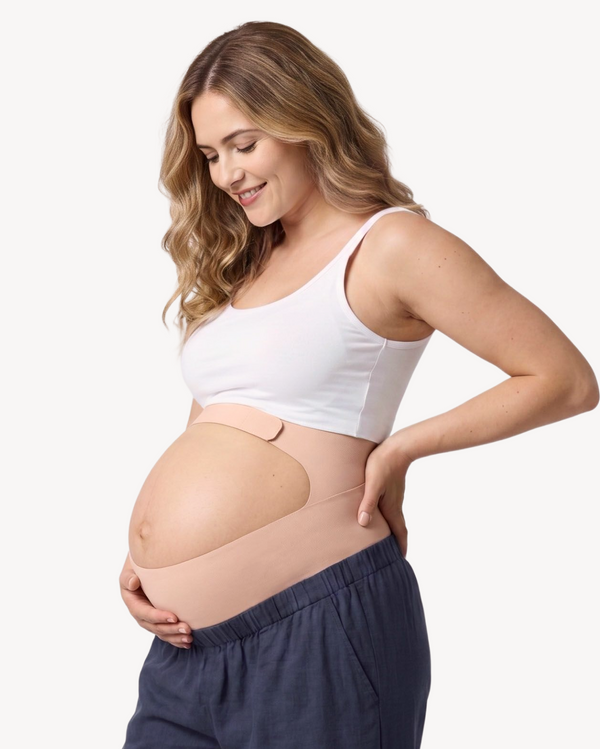
As your bump grows, “supportive” should never mean tight, restrictive, or one-size-fits-most. The right plus size pregnancy belly band should match your current bump, lift gently from underneath, and feel comfortable through real-life movement. Here, we'll show you how to compare support levels, choose an adaptable fit, and use a belly band safely.
Benefits of Wearing a Plus Size Maternity Support Belt or Belly Band
Pregnancy changes more than the size of your belly. Your center of gravity shifts, your abdominal muscles stretch, and extra weight can increase the workload on your lower back and pelvis. These changes may feel even more noticeable with twins, multiples, a larger single-baby bump, or a job that keeps you standing for long periods.
A well-fitted support garment may help in several practical ways:
-
Gentle lift from underneath: A contoured cradle can support the bump against downward pull without pressing across the front of the abdomen.
-
More balanced weight distribution: Designs that combine abdominal, lower-back, and shoulder support can spread the load across a wider area instead of concentrating it at the waist.
-
Added stability during activity: Some people feel steadier and more comfortable while walking, commuting, doing light chores, or working on their feet.
-
Less strain on the lower back: The American College of Obstetricians and Gynecologists notes that an abdominal support garment can help take some belly weight off the back muscles. A 2025 systematic review of pelvic belts in pregnancy also found that pelvic belts may provide modest pain reduction, although the certainty of the evidence was low.
-
A more confident fit: A true plus size maternity belly band should be selected by current bump measurements, not by pre-pregnancy clothing size and should leave room for continued growth.
A support belt is an aid, not a treatment or a replacement for prenatal care, movement, or appropriate strengthening. If pain is severe, new, persistent, or interfering with daily life, speak with your maternity care professional or a pelvic health physiotherapist.
Best Plus Size Pregnancy Belly Bands to Shop
“Best” depends on how much support you want and when you plan to wear it. A soft sleeve may be enough for light coverage, while a heavier or faster-growing bump may feel better with a structured system. Use the following categories to narrow your search.
Schmerzlinderung
Komfort
Effektivität
Best for Twins, Multiples, or a Heavier Bump: Momcozy Go As You Grow™ Maternity Belly Band
The Momcozy Go As You Grow™ Maternity Belly Band is designed for stronger support during twin, multiple, and fast-growing pregnancies. It may also suit plus-size moms carrying a larger single-baby bump, expectant moms who stand for long shifts, and anyone whose care provider recommends more substantial abdominal and lower-back support.
Its integrated three-zone system combines:
-
A wide, contoured belly cradle with an optimized lifting angle to support the bump from underneath without compression.
-
The 2.0 Ergonest Support Structure™ with dual-side stays to stabilize the lower back and disperse pressure.
-
An ergonomic racerback with wide padded straps to distribute some of the load across the shoulders instead of relying on the abdomen alone.
The design is highly adjustable for later pregnancy. Shoulder straps, grab handles, extended hook-and-loop panels, and dual-side adjustments make it easier to tailor the fit without repeatedly reaching under the bump. Buttery-soft fabric, airflow channels, and grip strips are intended to reduce friction, release heat, and help the band stay in place.
The current size range is based on baby-bump circumference: L Pro fits 42–46 inches, XL Pro 47–50 inches, 2XL Pro 51–54 inches, and 3XL Pro 55–59 inches. Measure around the fullest part of your baby bump using a soft measuring tape, check the current size chart, and size up if you fall between sizes. Do not use your usual pants size as a shortcut. You can also compare support levels in the full Momcozy pregnancy belly band collection.
Best for Light Support and Clothing Coverage: A Stretch Belly Sleeve
A seamless belly sleeve is a simple option when your main goals are light support, smoother layering, or coverage over an unbuttoned waistband. It is usually less structured and easier to hide under clothes than a maternity belt. However, it may not provide enough lift for a heavier bump or enough stabilization for activity-related pelvic discomfort.
Look for an inclusive size chart, four-way stretch, breathable fabric, and a wide lower edge that does not roll. A sleeve should conform to your body without leaving deep marks or making it harder to take a full breath.
Best for Targeted Support During Walking: A Low-Profile Under-Bump Belt
A narrow or medium-width belt worn low around the pelvis may be useful when discomfort is mainly triggered by standing or walking. Both NHS guidance on pelvic pain in pregnancy and RCOG patient guidance on pelvic girdle pain include support belts among options a physiotherapist may suggest.
Placement matters: a pelvic belt generally sits around the pelvis and below the bump, not across the middle of the abdomen. Because pain patterns differ, consider asking a pelvic health physiotherapist to check the position and tension—especially if you have pubic, sacroiliac, hip, or one-sided pain.
Best for Individual Needs: A Professionally Fitted Support Garment
If an off-the-shelf band rides up, twists, presses on scars, or fails to support your particular bump shape, a clinician-fitted garment may be the better choice. This is especially relevant if you have significant pelvic girdle pain, a history of back or pelvic injury, skin sensitivity, mobility limitations, or a high-risk pregnancy. Personalized fitting can help determine whether you need abdominal lift, pelvic stabilization, back support, or a combination.
What Is a Plus Size Belly Band for Pregnancy?
A plus size belly band for pregnancy is a wearable support garment made to accommodate a broader range of bump circumferences and body shapes. Depending on the design, it may be a soft fabric sleeve, an adjustable under-bump belt, or a more structured system that supports the abdomen, lower back, and shoulders.
The purpose is external support. A band may gently lift the bump, stabilize the lower torso, or redistribute some of the load during daily movement. It should not flatten the bump, force your posture into an unnatural position, or replace your muscles.
“Plus size” should describe genuinely inclusive fit, not simply a longer strap. The shape of the belly panel, adjustment range, back coverage, closure placement, and proportions of any shoulder straps all affect whether a design works comfortably on a larger body.
What to Look For in a Pregnancy Belly Band for Plus Size
For plus-size support, a pregnancy belly band should be judged by fit and function rather than a size label alone.
-
Current bump-based measurements. Measure the area specified by the manufacturer, usually the fullest part of the bump or the circumference under the bump. Recheck as pregnancy progresses. Choose a design with enough adjustment for growth, and compare your measurement with the exact product chart.
-
The right support level. Light sleeves are suited to coverage and mild support. Under-bump belts focus on lift or pelvic stability. Three-zone systems can be more appropriate for a heavier bump because they support the abdomen and lower back while spreading weight through shoulder straps.
-
A contoured, non-compressive belly panel. The lower edge should cradle the bump rather than cut across it. You should be able to breathe normally, change positions, and move without pressure on the center of your abdomen.
-
Easy-to-reach adjustments. Closures become harder to access later in pregnancy. Side adjustments, extended tabs, and grab handles can reduce bending and let you fine-tune each side.
-
Back structure without rigid discomfort. Flexible stays or shaped back panels may add stability, but they should not poke, pinch, or force an exaggerated posture. The garment should remain supportive when you move, not only when you stand still.
-
Breathable, skin-friendly materials. Pregnancy can increase warmth and skin sensitivity. Look for soft seams, airflow, moisture management, and anti-slip features that do not rely on excessive tightness.
-
A realistic wear plan. Think about the moments you need support most: a commute, a walk, meal preparation, errands, or a standing shift. The best band is one you can put on correctly, adjust independently, and remove when your body needs a break.
When to Use a Plus Size Pregnancy Belly Band
Many people begin using a band in the second or third trimester, when the bump becomes heavier and everyday movement starts to feel more demanding. With twins or multiples, support may feel useful earlier. Common times to wear one include walking, standing at work, commuting, light household tasks, or other activities that increase the sense of downward pull.
Start with a short trial at home. Check the fit while standing, walking, and sitting. Support should feel noticeable but gentle. Remove or readjust the band if it rolls, slips, creates pressure, or shifts your discomfort elsewhere.

Can You Wear a Pregnancy Belly Band in the First Trimester?
You can ask your prenatal care professional about using one in the first trimester, but many people do not need substantial abdominal lift that early. If you have early pelvic or back discomfort, a history of pelvic girdle pain, or a rapidly changing multiple pregnancy, individualized advice is more useful than choosing a band based on gestational week alone. Never use firm compression to change the appearance of your abdomen.
How Long Can You Wear a Pregnancy Belly Band Each Day?
There is no universal schedule for every design. Follow the manufacturer’s instructions and your clinician’s advice, and use the band during the activities when support matters most rather than assuming longer is better. Momcozy recommends limiting wear of the Go As You Grow™ Belly Band to 2–3 hours per day. Build up gradually, take breaks, and inspect your skin after wear.
When Should You Not Wear a Maternity Support Belt?
Do not wear a band while sleeping unless your healthcare professional specifically instructs you to. Remove it if you experience pain, numbness, tingling, shortness of breath, dizziness, overheating, skin irritation, deep pressure marks, contractions, or a noticeable change in your baby’s usual movement. Seek prompt medical advice for bleeding, fluid leakage, severe or persistent pain, fever, urinary symptoms, regular contractions, or reduced fetal movement rather than trying to manage these symptoms with a belt.
Also check with your care team before use if you have a high-risk pregnancy, circulation concerns, an abdominal wound or infection, or any condition for which external support or pressure may be inappropriate.
Alternative Options
A belly band is only one part of a comfort plan. Depending on your symptoms and preferences, alternatives or complements may include:
-
Supportive maternity leggings or underwear for light, evenly distributed support.
-
A pregnancy pillow from the Momcozy pregnancy pillow collection can be placed under the bump and between the knees for side sleeping.
-
Supportive, low-heeled shoes and a footrest during long periods of standing.
-
Activity pacing and position changes instead of staying seated or standing for too long.
-
Prenatal or pelvic health physiotherapy for an individualized assessment, movement advice, and safe strengthening.
-
Kinesiology tape applied by a qualified professional if your skin tolerates adhesive.
Persistent pain deserves evaluation. A support garment can complement professional care, but it should not mask symptoms that need attention.
Full Body Support
Effective Pain Relief
Soft and Comfortable
Multi-Purpose Use
Plus Size Pregnancy Belly Band FAQs
Q1. How Tight Should a Pregnancy Belly Band Be?
It should feel secure enough to lift or stabilize, but never constrictive. You should be able to breathe deeply, speak normally, and move between sitting and standing without the band cutting into your abdomen. There should be no numbness, throbbing, sharp pain, or deep marks. If tightening the band is the only way to stop it slipping, the size or design may be wrong.
Q2. Can a Pregnancy Belly Band Hurt the Baby?
A maternity band is designed to provide external support, not to compress the baby. However, correct sizing and placement are essential, and research does not support treating every design or fit as risk-free. Stop using the band if it causes pressure, pain, breathing difficulty, contractions, or changes in your baby’s usual movement, and contact your maternity care professional if you are concerned.
Q3. Do Pregnancy Belly Bands Help With Back Pain?
They may help some people by taking part of the bump’s weight off the back muscles or improving comfort during activity. Research suggests pelvic belts may offer modest pain reduction, but results vary and the evidence quality is limited. A band is most useful as part of a broader plan that can include posture changes, appropriate activity, supportive footwear, and physiotherapy.
Q4. Can You Sit Down While Wearing a Pregnancy Belly Band?
Usually, yes, if the product is designed for it and remains comfortable. Check that the front does not fold into the bump and the lower edge does not dig into your groin or ribs. You may need to loosen the band slightly or remove it during a long seated period. Recheck the position before standing and walking again.
Q5. Is a Belly Band the Same as a Maternity Support Belt?
The terms are often used interchangeably, but the designs can differ. “Belly band” may refer to a soft sleeve that offers light support and clothing coverage. “Maternity support belt” more often describes an adjustable, structured garment worn under the bump. Some products, including multi-zone systems with back panels and shoulder straps, combine features of both. Compare the actual construction and support level instead of relying on the name.
Find Support That Fits Your Pregnancy
The best plus size pregnancy belly band meets your body where it is today and adapts as your bump grows. Prioritize accurate measurements, gentle under-bump lift, breathable materials, reachable adjustments, and the support level your routine requires. For twins, multiples, or a heavier bump, the Momcozy Go As You Grow™ Maternity Belly Band offers a structured three-zone option designed to share the load more comfortably.