The real choice is not simply electric or manual. It is how much practical help you want from one soothing seat. An electric baby swing can provide consistent motion while you eat, pump, or prepare a bottle nearby. A manual option is usually lighter, simpler, and easier to store. Neither is essential for every family, and neither is a safe sleep space.
Is an Electric Baby Swing Worth It?
It can be worth it when consistent, hands free motion solves a recurring problem. It may help during fussy periods or brief tasks when manually moving a seat would defeat the purpose, but not every baby will settle.
A manual seat may be enough if you prioritize portability, lower cost, and fewer features. If space or budget is tight, buy one option first and observe your baby's response.
Whichever option you choose, use it only for supervised awake time. If your baby falls asleep, transfer them to a firm, flat sleep surface on their back.
What Counts as a Manual Swing or Manual Baby Seat?
The term manual swing is used loosely. It may describe a baby powered bouncer, a caregiver powered rocker, or a non-electric seat with a curved base. Compare the actual design because these products do not create identical motion.
Manual options need no batteries, outlet, or motor and tend to be easier to carry. A parent powered model still requires active input, while a baby powered bouncer may move little when the baby is calm.
Momcozy baby swings should not be classified as manual rockers or bouncers. They are powered swings designed to provide adjustable automatic motion.
What Is an Electric Baby Swing?
An electric infant swing uses a motor to move the seat without continuous pushing. Depending on the model, motion may travel from side to side, from front to back, vertically, or through combined patterns. Adjustable speed lets caregivers begin gently and respond to the baby's preference.
Models may also include timers, sounds, vibration, toys, recline, remote control, or washable fabric. Their main value is controlled motion while a nearby caregiver briefly uses both hands.
Electric Baby Swing vs Manual Swing: Key Differences
Both options can give a baby a comfortable place for supervised awake time, but they ask very different things of the caregiver. The practical divide becomes clearer when motion, convenience, space, power, and cost are considered separately.
1. Motion: automatic vs baby powered or parent powered
Electric models create powered movement at a selected speed. Manual seats rely on kicks, body weight, or caregiver input. An automatic baby swing provides steadier motion when that is what your baby prefers.
2. Convenience: hands free support vs active involvement
An electric model helps when you need to pump, eat, prepare a bottle, or help another child while staying nearby. A manual model may not free your hands if it needs frequent nudging.
3. Portability: compact and light vs larger and more feature rich
Manual seats are often easier to lift, fold, and store. A motor, controls, and larger frame can make an electric swing heavier, so check dimensions and carrying method.
4. Power source: no power vs corded or battery powered
Manual seats work without electricity. Electric swings may use wall power, batteries, charging, or a combination, which affects placement, cables, ongoing cost, and travel.
5. Cost: simple gear vs feature investment
Manual products generally cost less. With electric models, pay for functions you will use, such as motion variety, speed control, washable fabric, or a timer.
When an Electric Baby Swing Makes More Sense
Electric motion earns its place when it solves a real daily need rather than simply adding another powered item to the nursery. It is most useful in homes where steady movement and brief hands free moments would be used regularly.
You want consistent motion without manually rocking
The motor maintains movement until the timer ends or you switch it off, so motion does not depend on a free hand or a baby's kicks.
Your baby responds well to movement
An automatic infant swing is useful only when your baby enjoys its motion, so keep expectations realistic and retain the return policy.
You need short hands free moments at home
Electric motion can create a brief window to eat, pump, or care for a sibling while you remain nearby. It never replaces interaction or supervision.
You want adjustable motion modes and speeds
Multiple patterns and speeds let you start gently and make one adjustment at a time. See the 2-in-1 vs 3D motion baby swing comparison for a closer look.
You prefer built in calming features
Sounds, vibration, toys, a timer, remote, and washable fabric can simplify use, but none guarantees soothing. Prioritize secure restraint, stable construction, suitable recline, and clear controls.
When a Manual Swing, Bouncer, or Rocker May Be Enough
A simpler seat can be the more thoughtful choice when easy movement and storage matter more than automatic soothing. For many families, fewer settings also mean less expense and one less device to manage.
You live in a small space
A light manual bouncer often has a smaller footprint. Measure both its open and stored size before assuming a folding model will fit.
You want fewer gadgets
A simple seat has no motor settings, remote, or cord, which can suit families who prefer lower stimulation and immediate operation.
You are budget conscious
Manual gear is a practical first purchase when you do not know whether your baby will enjoy motion. More functions do not always soothe better.
You need something portable
For room changes or travel, low weight may matter more than automatic motion. Check folding, frame locks, and how it should be carried without the baby.
You want to wait and see
Waiting can reveal whether movement helps and what type your baby prefers. Start with one seat and add another only if a clear need appears.
Is an Electric Baby Swing Too Stimulating?
Begin with the lowest speed and a simple motion. Add sound, vibration, or a toy only if your baby remains comfortable. Electric does not mean every feature must run at once.
Turning away, repeated fussing, stiffening, arching, frantic movement, or crying can mean the setting is not helping. Pause the swing and offer a quieter environment. A calm baby may not need music or extra stimulation.
What Features Actually Matter in an Electric Baby Swing?
A long feature list can make two swings look more different than they really are. The details below matter because they affect fit, control, cleaning, or everyday ease, not because every family needs every option.
Adjustable speed settings
Several levels let you begin slowly and adjust to the moment.
Multiple motion modes
Side to side, front to back, bouncing, gliding, or combined movement provide options when switching is simple and controlled.
Recline and support
Follow the manufacturer's age, weight, and developmental guidance. Use only approved positions and inserts.
Secure harness
Fasten the supplied harness every time. Straps should lie flat and fit according to the manual.
Timer or automatic shutoff
A timer keeps sessions parent controlled. Check its duration and restart behavior.
Calming sounds or white noise
Start built in sound quietly and turn it off if your baby appears unsettled.
Remote control
A remote can adjust settings without approaching the seat. It is convenient, not a safety feature, and never replaces supervision.
Washable seat fabric
Check whether the cover is removable, machine washable, and easy to dry. A broader best baby swing guide can help compare models.
Motion and settings at a glance
|
Control
|
What it changes
|
Practical value
|
|
Motion mode
|
Direction or movement pattern
|
Helps you test which movement your baby prefers
|
|
Speed
|
Intensity of movement
|
Lets you begin gently and adjust gradually
|
|
Timer
|
How long powered motion runs
|
Keeps use deliberate and easier to monitor
|
|
Sound
|
Music, nature audio, or white noise
|
Adds optional calming input without requiring a separate device
|
|
Remote
|
Settings from a short distance
|
Allows adjustment while the caregiver remains nearby
|
Electric Baby Swing Safety: What Is Different From Manual Options?
Powered movement and electrical components add a few checks, but the core rules apply to both categories. Read the product manual and follow its age, weight, developmental, recline, and session guidance. All powered infant swings sold in the US must meet CPSC infant swing safety requirements under 16 C.F.R. part 1223, which cover structural integrity, restraint systems, and stability.
Place the swing on a flat, stable floor, never on a bed, table, counter, or other raised surface.
Fasten the harness for every use and stop using swing mode when the manual's limit or developmental milestone is reached.
Inspect the frame, fasteners, harness, cover attachments, motor sounds, and motion before use.
Keep power cords, charging cables, and remote batteries away from the baby.
Do not add loose blankets, pillows, rolled towels, or unapproved inserts.

Stay nearby and supervise every awake session.
Most importantly, an electric newborn swing is not a crib or bassinet. The American Academy of Pediatrics safe sleep guidance says that a baby who falls asleep in a swing should be moved to a firm, flat sleep surface on their back as soon as possible. For more detail, read are baby swings safe and how to use a baby swing safely.
Should You Buy an Electric Baby Swing Before Baby Arrives?
Buying early makes sense if you have room, understand the return policy, and already know that hands free motion fits your routine. Assemble it in advance, confirm that every part is present, and learn the controls without a baby in the seat.
Waiting is equally reasonable when space is tight, you prefer minimal gear, or the cost would limit more essential purchases. Baby preference varies, so no model is guaranteed to be useful.
A secondhand swing requires extra care. Check the model and manufacture information in the CPSC recall database, obtain the correct manual, and confirm that all frame parts, restraints, covers, and electrical components are original, intact, and working. Skip any unit with missing parts, damage, unauthorized repairs, or an uncertain history.
Electric Baby Swing vs Manual Swing: Quick Decision Table
|
Decision factor
|
Choose electric when
|
Choose manual when
|
|
Motion
|
You want steady powered movement
|
Baby powered or caregiver powered movement is enough
|
|
Hands free support
|
You need brief use of both hands while staying nearby
|
You do not mind nudging the seat
|
|
Portability
|
It will mainly stay in one home area
|
You move it frequently or travel often
|
|
Power
|
An outlet, battery, or charging plan is convenient
|
You want a seat that works without power
|
|
Footprint
|
You have room for a motorized frame
|
Storage and open floor space are limited
|
|
Cost
|
Adjustable settings justify the higher price
|
A lower cost, simpler seat meets the need
|
|
Stimulation
|
You want selectable motion and optional sounds
|
You prefer fewer sensory features
|
|
Best fit
|
Consistent soothing is the priority
|
Simplicity and portability are the priority
|
Where Momcozy Fits: Electric Baby Swing Options for Adjustable, Hands Free Soothing
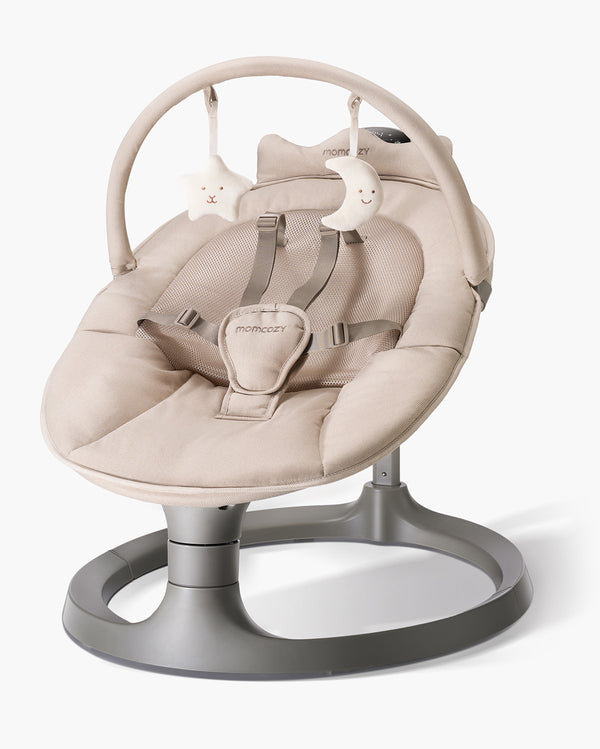
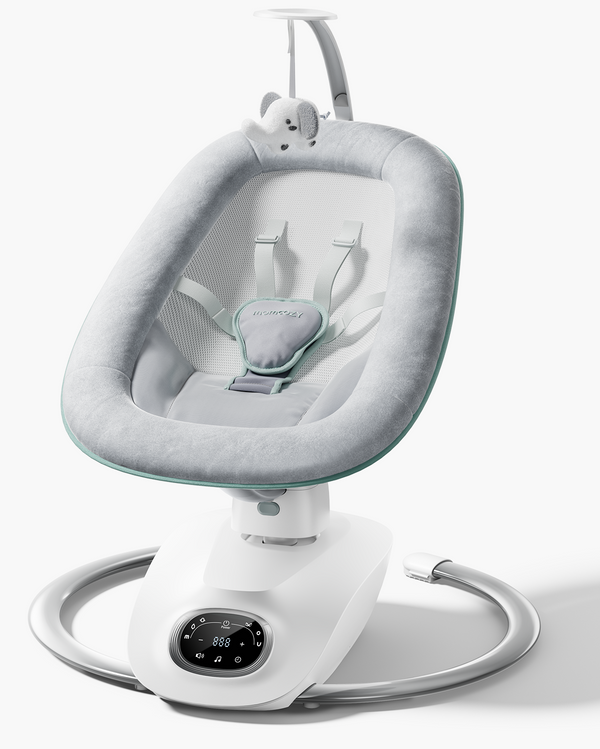
The Momcozy baby swings collection currently offers powered models, not manual rockers or bouncers. Both are intended for supervised awake use and pair automatic motion with secure restraint and removable, machine washable seat fabric.
The Momcozy 2-in-1 Electric Baby Swing provides four parent inspired motions, four speeds, a dual arm support structure, two recline positions, eight sounds, and two plush toys. Swing mode is limited to 20 pounds or 9 months, whichever comes first. It then converts to a stationary seat that supports up to 66 pounds, and power must remain unplugged in seat mode.
Dual-Arm Support
Parent-Inspired Swing Motions
Comfortable Seat
Doubles as a Stationary Seat
Patented 3D Swing Tech
6 swing motions
180° rotatable seat
5-point harness
The Momcozy CocoSway 3D-Motion Electric Baby Swing provides six motion patterns, four speeds, a 180 degree rotatable seat, a five point harness, a sturdy base, eight soothing sounds, a touch panel, and a remote. Its seat cover is machine washable. Families choosing between these approaches can use the Momcozy baby swing comparison and the 2-in-1 vs 3D motion baby swing comparison to match motion style and daily routine.
When deciding whether to choose a baby swing with electric motion, focus on the model's actual limits and controls rather than assuming powered means universally better. The right fit is the option you can place safely, clean easily, and use according to its manual.
FAQs About Electric and Manual Baby Swings
Q1. Is an electric baby swing better than a manual swing?
Not always. Electric is better for consistent hands free motion. Manual is often better for portability, simplicity, and budget. The stronger choice is the one that fits your home and your baby's response.
Q2. Do electric baby swings need batteries or a plug?
Power arrangements vary. A model may use wall power, replaceable batteries, charging, or more than one method. Check before buying because the power source affects placement, cable management, and ongoing cost.
Q3. Are electric baby swings too strong for newborns?
Use only a model approved for your baby's current age and weight, start with the lowest setting, and follow its recline and harness instructions. Stop if the baby appears uncomfortable or poorly positioned.
Q4. Is remote control useful in a baby swing?
It is convenient but not essential. A remote can adjust motion, speed, sound, or a timer without approaching the control panel. It does not permit use from another room or replace direct supervision.
Q5. Should I buy an electric baby swing secondhand?
Only after checking recalls, the manual, product history, frame, harness, fasteners, cover, motor, cord, and controls. Do not use a swing with missing or substituted parts, damage, or a safety history you cannot verify.
Q6. Can an electric baby swing replace a bouncer?
For some families, yes, especially when automatic motion is the priority. A bouncer may still be easier to carry or store. Read about when to stop using a baby swing to understand the full usage window before deciding which product better fits your routine.
Final Takeaway: Electric Is Best for Convenience, Manual Is Best for Simplicity
Choose electric when consistent hands free motion will meaningfully help your home routine. Choose manual when portability, low cost, and simplicity matter more. Do not buy both by default, and remember that baby preference can overturn any plan. Whichever seat you select, follow its limits, supervise awake use, and transfer a sleeping baby to an approved firm, flat sleep surface.