


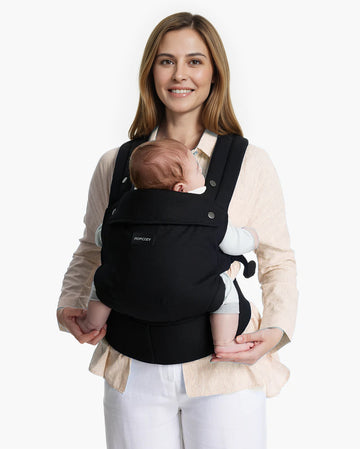
Why does my baby carrier feel heavy, even when your baby’s weight seems manageable? If your shoulders ache, your lower back feels strained, or you find yourself leaning backward while carrying your little one, the problem may not be the weight alone. The way your baby sits in the carrier, how the waistband fits, and where the straps rest can all influence how carrying feels.
A baby carrier is designed to keep your baby close while leaving your hands free, but comfort depends on more than choosing a padded or lightweight design. A carrier that is positioned too low, adjusted unevenly, or no longer configured for your growing baby may feel uncomfortable during an otherwise ordinary walk.
Start by reviewing the carrier’s instructions and checking your baby’s position. Momcozy’s guide to baby carrier positions by age explains why positioning should reflect your baby’s developmental readiness as well as the carrier’s requirements.This guide walks through five common fit mistakes, how to check them, and the order in which to make adjustments.
Key Takeaways
- Check your baby’s position first. A low or loose carry may change how the load feels and can compromise positioning.
- Make sure the waistband stays in place. A shifting or tilted waistband can affect the carrier’s stability and your comfort.
- Adjust shoulder straps evenly. Straps that pull toward your neck or dig into one shoulder may need repositioning.
- Keep your baby close and supported. A baby who hangs away from your torso may feel harder to carry.
- Recheck the settings as your baby grows. The fit that worked a few weeks ago may need adjustment today.
- Follow the carrier’s specific instructions. Safe positioning, weight limits, and approved carry positions vary by model.
- Do not ignore persistent pain. If adjustments do not improve comfort, stop carrying and seek appropriate help.

Start Here: Where Does the Carrier Feel Heavy?
Before changing every strap, identify where you feel the most pressure. Different discomfort patterns can point toward different fit issues, although they cannot diagnose the cause of pain on their own.
|
Where you feel discomfort |
What to check first |
|
Neck or tops of shoulders |
Shoulder strap position, tension, and symmetry |
|
Lower back |
Waistband placement, stability, and baby’s position |
|
One shoulder more than the other |
Uneven straps, twisting, or an off-center carry |
|
Pressure around the waist |
Waistband tension, placement, and clothing under the belt |
|
General pulling or leaning backward |
Whether your baby sits securely and close to your body |
|
Increasing discomfort during a walk |
Whether the carrier is loosening, shifting, or no longer adjusted appropriately |
Use this table as a starting point, not as a diagnosis. Several fit issues can happen at once. For example, a low baby position may coincide with a loose waistband and shoulder straps that are carrying more of the load than intended.
Before you begin, place your baby somewhere safe if you need both hands to adjust the carrier. Follow the manufacturer’s instructions for putting the carrier on and taking it off. Never loosen or remove important support components while your baby is unsecured.
For a broader safety refresher, read Momcozy’s baby carrier dos and don’ts. Safety checks should come before attempts to improve comfort.
Mistake #1: Your Baby Is Sitting Too Low
One of the first things to check when a carrier feels heavy is your baby’s height and position. If your baby gradually sinks lower on your torso, you may notice more pulling, pressure, or a tendency to lean backward.
A low position can also make it harder to monitor your baby’s face. For that reason, this is not simply a matter of comfort: the carrier must support safe positioning and keep your baby’s airway unobstructed.
Why a low position can feel uncomfortable
When your baby sits lower than intended, the carrier’s straps and waistband may no longer sit where the manufacturer designed them to rest. The load may feel as though it is pulling down and away from your torso. You might respond by tightening the shoulder straps, but that may not solve the underlying problem if the waistband or overall setup is incorrect.
How to check your baby’s height
Start with the carrier’s own fit guidance. In general, you should be able to see your baby’s face clearly without moving fabric out of the way. Your baby should be close enough for easy monitoring, with the nose and mouth unobstructed and the chin not pressed against the chest.
Do not rely on a single height rule for every baby and carrier. The correct position depends on the carrier model, your baby’s size and development, and its instructions. If your baby is too small for the carrier to provide the required support, do not compensate by improvising with unapproved inserts or folded fabric.
Review the Momcozy guide to baby carrier positions by age for a general explanation of how carrying positions change as babies develop. For model-specific directions, use the product manual.
How to correct the fit
- Remove your baby from the carrier if the setup needs a full reset.
- Check that the waistband or supporting belt is positioned as directed.
- Put your baby back into the carrier using the manufacturer’s steps.
- Adjust the straps in the recommended order so your baby sits securely and close to your torso.
- Check your baby’s face, airway, back, and leg position before moving.
Avoid pulling every strap as tightly as possible. Excessive tightening can create pressure points and may not correct the real issue.
When to stop: If you cannot achieve the position shown in the manual, or your baby repeatedly slumps or slips down, stop using that setup until you can resolve the problem. Contact the manufacturer or a qualified babywearing educator for assistance.
Mistake #2: The Waistband Is Sliding or Tilting Under Load
The waistband or waist belt helps anchor many structured carriers. If it slides down, twists, or sits unevenly, the rest of the carrier may shift with it. That can change where you feel pressure and make the entire setup seem heavier.
Why waistband placement matters
A waistband that is too loose may move as you walk. One that is uneven may cause the carrier to sit off-center. If the belt is placed differently from the position shown in the manual, the shoulder straps may also end up at an awkward angle.
The right placement is not necessarily identical for every caregiver. Torso length, body shape, clothing, and carrier construction can affect the fit. Follow the specific instructions for your model instead of relying on a universal rule about exactly where the waistband must sit.
Signs that the waistband needs attention
Look for these clues:
- The belt gradually moves from its starting position.
- The carrier feels stable when you first put it on but shifts after walking.
- One side of the waistband sits higher than the other.
- You keep pulling the belt back into place.
- Your shoulders feel more strained as the waistband slips.
If the belt shifts, check that it is fastened correctly and adjusted to the fit range described by the manufacturer. Make sure clothing or bulky layers are not preventing it from sitting as intended.
How to reset the waistband
First, support your baby safely and remove the carrier if needed. Reposition the waistband according to the manual, then secure the fastening. Check that the belt lies flat and that the carrier is centered rather than twisted.
Next, reattach or adjust the shoulder straps as instructed. Do not use the shoulder straps to compensate for a waistband that will not stay in place. If the belt continues to slide despite following the directions, the carrier may not be fitting your body well, or a component may need inspection.
Caregivers with shorter torsos or petite frames may need to pay particular attention to adjustability. Momcozy’s baby carrier fit guide for petite moms discusses how fit and adjustment can influence slipping. Its advice should still be checked against the specific carrier you use.

Do not confuse a snug fit with an overly tight fit
The waistband should be secure enough to remain in place, but you should not need to force it closed or tolerate painful pressure. If the correct setting feels uncomfortable, review the available adjustment range and sizing guidance.
A different carrier may fit your proportions better, but a new purchase is not the first step in every case. Check the setup, confirm the fit range, and seek help if the belt continues to move.
Mistake #3: The Shoulder Straps Are Pulling Toward Your Neck
Shoulder straps are another common source of discomfort. If they sit too close to your neck, dig into the tops of your shoulders, or pull unevenly, carrying may become uncomfortable even when your baby is positioned correctly.
Why strap placement affects comfort
Straps help keep the carrier stable and secure. Their position and tension affect how pressure feels across your upper body. If they are twisted, uneven, or adjusted in the wrong sequence, they may create concentrated pressure instead of a comfortable fit.
Padding alone cannot guarantee comfort. A padded strap can still press into the wrong area, and a strap that feels comfortable at first may become irritating if the carrier shifts during use.
Check for these strap problems
Before making adjustments, look for:
- Straps that are twisted or folded.
- One strap that is visibly tighter than the other.
- Strap edges pressing into your neck.
- Buckles or adjustment hardware resting uncomfortably.
- A back panel or strap arrangement that does not match the manual’s instructions.
Some carriers use crossed shoulder straps, while others use a different configuration. Do not assume that crossing straps is the correct solution for every model. Use the arrangement designed for your carrier.
How to adjust shoulder straps
Begin with the carrier’s instructions and confirm that the waistband and baby position are already correct. Then adjust the shoulder straps in the specified sequence.
Aim for a secure fit without pulling so tightly that the straps cause pain or restrict comfortable movement. Check that the straps are not twisted and that the carrier remains centered. If the manual allows adjustments to a connecting strap or back panel, make those changes only as directed.
What if one shoulder still hurts?
Uneven discomfort may come from an off-center carrier, an uneven strap setting, the way you naturally stand, or a separate physical issue. It is not possible to identify the cause from the location of discomfort alone.
Reset the carrier and check the fit carefully. If one-sided pain persists, stop carrying and consider seeking advice from a healthcare professional. If the carrier itself seems to be sitting incorrectly, ask the manufacturer or a qualified babywearing educator to review the setup.
For additional context when comparing designs, explore the Momcozy PureHug Ergonomic Baby Carrier. The product page describes its adjustable shoulder and waist straps and X-shaped back design. These are product features, not a guarantee that the carrier will fit every caregiver or eliminate discomfort.
Mistake #4: Your Baby Is Too Far From Your Body
A carrier can feel harder to manage when your baby is not held close and securely in the position intended by the design. If your baby’s body moves away from your torso, you may feel more pulling or find yourself changing your posture to compensate.
The goal is not to squeeze your baby against you. It is to achieve the secure, supported position described in the manufacturer’s instructions while maintaining your baby’s airway and comfort.
How distance can change the carrying experience
When a load is held farther away from the body, it can feel more demanding to carry. With a baby carrier, looseness or a poor fit may allow your baby to move or slump, which can make the carrier feel unstable.
However, not every feeling of heaviness is caused by distance. Your baby’s growing weight, the duration of the carry, your own fatigue, and the carrier’s design may all contribute. Treat closeness as one part of a complete fit check rather than a universal cure.

How to check closeness and support
Review the carrier from the front and side, using the manufacturer’s illustrations as your reference. Check that your baby is supported in the intended position and that the fabric or seat is adjusted as directed.
Your baby’s face must remain visible, and their nose and mouth must remain unobstructed. Their chin should not be forced down toward their chest. Do not tighten a carrier in a way that compresses your baby or makes breathing difficult.
For more information on age and positioning, use Momcozy’s baby carrier positions guide. If you are considering a front-facing position, review its separate guide to when a baby can face forward in a carrier and follow the instructions for your specific model. Do not switch positions simply because your current carry feels heavy.
Reset the fit rather than repeatedly tightening
If your baby appears to move away from your body during use, stop in a safe place. Check the waistband, seat or panel, and straps in the sequence specified by the manual. Reposition your baby as instructed and confirm that the carrier stays stable when you move gently.
Do not add homemade padding or use accessories that are not approved for the carrier. If your baby cannot remain in the intended position, or the fit repeatedly loosens, stop using that setup until you have received appropriate guidance.
Mistake #5: You Haven’t Rechecked the Fit as Your Baby Has Grown
A carrier that felt comfortable last month may not feel the same today. Babies grow, become more active, and develop new movement skills. Caregivers’ routines and clothing also change. As a result, the settings that worked previously may need to be reviewed.
Growth can change the fit
A growing baby may occupy more of the carrier’s seat or panel, and the straps may need to be adjusted within the manufacturer’s approved range. A position that once looked appropriate may no longer provide the intended support.
Development matters alongside size. Age alone does not determine whether a baby is ready for a particular carrying position. Head and neck control, sitting ability, and the specific carrier’s instructions all matter.
When to review the settings
Recheck the fit when:
- Your baby has noticeably grown.
- You change to a different carrying position.
- The carrier begins to slip or feel different.
- You change clothing layers that affect the fit.
- Another caregiver uses the carrier.
- Your baby starts to slump, resist the position, or appear uncomfortable.
Use the product manual to identify the settings intended for your baby’s current size and stage. Do not assume that every carrier has the same adjustment system or supports the same positions.
Momcozy’s carrier positions by age guide offers general positioning information. Its PureHug Ergonomic Baby Carrier product page lists product-specific sizing and adjustment details. Always confirm the current information and instructions for the exact model you own.

De$59.99code ÉCONOMISEZ 20%
Check the carrier’s condition, too
A changing fit is not always about your baby’s growth. Buckles, fasteners, webbing, seams, and adjustment mechanisms can become worn or damaged. Inspect the carrier according to its care and safety instructions.
Do not use a carrier with damaged or unreliable fasteners, torn material, or other defects that could compromise support. Contact the manufacturer if you are unsure whether a component is safe to use.
A Two-Minute Adjustment Order: Reset the Fit in the Right Sequence
If your baby is safe and you have identified discomfort, use this short routine as a reminder to check the setup methodically. It is not a substitute for the carrier’s instructions, and it should not be rushed if you need more time.
Step 1: Pause and make sure your baby is safe
Stop walking and choose a stable place to check the carrier. If you need to remove or significantly adjust it, first place your baby in a safe location or have another adult support them.
If your baby’s face is covered, their breathing seems affected, or they are slumping in a way that compromises their airway, address the safety concern immediately rather than continuing the comfort check.
Step 2: Confirm that the carrier is appropriate
Check the model, size, weight requirements, and approved carrying position. Confirm that your baby meets the requirements for the position you are using.
If you are unsure, consult the product manual and Momcozy’s baby carrier safety guide. Never assume that one carrier’s settings or weight limits apply to another.
Step 3: Reset the waistband
Check that the waistband is positioned as directed, fastened securely, and lying flat rather than twisted. Confirm that it remains in place without causing painful pressure.
If the waistband keeps sliding, do not try to solve the problem by making the shoulder straps excessively tight. Review the carrier’s sizing and fit instructions.
Step 4: Reposition your baby
Follow the manual to place your baby in the intended position. Check that your baby is supported and close to your body as designed.
Make sure the face remains visible, the nose and mouth are unobstructed, and the chin is not pressed against the chest. Check that the back and legs are supported appropriately for the baby’s stage.
Step 5: Adjust the shoulder straps
Follow the prescribed order to tighten or reposition the straps. Look for twists, uneven tension, or pressure against your neck. Aim for a secure fit without forcing the carrier into an uncomfortable position.
Step 6: Check the whole setup before moving
Take a final look at your baby’s airway, position, support, and comfort. Confirm that every buckle or fastening is secured and that the carrier matches the manufacturer’s directions.
Move gently and check whether the fit remains stable. If the carrier shifts, your baby slumps, or pain continues, stop and reassess rather than repeatedly tightening the straps while walking.
Remember: Two minutes is a convenient target, not a deadline. Take the time you need to establish a safe fit.
Check Fit Before You Compare Features—but Know When Fit Is Not Enough
When a carrier feels heavy, it is easy to assume you need a different product. Sometimes a different design or size may fit better, but first separate an adjustment problem from a product-fit problem.
A carrier may have useful features yet still be unsuitable for your body or your baby’s current stage. Conversely, discomfort may be caused by an incorrect setup rather than a design flaw. Neither possibility can be established from heaviness alone.
Questions to ask before shopping
Before choosing another carrier, consider:
- Have I followed the instructions for this exact model?
- Does the carrier fit my baby’s current size and developmental stage?
- Does the waistband remain stable?
- Are the shoulder straps positioned as intended?
- Can I maintain the required position without pain or repeated slipping?
- Is the carrier in good condition?
- Have I tried a properly supervised fit check?
If the answer to any safety-related question is no, resolve that issue before continuing to use the carrier.
What if the carrier still feels uncomfortable?
If you have followed the instructions and the carrier still does not fit securely or comfortably, it may be time to ask for help or compare other designs. Differences in torso length, shoulder width, waist placement, and preferred strap arrangements can affect personal fit.
Momcozy’s baby carrier collection is a starting point for reviewing available styles. The PureHug Ergonomic Baby Carrier, for example, is described on its product page as having adjustable straps, waist support, and an X-shaped back design. Those features may be worth reviewing if you are comparing structured carriers, but they do not guarantee that a product will suit every caregiver.
You can also read Momcozy’s comparison of baby carrier types to understand how different styles are intended to be used. Compare the design with your needs, your baby’s stage, and the official instructions rather than relying on a feature list alone.
If the Fit Is Right, What Carrier Features Are Worth Comparing Next?
After checking the fit and confirming that the carrier is suitable, you can evaluate design features that may affect everyday usability. Think of these as comparison points, not promises that a particular product will remove all discomfort.
1. Waistband design and adjustment range
Consider whether the waistband is easy to position, stays stable, and offers adjustments appropriate for your body. Read the sizing information and instructions carefully. A belt that works for one caregiver may not fit another in the same way.
2. Shoulder strap configuration
Some carriers use crossed straps, while others use a different back configuration. Review how the straps are intended to sit, whether the adjustment steps are manageable, and whether the carrier remains centered when worn correctly.
Do not choose a strap design based on appearance alone. If possible, try the carrier with appropriate guidance before relying on it for longer periods.
3. Support and padding
Padding can affect how a carrier feels against your body, but more padding does not automatically mean a better fit. Pay attention to whether seams, buckles, and strap edges create pressure points.
4. Adjustability as your baby grows
Check how the carrier accommodates changes in your baby’s size and development. Look at the official minimum and maximum requirements and the positions actually supported by that model.
For an example of product-specific information, see the PureHug carrier details. Read the current product listing alongside the manual, since product specifications and approved configurations can vary.
5. Fabric, airflow, and care
Fabric can affect temperature and everyday practicality. Consider your climate, how long you usually carry your baby, and the cleaning instructions. A breathable fabric may be helpful in warm weather, but you still need to monitor your baby for overheating and follow all safety guidance.
6. Ease of putting the carrier on
If the carrier is difficult to put on or adjust, you may be more likely to miss a step. Review the fastening sequence and consider whether you can follow it reliably. Ask for assistance if you cannot securely position the carrier by yourself.
7. Clear instructions and support
A useful carrier should come with instructions you can understand and follow. Make sure you can access the manual and contact the manufacturer with questions about fit, settings, maintenance, or damaged components.
The key is to compare features only after confirming that the carrier is appropriate and can be adjusted safely. No design can promise a pain-free experience for every person.
When to Stop Adjusting and Ask for Help
Not every comfort problem should be treated as a simple strap adjustment. Continuing to carry through pain, ignoring a loose fastening, or repeatedly repositioning a baby who cannot stay supported can create unnecessary risks.
Stop using the carrier until the problem is resolved if:
- Your baby’s face cannot remain visible and their airway unobstructed.
- Your baby repeatedly slumps or cannot maintain the required position.
- A buckle, strap, seam, or other component appears damaged.
- The carrier does not fit securely within its approved adjustment range.
- You cannot follow the manufacturer’s instructions for the carry you are attempting.
- Adjustments cause pain or fail to create a stable fit.
If your baby appears to have difficulty breathing, has a change in color, or is unusually unresponsive, remove the immediate obstruction or remove the baby from the carrier as appropriate and seek urgent medical help. Do not continue adjusting the carrier while delaying care.
For general reminders, revisit Momcozy’s baby carrier dos and don’ts. For positioning as your baby grows, use the age-based carrier position guide. Neither resource replaces the manual for your exact carrier or individualized medical advice.
FAQs
Why does my baby carrier feel heavy even when my baby is small?
Your baby’s weight is only one part of the carrying experience. A low position, shifting waistband, uneven shoulder straps, or a loose setup may make carrying feel harder. Check the carrier’s instructions and reset the fit before deciding that the carrier itself is the problem.
Should I tighten the shoulder straps if my carrier feels heavy?
Not automatically. First check that the waistband is positioned correctly and that your baby is supported as intended. Then adjust the shoulder straps according to the manual. Over-tightening may cause discomfort and may not fix the underlying issue.
Should my baby sit higher in the carrier?
The correct position depends on your baby’s size, development, and the carrier’s instructions. Make sure you can see your baby’s face, their airway remains clear, and their body is supported as directed. Use the Momcozy baby carrier positions guide for general information, then confirm the details in your product manual.
Why does my baby carrier hurt my shoulders?
Shoulder discomfort can be associated with strap placement, uneven tension, a twisted carrier, or a fit that does not suit your body. The cause cannot be confirmed from shoulder pain alone. Reset the fit and stop carrying if the discomfort persists or worsens.
Why does the waistband keep sliding down?
The belt may not be positioned or fastened as directed, the fit range may not suit your body, or another part of the setup may be causing the carrier to shift. Follow the model-specific instructions and review the Momcozy petite-fit guide if body proportions and slipping are concerns.
Can a different baby carrier make carrying more comfortable?
Possibly, if the current carrier does not fit your body or your baby’s stage. However, discomfort can also result from incorrect adjustment or a physical issue unrelated to the carrier. Check the fit first, then compare carrier styles and adjustment features using the Momcozy baby carrier collection and carrier-type comparison guide.
How often should I check my baby carrier’s fit?
Check the fit every time you put the carrier on and whenever something changes, including your baby’s growth, carrying position, clothing layers, or the caregiver wearing it. Inspect the carrier’s condition regularly and follow the manufacturer’s maintenance instructions.
What if the carrier feels heavy after I have adjusted everything?
Do not assume that you need to keep tightening it. Stop and check that the carrier is appropriate, the setup matches the manual, and your baby remains safely positioned. If discomfort continues, stop carrying and seek fitting help or medical advice as appropriate.
Conclusion
If you have been asking why my baby carrier feels heavy, begin with the fit rather than assuming that your baby is simply too heavy to carry comfortably. A low baby position, shifting waistband, poorly positioned shoulder straps, excess space between you and your baby, or settings that have not been updated as your baby grows can all affect the carrying experience.
Make one change at a time and follow the instructions for your exact carrier. Check your baby’s face and airway, confirm that their body is supported as intended, and make sure the waistband and straps remain secure. Do not keep tightening the carrier if it causes pain or prevents your baby from sitting in the required position.
If you confirm that your existing carrier does not fit your needs, you can compare the available designs in the Momcozy baby carrier collection and review the specific features and requirements.








