


MEDICALLY REVIEWED BY

Una Qian, Infirmière autorisée (IA), IBCLC
Infirmière autorisée (IA) et consultante en lactation certifiée IBCLC, basée à Pékin, en Chine. Forte de 16 ans d'expérience en obstétrique et gynécologie, elle se consacre actuellement au soutien clinique à l'allaitement.
Remarque : le texte original (en anglais) a été révisé par des experts ; le présent texte est une traduction en français de cette version.
If you are staring at a basket of bottle parts late at night, the short answer is: usually yes. If the parts are dishwasher-safe and you run hot water with a heated drying cycle or a sanitize setting, the dishwasher is usually enough to clean and sanitize baby bottles, and you generally do not need a separate sanitizing step after every wash. If your baby is under 2 months old, was born premature, or has a weakened immune system, daily sanitizing matters more, so make sure your routine includes that every day.
What many parents call “sterilizing” is, in home care, usually closer to sanitizing, which means reducing germs to a level considered safe. That is the real goal: bottles that are clean, fully dry, and ready for the next feed.
Quick Action Checklist
- Boil new bottle parts for 5 minutes before first use.
- After each feeding, take bottles fully apart and clean them. Throw out leftover formula after a feed.
- If you use the dishwasher, put small parts in a closed-top basket or mesh bag.
- Run a cycle with hot water plus heated dry or sanitize.
- If anything comes out damp, air-dry it completely and do not rub it dry with a dish towel.
- Add a daily boil or steam sanitize step if your baby is under 2 months, premature, immunocompromised, or your dishwasher does not give you a hot, heated-dry wash.

What Counts as “Enough”?
For most healthy, full-term babies, the dishwasher is enough when the routine is solid: every part comes apart, every part gets washed, the cycle uses heat, and the parts are stored only after they are dry.
The weak spots are usually not the dishwasher itself. They are the tired-parent shortcuts: a nipple tossed loose into the machine, a bottle that only got a quick rinse, or parts put away with water droplets still inside. Complete air-drying matters because moisture makes it easier for germs and mold to stick around.
Dishwasher vs. Extra Sanitizing
|
Option |
What it does |
Usually enough on its own? |
Best fit |
Watch out for |
|
Dishwasher with hot water + heated dry/sanitize |
Cleans and sanitizes |
Usually yes |
Most healthy babies; also works as the daily sanitize step if used consistently |
Only for dishwasher-safe parts |
|
Dishwasher without heated dry or sanitize |
Cleans well, but gives you less germ-removal margin |
Often okay for older healthy babies if bottles are cleaned carefully after each use |
Families who still do a separate sanitize step |
Do not store parts damp |
|
Hand-wash in a clean basin used only for feeding items |
Cleans |
No |
Parts that are not dishwasher-safe or need a quick turnaround |
Do not wash directly in the sink, and do not towel-dry |
|
Wash, then boil or steam |
Cleans and sanitizes |
Yes |
Newborns, preemies, medically fragile babies, or times when you want extra reassurance |
Clean first and follow the manufacturer’s instructions |
When You Still Need More Than the Dishwasher
There are a few times when “just run it through the dishwasher” is not the full answer.
If your baby is very young or medically vulnerable, daily sanitizing should be part of the baseline routine, not just an occasional extra. That includes babies younger than 2 months, born prematurely, or with a weakened immune system.

If your dishwasher does not run a hot wash with heated dry or sanitize, it can still help with cleaning. But if you want extra germ removal, add a separate boil or steam step after washing.
If some parts are hand-wash only, do not force them through the dishwasher. Follow the item’s instructions. The same idea applies to breast pump parts: clean the milk-contact parts after every use, use the dishwasher only if the manufacturer allows it, and secure small pieces in a basket.
A separate countertop sterilizer can still be useful, but mostly as a workflow tool. If it helps you keep clean, dry bottles ready during night feeds or a heavy pumping day, that is a convenience choice, not proof that your dishwasher routine is unsafe.
If your dishwasher routine still leaves you with damp parts and one more job before bed, Momcozy KleanPal Pro Baby Bottle Washer and Sterilizer is the kind of workflow tool a lot of moms mention because it washes, steam sterilizes, dries, and then stores bottles sterile for up to 72 hours. It does not make the rules different, but it can make the routine much easier to repeat.
In addition, Momcozy has launched a new baby bottle washer--Momcozy DeepClean Lite Baby Bottle Washer and Sterilizer. Meet the Momcozy DeepClean Lite Baby Bottle Washer — a compact all-in-one washer built to simplify everyday bottle care without taking over your counter. Wash, steam, dry, and store bottles, pump parts, and feeding essentials in one streamlined routine. With powerful multi-layer spraying, Pump360 Rotary Jets, and a space-saving 9-inch footprint, DeepClean Lite fits naturally into busy kitchens and feeding routines.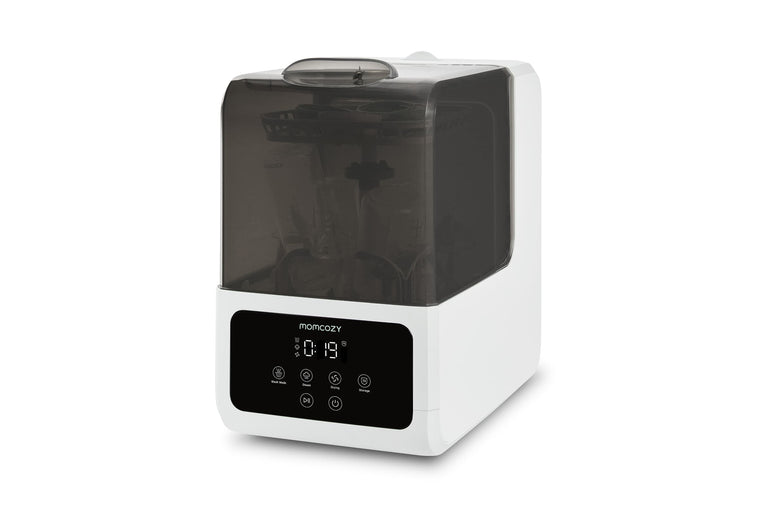 $299.99code ÉCONOMISEZ $30
If you're exploring different bottle hygiene solutions, Momcozy has a full collection of baby bottle sterilizers and washers. Check them out here: Momcozy Baby Bottle Sterilizers Collection.

The Simple Rules That Matter Most
The biggest safety wins are not fancy. They are consistent.
Clean bottles after every feeding. A quick rinse is not the same as cleaning, especially around nipples, rings, valves, and bottle seams.
And for the in-between moments, a simple hand-wash setup still matters. Momcozy Innovative Push-Press Design Bottle Brush Kit is handy when you need to scrub one bottle or nipple quickly between full loads, especially because the soap-dispensing handle keeps the whole thing less fussy when you are already holding parts in one hand.
Keep drying boring and thorough. Air-dry on a clean, unused towel or paper towel, or use a drying rack that you clean regularly. Do not rub parts dry with the family dish towel.

Remember that clean bottles do not make old milk safe. Prepared formula should be used within 2 hours of making it and within 1 hour once feeding starts. Fresh breast milk can stay at room temperature for up to 4 hours, and once it has been warmed or brought to room temperature it should be used within 2 hours and never rewarm. Neither formula nor breast milk should be heated in a microwave, because hot spots can burn your baby’s mouth.
Normal vs. Red-Flag Situations
A normal situation is a healthy full-term baby, clean water, dishwasher-safe bottles, and a routine that gets parts washed and fully dry. In that setup, the dishwasher is usually enough.
A red-flag situation is a baby who is under 2 months, premature, immunocompromised, or following stricter NICU or pediatric instructions. Treat daily sanitizing as essential in that case. If you are also dealing with water safety concerns, illness, or a medically fragile baby, follow your care team’s instructions even if they are stricter than standard home guidance.
FAQ
Q: Do I need to sterilize baby bottles after every wash?
A: Usually not. For
older, healthy babies, careful cleaning after each use is often enough. Daily sanitizing is more important when your baby is under 2 months, premature, or has a weakened immune system.
Q: Is a separate bottle sterilizer better than a dishwasher?
A: Not necessarily. If your dishwasher uses
hot water plus heated dry or a sanitize setting, it can do the sanitizing job. A separate unit may still be helpful if you want faster small loads or a simpler night-feed routine.
Q: Can I put bottles away if they still have a few water drops in them?
A: Better to wait.
Let bottle parts air-dry thoroughly before storing them. Storing them damp is one of the easiest ways to undo a good wash.








