


MEDICALLY REVIEWED BY

Zola Zhang, MD, IBCLC, Breast Surgeon, Mother
Chirurgienne du sein | Consultante en lactation certifiée IBCLC | Mère Chirurgienne du sein dévouée et consultante en lactation certifiée IBCLC forte de 21 ans d'expérience clinique, mon travail prend racine à la fois dans l'expertise médicale et dans la réalité vécue de la maternité. Plus qu'une clinicienne, je suis une mère qui a allaité exclusivement son propre enfant pendant deux ans. Cette double perspective imprègne chacune de mes interactions, me permettant de conjuguer la rigueur scientifique à une empathie profonde face aux joies et aux défis de l'allaitement. Remarque : le texte original (en anglais) a été révisé par des experts ; le présent texte est une traduction en français de cette version.
A diaper pail is only one layer of pet-proofing—not a guarantee that a curious cat or determined dog cannot reach its contents. The most workable setup combines a securely closing, stable pail with a placement barrier that fits your pet’s behavior, while keeping disposal quick enough for frequent, one-handed diaper changes.
Do not assume that a child safety lock, foot pedal, or odor-sealing lid is automatically pet-resistant. Instead, check how your own pet approaches the pail: Can they nose a lid open, paw at a mechanism, tip it, chew exposed plastic, or pull out a liner? If the answer is yes, the pail needs backup from a cabinet, closet, gate, or controlled room access.
Assess the Pet’s Actual Access Route
A dog may steal used or unused diapers and wipes, and swallowing them can lead to gastrointestinal upset or an obstruction. That makes prevention more than an odor-management task: the goal is to keep both dirty and clean diaper supplies out of reach. 
Start with a short, supervised setup audit. With the pail empty and closed, observe what your pet can realistically do around it.
- Lid access: Can your pet lift, push, nose, or paw at the lid or disposal opening?
- Pedal or handle access: Does a dog repeatedly press a pedal, or does a cat investigate a movable handle?
- Tipping risk: Can the pet bump, lean against, or knock over the pail?
- Chewing risk: Are there edges, lids, handles, or exposed bags your pet is likely to chew?
- Liner access: Could a pet pull a bag through an opening or grab it during bag changes?
- Persistence: Does your pet return to the pail after being redirected, especially when it contains used diapers?
A locking or pet-resistant receptacle can be a sensible first layer, and unused diapers should also be stored out of a dog’s reach. But the practical test matters more than the label. A small cat that only investigates an occasional lid may be managed with a closed pail in a restricted nursery. A strong, food-motivated dog that noses bins, tips containers, or chews plastic should begin with a pail-plus-barrier plan.
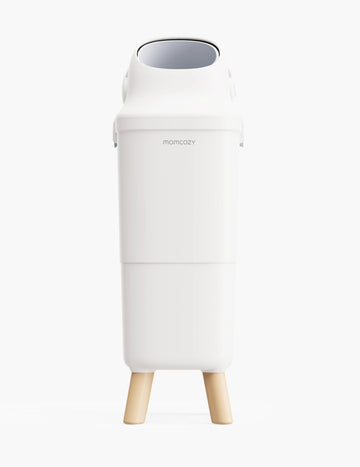
Some diaper pails include features intended to make daily disposal easier. For example, the Momcozy Triple-Seal Diaper Pail is described as having a built-in child safety lock and a hands-free wide opening. Those are manufacturer-described features, not evidence that the pail will resist cats or dogs. Confirm the current instructions and test the setup with your own pet in mind.
Choose the Least Restrictive Reliable Barrier
The best barrier is the one that your pet cannot defeat and a caregiver can use safely during a diaper change. Start with the simplest arrangement that works, then add protection if your pet continues to investigate the pail.
Open-Room Placement with Supervision
This can work for a low-interest pet that does not manipulate, tip, or chew the pail. Keep the pail beside the changing area rather than across the room, so you are not tempted to leave a baby unattended while disposing of a diaper.
This option is not a good fit for a pet that repeatedly raids household trash or follows you into the nursery.
A Gated Nursery or Changing Zone
A gate can create a useful first boundary when the pail needs to stay close to the changing surface. It preserves quick access for the caregiver while limiting a pet’s ability to approach the pail.
Before relying on a gate, check whether your pet can jump it, push through it, squeeze around it, or wait for someone to leave it open. A gate that fails intermittently is not a dependable waste-control plan.
A Closed Closet
A nearby closet can provide stronger separation without moving the pail far from the changing station. This can be a practical choice when a dog can open or tip the pail but cannot access the closet.
The workflow test is important: Can you open and close the closet safely while holding or attending to a baby? If not, the closet may create enough friction that diapers end up left on a changing surface or nearby furniture.
A Secured Cabinet
Cabinet storage adds another physical layer around the pail. General household pet-proofing guidance includes keeping garbage in a cabinet and using cabinet hardware or locks where needed. Still, neither a cabinet lock nor a child-oriented lock should be assumed to defeat every pet.
Choose this route when your pet has already shown that a pail alone is not enough. Make sure the cabinet door closes fully, the pail can be removed safely for emptying, and the routine does not require awkward lifting or reaching during a diaper change.
Keep Disposal Fast, Closed, and Boring
Pet-proofing works best when it does not create a complicated routine. Each extra step can make it harder to dispose of diapers promptly, especially overnight or when one hand is occupied.
Use a simple sequence:
- Keep clean diapers, wipes, and cream stored where pets cannot reach them.
- Dispose of the used diaper promptly.
- Close the pail immediately according to its instructions.
- Check that the liner is seated properly and not exposed around the rim.
- Empty the waste regularly rather than waiting for the pail to become difficult to manage.
Odor control may help reduce household odor, but it is not proof that a pet will lose interest. Some pails are marketed with clamp-seal or multi-seal odor-control designs; treat those as convenience features to verify, not as pet-deterrent claims.
If odor or pet attention continues, individually bagging a used diaper before placing it in the pail may make its odor less noticeable to a dog. This is a possible additional layer, not a substitute for a secure closure and physical barrier. If a pet can still access the pail, focus on restricting access rather than relying on scent control alone.
Test Caregiver Access Before Making the Setup Permanent
A highly secure arrangement is not ideal if it makes normal diaper changes cumbersome. Before committing to a cabinet, closet, or gated layout, run through a realistic change.
Ask:
- Can one adult place a diaper in the pail while staying close to the baby?
- Can the pail or barrier be operated with one hand when necessary?
- Is the pail close enough for nighttime changes?
- Can the lid or barrier be closed immediately afterward?
- Can the bag be removed without leaving dirty waste exposed where a pet could reach it?
- Does every caregiver in the home understand the closing routine?
If the answer to any of these is no, simplify the setup or move the barrier closer to the changing station. The goal is not the maximum number of locks; it is a routine that is both consistently secure and easy enough to follow when everyone is tired.
If a Pet Gets Into the Pail or Eats Its Contents
Treat suspected ingestion as a prompt call for professional guidance. Dogs can develop gastrointestinal upset or an obstruction after eating diapers or wipes. Diaper cream adds another concern: if a dog vomits after eating certain ointments, or vomiting is induced, ointment can enter the lungs and cause serious aspiration pneumonia.
If your pet may have eaten a diaper, wipe, pail liner, diaper cream, or another pail item:
- Secure the remaining waste and keep other pets away from it.
- Note what may have been eaten, when it happened, and any packaging or product information available.
- Contact your veterinarian, an emergency veterinary clinic, or an appropriate animal poison service promptly.
- Do not force or induce vomiting unless a veterinarian specifically directs you to do so.
- Seek emergency veterinary care immediately for severe or concerning symptoms.
For poison-exposure guidance involving a dog and baby items, the Pet Poison Helpline can be reached at (855) 764-7661. A helpline call does not replace emergency care when a pet has severe symptoms or a veterinary professional directs urgent treatment.
Choose the most secure setup that still supports one-handed disposal at the changing station. If your pet can defeat the pail, add a real access barrier rather than experimenting with the same arrangement again. Keep waste emptied regularly, and if a pet gets into the contents, act promptly. Build the rest of your changing area around that same principle: organized enough for everyday care, and protected enough for the curious animals who share your home.









