MEDICALLY REVIEWED BY

Mary Bicknell, MSN, BSN, RNC, ANLC
Mary Bicknell possède plus de 30 ans d'expérience en tant qu'infirmière autorisée (IA) en unité de soins intensifs néonataux (USIN). L’éducation des mères sur l’importance d’un allaitement sain lui tient particulièrement à cœur. Maintenir un allaitement réussi peut s'avérer complexe lors de situations difficiles ou de longues hospitalisations. Mary s'engage à aider les familles à définir ce que représente pour elles un allaitement réussi et à les accompagner pour atteindre leurs objectifs. Après avoir quitté les soins au chevet des patients, Mary est devenue infirmière leader, veillant à ce que l'éducation et le soutien à l'allaitement soient toujours accessibles aux familles de son unité. Remarque : le texte original (en anglais) a été révisé par des experts ; le présent texte est une traduction en français de cette version.
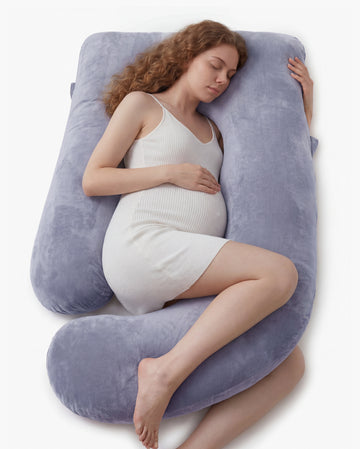
Set up a pregnancy pillow around a relaxed side-lying position: keep your head level, cushion the space between your thighs and knees, add gentle support under your bump, and use back support only as is comfortable—not a restraint.
From 28 weeks of pregnancy to birth, aim to start sleep on either side rather than flat on your back. You do not need to control every movement overnight. If you wake up on your back, roll onto a side and settle in again. Guidance on sleeping posture in pregnancy focuses on the position you choose when going to sleep, not on policing normal turns during the night.
The goal is not a perfectly fixed pose. It is a position that feels supported, lets you breathe and move comfortably, and does not leave your neck, shoulder, hips, or legs doing extra work.

Start with a side position you can relax into
Choose the side that feels more comfortable. Keep your knees slightly bent and try to stack your shoulders and hips rather than twisting far forward or leaning far backward.
A pillow behind your back can be useful if you like a little feedback when you start to roll backward. Place it close enough to offer a soft buffer, but not so tightly that you feel wedged in. It is a support for comfort, not a device that can—or should—hold you in one position all night.
If you wake on your back, simply roll back to either side and return to sleep. There is no need to panic. If lying flat repeatedly brings on nausea, dizziness, or shortness of breath, though, bring that up with your prenatal clinician rather than treating it as a pillow problem. This pregnancy sleep-position guide explains why the practical focus is starting sleep on a side and responding calmly if you shift overnight.
Build the core setup, one support area at a time
A pregnancy pillow can make this simpler, but the arrangement matters more than the shape. Set up your bed in this order.
1. Support your head and neck first
Use your usual head pillow, or the upper end of a body pillow, to keep your head level with your spine. Your head should not tip noticeably toward the mattress or be pushed up toward the ceiling.
A quick check: imagine your nose pointing straight ahead, not up or down. If your shoulder feels compressed, your head pillow may be too low, too high, or positioned too close under the shoulder itself.
2. Add gentle support under your bump
Slide part of the pillow under the front of your abdomen until your bump feels comfortably held. The support should fill the space between your body and the mattress; it should not push your bump upward or create pressure across your abdomen.
Small changes matter here. Move the pillow a little closer to your waist if there is a gap, or pull it slightly forward if it feels like it is lifting rather than supporting.
3. Support the thighs and knees—not only the knees
Place the lower section of the pillow between your thighs and knees. The aim is to cushion the length of the upper leg so it does not drop forward and pull at your hips or pelvis.
You do not necessarily need a pillow between your ankles. Start by supporting the thighs and knees, then see whether extending the pillow farther down feels more comfortable for you.
4. Use back support only if it helps
If you want a back pillow, position it behind you after your head, bump, and leg supports are working. It should be light contact, not a firm wall. If it makes turning difficult, creates lower-back pressure, or makes you feel trapped, reduce the bulk or remove it.
Do a 10-minute alignment check
After settling in, ask:
- Is my head level rather than tipped up or down?
- Does my lower shoulder feel free rather than compressed?
- Are my shoulders and hips generally aligned?
- Does my bump feel supported without being lifted or pressed?
- Are my thighs and knees cushioned?
- Can I change position without wrestling the pillow?
If one area feels wrong, change one thing at a time. Adding more pillows everywhere often makes a setup harder to evaluate—and harder to move in.
Use your pillow shape as a layout, not a rule
Different shapes can help organize support in different places. None is automatically best; comfort also depends on your body, mattress, pillow fill, and how diffcult it is for ou to turn.
Pillow shape |
A practical side-sleeping setup |
C-shaped |
Place the curve behind your back if you want back support, rest your head on the upper section, and bring the lower end between your knees. If you prefer more bump support than back support, reverse the orientation. |
U-shaped |
Use one leg of the U for your head and upper body, then position the other where it best supports your front or back. Keep the lower portion available between your thighs and knees. A U shape may feel supportive around the body, but it should still leave enough room to turn. |
J-shaped |
Position the upper end under your head and upper body, then bring the longer section in front of you to support your bump and knees. This can suit people who want front support without a full wraparound feel. |
Wedge |
Use it for targeted support under your bump or behind your back. Because a wedge does not provide full-body support, you may still want separate pillows for your head and between your legs. |
A C-, U-, or J-shaped pillow can support several areas at once, while a wedge is more targeted. This guide to pregnancy pillow shapes describes the typical support areas of these designs. Treat those as starting points, not promises: if a configuration feels bulky or strains your neck, it is not the right arrangement for you.
Troubleshoot the discomfort you actually feel
A pillow adjustment may improve ordinary pressure or positioning discomfort, but it does not diagnose or treat the cause of pain.
If this is the problem |
Try this first |
Keep in mind |
Hip or pelvic discomfort |
Move the leg section higher so it supports the upper thighs as well as the knees. Keep the top leg from dropping forward. |
An inter-leg pillow may reduce stress on the hips and pelvis, but persistent or worsening pelvic pain needs clinical advice. |
Lower-back discomfort |
Check whether you are twisted forward or leaning too far backward. Re-center the pillow under your bump and between your knees; add only gentle back support if it feels helpful. |
More bulk is not always better. A large back pillow can increase pressure or make turning harder. |
Shoulder pressure |
Adjust your head pillow before changing the body pillow. Your lower shoulder should not be buried under the head pillow. |
A neutral neck and an uncompressed shoulder matter more than forcing your head into the body pillow’s top curve. |
Bump feels unsupported |
Fill the gap beneath your bump with a small portion of the pillow or a targeted wedge. |
Stop if the support pushes your abdomen upward or feels restrictive. |
Heartburn at night |
Elevate your head and chest slightly while keeping your neck in a neutral position. |
Avoid building a high, soft stack that bends your neck. Elevation may ease symptoms but is not a solution for severe or persistent reflux. |
Tingling or numbness |
Reduce pressure points and make the setup easier to move in. |
Persistent, worsening, or sciatica-like pain, tingling, or numbness should be discussed with a clinician. |
For pregnancy-related pelvic discomfort, side sleeping with support between the legs is commonly used to reduce hip and pelvic stress. This pelvic-pain guidance describes it as a symptom-management measure—not a diagnosis or a replacement for assessment.
When the pillow feels too hot, too firm, too flat, or too hard to turn with
A difficult setup usually needs a smaller, more targeted change—not an entirely new pile of bedding.
- Too hot: Keep the room cool, consider breathable cotton or linen bedding, and use a fan if that improves airflow. The often-cited 60–67 degree range is a general sleep-environment target, not a pregnancy-specific medical requirement.
- Too firm: Pull the pillow slightly away from the area that feels pressed, especially at your bump or back. You may need less contact, not more.
- Too flat: Add a small pillow only where support is missing—for example, under your bump or between your upper thighs.
- Hard to turn: Create a little space in front of your torso and keep the leg support in place. If the back section is the obstacle, reduce or remove it.
- Feeling trapped: Use only the pieces that are helping. A full-body pillow does not have to wrap around your entire body to be useful.

Test each change for several minutes in your normal side position. Keep it only if it improves comfort and makes movement no harder.
When to stop adjusting and call your prenatal clinician
A pillow is appropriate for comfort troubleshooting, not for managing warning signs.
Contact your prenatal clinician promptly if you have recurrent nausea, dizziness, or shortness of breath when lying flat; persistent or worsening pain; or back pain along with vaginal bleeding, fever, cramping or contractions, or burning with urination.
Seek urgent help for dizziness or fainting, trouble breathing, chest pain or a fast-beating heart, severe belly pain that does not go away, vaginal bleeding or fluid leaking, or your baby’s movements stopping or slowing. Urgent maternal warning signs are not limited to this list—seek help if something feels wrong or you are unsure how serious a symptom is.
Set it up tonight
- Start on either side, with knees slightly bent.
- Level your head and neck first.
- Support the space under your bump gently.
- Run leg support between your thighs and knees.
- Add a light back cue only if it improves comfort.
- Check that you can still turn without feeling trapped.
Keep the setup if you feel neutral, supported, and able to move. If one spot hurts, feels numb, overheats, or lacks support, make one targeted adjustment and test again. If your current pillow shape cannot comfortably reach the areas you need, compare Momcozy shapes based on the support layout—not on a promise to solve pain. And if symptoms persist, worsen, or come with warning signs, contact your prenatal clinician rather than continuing to troubleshoot the bedding.