


MEDICALLY REVIEWED BY

Zola Zhang, MD, IBCLC, Breast Surgeon, Mother
Chirurgienne du sein | Consultante en lactation certifiée IBCLC | Mère Chirurgienne du sein dévouée et consultante en lactation certifiée IBCLC forte de 21 ans d'expérience clinique, mon travail prend racine à la fois dans l'expertise médicale et dans la réalité vécue de la maternité. Plus qu'une clinicienne, je suis une mère qui a allaité exclusivement son propre enfant pendant deux ans. Cette double perspective imprègne chacune de mes interactions, me permettant de conjuguer la rigueur scientifique à une empathie profonde face aux joies et aux défis de l'allaitement. Remarque : le texte original (en anglais) a été révisé par des experts ; le présent texte est une traduction en français de cette version.
Weekly descaling is not necessary for every bottle warmer. The care guide for your exact warmer model should set the rule; water hardness, how often the warmer is used, visible residue, and changes in warming performance can help you decide when to inspect or descale sooner. Mineral buildup can slow heat transfer and may affect temperature control in some designs, but it does not automatically mean a heating sensor is damaged or that the warmer has reached the end of its life.
Before cleaning, unplug the warmer and allow it to cool unless your model’s instructions specifically say otherwise. Use only the descaling agent, method, rinse process, and water levels approved for that exact model.
What mineral scale can do to a warmer
The white or chalky film sometimes left in a water chamber is commonly mineral scale. It forms when water is heated and evaporates, leaving minerals behind on the chamber surface or heating area.

In liquid-heating appliances, scale adds thermal resistance between the heater and the water. In practical terms, heat may move less efficiently through the buildup, so the appliance can take longer to respond to heating changes. A technical description of liquid-heating systems similarly identifies limescale as a factor that can reduce thermal gain and increase response time. Read the liquid-heating limescale detection method.
That mechanism is useful context, but it has limits:
Scale may contribute to |
Scale does not automatically prove |
Slower or less consistent warming |
A failed temperature sensor |
Visible white deposits in the chamber |
An unsafe bottle temperature |
Less efficient heat transfer |
That every warmer needs weekly descaling |
A need for a manual-approved descale |
Permanent appliance damage |
A warmer’s sensor may sit near the heater, in another part of the appliance, or work with a control system that responds differently from another model. Some liquid-heating systems can detect scale-related changes through temperature measurements, but that does not mean every bottle warmer uses the same sensor type, diagnostic method, or error-message system.
If a warmer that previously performed normally now takes longer to warm after visible deposits have appeared, a model-approved descale is a reasonable maintenance step. It is not, by itself, proof that the sensor has been harmed.
Is weekly descaling the right schedule?
Not universally. No single weekly, monthly, or per-use schedule applies to every bottle warmer.

Start with the manufacturer’s maintenance instructions. If the manual specifies an interval or tells you what to do when deposits appear, follow that guidance rather than adapting a schedule from another brand, kettle, coffee machine, or online video.
Then use this practical decision framework.
Normal use, no visible residue
If you use the warmer occasionally, the chamber looks clear, and performance has not changed, inspect it regularly and follow the manual’s normal cleaning instructions. Weekly descaling may be unnecessary unless the manual specifically calls for it.
Frequent use or hard water
Water hardness matters because it affects the amount of mineral content that can be left behind as water is heated. A household that uses its warmer many times a day or has hard tap water may need to inspect the chamber more often than a household with softer water or occasional use.
That does not create a universal “weekly” rule. It means visible condition and model instructions matter more than a calendar reminder alone.
Visible deposits or slower warming
If you can see scale, or if the warmer appears to heat more slowly or less consistently than before, check the manual’s descaling section. Use the approved process for your model rather than waiting for a routine cleaning day.

Persistent faults after approved maintenance
Do not keep repeating descaling attempts if the warmer continues to underheat, overheat, leak, show error messages, or raise electrical concerns after you have followed the approved procedure. At that point, contact the manufacturer’s support channel.
Rinsing, cleaning, and descaling are different tasks
These terms are often used interchangeably, but they solve different problems.
Task |
What it does |
What it does not do |
Rinsing |
Removes loose water or residue from a surface |
Reliably removes mineral scale or fully cleans a chamber |
Routine cleaning |
Uses the manufacturer’s approved cleaning method to remove dirt and residue |
Necessarily dissolve mineral deposits |
Descaling |
Targets mineral buildup in the water chamber |
Replace normal cleaning of bottles and feeding parts |
Cleaning and sanitizing are also different. Cleaning removes dirt and impurities from surfaces; sanitizing reduces germs after cleaning. CDC guidance on cleaning and disinfecting explains that surfaces should be cleaned before they are sanitized.
For infant feeding items, bottles and related components need their own hygiene routine. Guidance to clean bottles after each feeding does not mean the warmer’s water chamber needs descaling after every use—or every week. Treat bottle care and chamber maintenance as separate jobs, following the instructions for each item.
How to descale without guessing
The safest procedure is not a universal vinegar recipe or a borrowed appliance-cleaning routine. Different warmers may permit different agents, contact times, fill levels, and rinse steps. Some appliances use a standing solution; others use a cycle. Those approaches should not be transferred from one model to another.
Use this safety-first sequence instead:
- Identify the exact model. Find the model number on the appliance, packaging, or manual. If the manual is missing, check the manufacturer’s official support resources before using any descaling product.
- Power down and cool the warmer. Unplug it and let it cool unless your model’s instructions explicitly direct another procedure.
- Use only the approved descaling agent. Do not assume vinegar, citric acid, a commercial descaler, or another household cleaner is safe for your warmer. An agent that is approved for one appliance may damage another or leave a residue that its manufacturer has not evaluated.

- Follow the model-specific method exactly. Pay attention to whether the solution is meant to sit in the chamber, whether a heating cycle is permitted, how full the chamber may be, and whether any parts must be removed or wiped separately. Never run a heated descaling cycle unless your exact manual permits it.
- Rinse exactly as directed. Descaling processes may require repeated clean-water rinsing and, for some appliances, a final fresh-water cycle. The correct number of rinses and whether a cycle is allowed depend on the warmer. Do not guess.
- Dry and inspect before feeding use. Empty the chamber, dry it as directed, and make sure no cleaner, odor, or visible residue remains before returning the warmer to use.
If you use a chemical product, follow its label instructions, provide ventilation where required, use any listed protective equipment, and never mix cleaners unless the labels specifically say it is safe.
Water choices and fill limits
It is tempting to switch to filtered, distilled, or softened water as a universal fix for scale. However, there is no general bottle-warmer evidence here showing that those water types are approved for every model or guaranteed to prevent buildup.
Follow the water type and fill-level directions in your own manual. Water-level instructions can vary by warmer and bottle size, and those instructions are for normal operation—not automatically for descaling solution.
Avoid overfilling. Water that rises too high around a bottle or spills over the warmer can create problems unrelated to scale.
When descaling is no longer the answer
A proper descale can address mineral deposits. It should not be used as a catch-all repair strategy.
Stop using the warmer and consult manufacturer support if you notice:
- ongoing unusually slow, inconsistent, or incorrect warming after a manual-approved descale;
- overheating or suspected temperature-control problems;
- error messages that remain after normal troubleshooting;
- leakage, water escaping from the intended chamber, or damage to the housing;
- frayed cords, electrical odors, unusual electrical behavior, or other power-related concerns.
There is no universal point at which every bottle warmer must be replaced after scale buildup. The manufacturer’s manual, warranty information, and support team are the appropriate sources for model-specific service or replacement decisions.
A calm maintenance checklist
- Check the exact model manual before choosing a schedule or descaling product.
- Inspect more closely if you have hard water, frequent use, visible scale, or changed warming performance.
- Descale only with an approved method, then rinse and dry exactly as directed.
- Seek manufacturer support instead of repeatedly descaling when temperature problems, leaks, electrical concerns, or error codes continue.
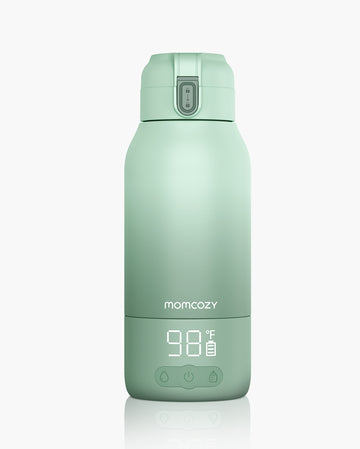
For a Momcozy warmer, use the care guide or support channel for your exact model rather than applying directions intended for another bottle warmer.








