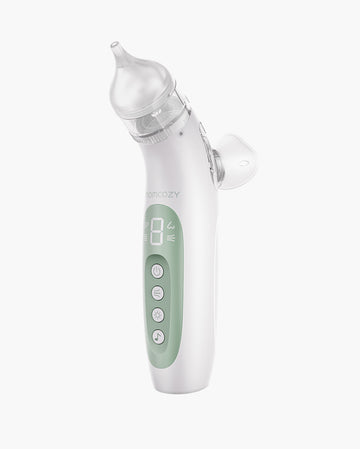
Can you use saline nose spray for newborns? The answer is yes in many cases. You can use plain saline spray or drops to add moisture to a newborn’s stuffy nose. It will help loosen mucus. But it comes with conditions. The product should be plain saline. It should be labeled for your baby's age. And it should fit your pediatrician's guidance, especially if your baby is very young.
But saline spray isn't your only option, and it isn't the same as other nose-care tools. There’s also saline drops, mists, suction tools and rinses. Drops and spray add a small amount of moisture. Suction removes mucus. Irrigation flushes the nose. They do different jobs.
So the real questions are these. Should you use drops or spray? Is spray too strong for a newborn? And do you need to suction afterward? This guide answers all three. If you're also looking at tools, you can browse baby nasal aspirators. But suction is optional. It only makes sense when there's loosened mucus to remove.
Key Takeaways
- Saline is for moisture and loosening. It's not for "sucking mucus out."
- Drops and mist or spray add a small amount of moisture. A full rinse is a different technique.
- Suction is optional. Use it only when loosened mucus is there and you can reach it.
- A clear nose does not need suctioning, even if your baby still sounds stuffy.
- Follow your pediatrician's guidance and the instructions on your product.
The Simplest Care Sequence: Moisture, Reassess, Suction Only If Needed

You probably want one routine you can repeat every time. Newborn nose care doesn't work that way. The right next step depends on what's in the nose and how old your baby is.
Here's a simple way to think about it:
- Moisture first, if the nose looks dry or the mucus looks sticky. Use plain saline in a format your product says is okay for a newborn.
- Reassess. Look at the nostrils. Listen to your baby. Is there mucus that has loosened and moved forward? Or is the nose clear?
- Suction only if mucus is there and you can remove it. If there's nothing to remove, suction has nothing to do.
The rest of this guide walks through each step.
Saline Drops vs. Saline Spray: What Is the Difference?
Both give your baby saline. They just deliver it differently.
Drops put a small amount of liquid right into the nostril. A mist or spray breaks the saline into tiny droplets with a spray mechanism. Products vary a lot. So the label and instructions matter more than the format name.
|
Saline drops |
Saline mist or spray |
|
|
How it's delivered |
A small amount of liquid placed in the nostril |
Saline sprayed as fine droplets |
|
Control |
Many parents find the amount easier to manage |
Depends on the product design |
|
Spread of moisture |
Stays close to where you place it |
May spread more broadly, depending on the product |
|
What to check |
Age label, plain saline, clean dropper |
Age label, plain saline, how the nozzle and mist behave |
|
Is one always safer? |
No |
No |
Neither one wins every time. It depends on your baby’s age and the pediatrician’s advice.
What Saline Drops Do
Saline drops add a little bit of moisture. That helps when mucus is dry or sticky and you want to soften it without adding too much liquid.
Many parents feel more in control with drops, especially with a very young baby. The trade-off is placement. You need to hold the dropper at the nostril opening. Don't insert it.
What Saline Mist or Spray Does

A mist breaks saline into fine droplets. That can spread moisture across the nasal opening. Some parents find it quick and easy.
The trade-off is that sprays aren't all alike. Droplet size, pressure and nozzle design change from product to product. What's true of one spray isn't automatically true of another.
One more thing. A saline spray is not a medicated decongestant spray. Plain saline is salt and water. On the other hand, medicated nasal products have active ingredients. Your pediatrician should guide you on those. This guide covers plain saline only.
When Can Saline Help a Newborn's Nose?
Saline helps most when the nose is dry, the mucus is sticky or thick, or secretions need a little moisture before they can move. That's it. It's supportive care. It doesn't diagnose or treat the cause of the congestion. That could be a cold, dry air or something else.
|
What you see |
Does saline fit? |
Why |
|
Dry nostrils or dry, sticky mucus |
Often yes |
Moisture can soften what's there |
|
Visible mucus that's already loose |
Not necessarily |
It may already move without more liquid |
|
Noisy or stuffy breathing, but no visible mucus |
Maybe, maybe not |
The sound may not come from removable mucus. Don't automatically escalate |
|
Trouble breathing or poor feeding |
Not the first step |
Call your pediatrician. See the red flags below |
Dry Nose or Sticky Mucus
Try using moisture if the nose looks dry or the mucus looks sticky. Softer mucus is easier for your baby to clear alone. It's also easier to deal with if you later decide gentle suction is right.
If the mucus has gone hard or crusty, that's a different job. Our guide to hard or dry baby boogers covers it. Don't just repeat attempts here.
Before Suction When Mucus is Hard to Move
Say you're thinking about a nasal aspirator. But the mucus looks too dry or sticky to move. Saline can be the step before it.
The goal is simply to soften the mucus. If it becomes movable, it can be removed gently. If nothing loosens, that tells you something too. We cover that below.
Are Saline Drops Gentler Than Spray for a Newborn?
It depends on the product and how you use it. Parents ask this a lot. The honest answer is that the word "spray" alone doesn't tell you much.
Why do drops feel gentler? You control a very small amount of liquid. You can see where it goes. Many parents reasonably feel that's gentler, especially with a tiny baby.
Does that mean spray is unsafe for a newborn? Not on its own. Sprays and mists differ in droplet delivery and pressure. Some are labeled for newborns and come with clear instructions. Others aren't. We won't compare pressure between products here. A real comparison needs verified numbers from each manufacturer.
So how do you choose? Look for plain saline. Look for a label that matches your baby's age. Follow that product's instructions. Not sure if it is right for a very young newborn? Ask your pediatrician first.
Parent forums are full of people asking the same thing. That shows how common the worry is. But a forum post isn't medical guidance. Don't let one make this call for you.
How to Use Saline Without Turning It Into a Full Nasal Rinse
On this page, "saline" means a few drops or a light mist to moisten the nose. It doesn't mean a flush. The difference comes down to amount, force and where the liquid ends up. Here's how to stay on the moisture side of that line.
Suppose anything below clashes with the product's own directions. Follow the product directions instead.
- Start with the smallest amount of saline that the directions allow. Moisture is the goal. You're not trying to wash anything out.
- The dropper rests the tip at the nostril opening. Don't insert it or aim it deep or upward.
- Don't squeeze or press to push liquid in. Let the drops fall or the mist spray gently.
- Watch where the liquid goes. Suppose it's pooling, running back out in a stream, or draining toward the throat or the other nostril. Then, that's more than moisture. Stop there.
- Don't stack applications. Skip repeated squirts in a row to see if more helps. Pause and look at the nose first.
- Leave adult habits out of it. Sinus-rinse and neti-pot methods are built to flush. Don't copy them for a newborn.
- Use plain saline labeled for your baby's age. Unless a medical professional has guided you otherwise, stick with low-volume use.
Keep Low-volume Saline Separate from Irrigation
People on the internet sometimes use spray, rinse, flush, and irrigation interchangeably. As such, many parents get confused.Let’s differentiate them. Drops and mist moisten the nose. Meanwhile, irrigation sends liquid through it, which is a different method with its own rules for positioning, water safety and age.
If a flush is what you're really asking about, read our infant nasal irrigation guide.
Can You Use Saline Before a Nasal Aspirator?
Yes. Saline may be used to loosen dry or sticky mucus before suction, if the product and manual allow it. What matters is the middle step. After the moisture, you reassess. You don't automatically suction.
Moisture First
A small amount of saline can soften mucus that is dry or sticky. Follow the product's directions for how much. Give the moisture a little time to work. Exact timing and amounts vary by product. Take them from the label or your pediatrician, not a rule of thumb.
Reassess Before Suction
After the saline, stop and look and listen.
- Is there visible mucus that looks loose and easy to reach? If it's bothering your baby, gentle suction may help.
- Is the nose clear, but your baby still sounds stuffy? Then there's probably nothing to suction. Suctioning a clear nose again and again won't fix a congested sound. It can also irritate your baby's delicate nasal tissue.
Suction is a second step. It's not a required partner for every saline use.
Read our guide on how to suction a baby's nose if you’re looking for information about the full method. For questions about repeat use, read our guide on when and how often to use a nasal aspirator.
When Does an Aspirator Add Value After Saline?
When there’s mucus that has loosened, that’s when the usefulness of an aspirator comes in. It doesn't help when there's no mucus to remove. Saline softens. Suction, when it fits, removes.
|
Fit |
Non-fit |
|
|
Situation |
Visible mucus that has softened and is ready to come out |
A clear nose, no mucus, or a stuffy sound with nothing to see |
|
What helps |
Gentle suction, following the manual |
Reassessing, reading the no-mucus guidance, and checking in with your pediatrician if you're worried |
|
What to avoid |
Skipping the reassess step |
Using more force or repeating attempts because nothing came out |
Best-fit Scenario: Loosened Mucus that is Ready to Remove
You used saline. You waited as the product directions allowed. Now you can see mucus that has softened and moved forward. That's when suction can make sense.
One tool built around this sequence is the BreezyClear™ 2-in-1 nasal aspirator. It's a mist and suction product. It puts the moisture step and the removal step in one device.
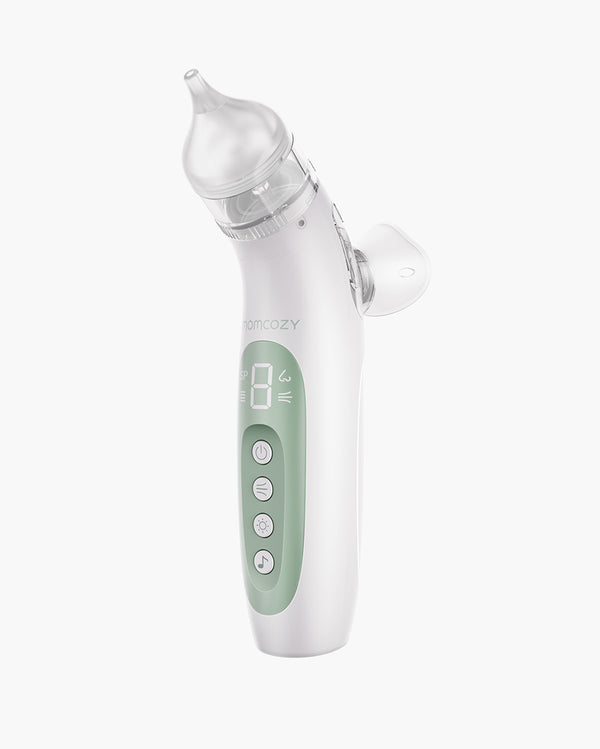
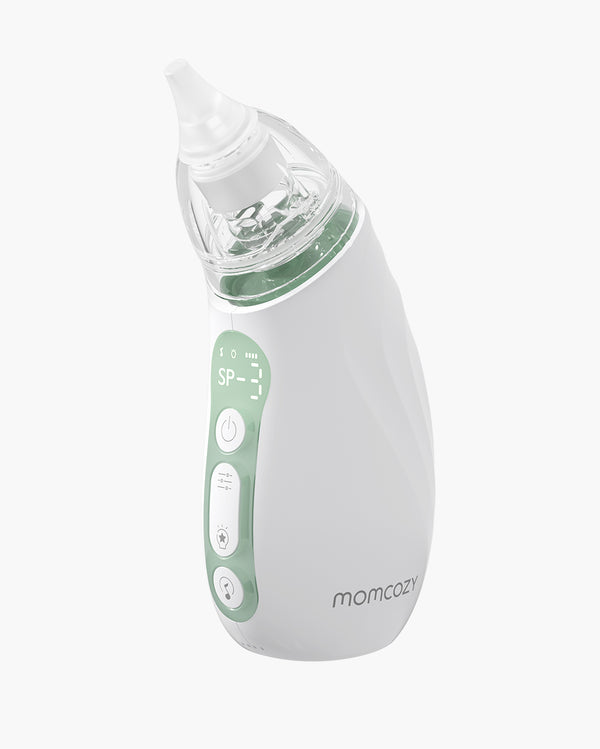
Please note that this product is not a nasal-irrigation system. It is neither a treatment for breathing or sleep. Please check the manual for age guidance, settings, and how to use it before you do.
Non-fit Scenario: No Mucus to Suction
Sometimes a baby sounds congested, but you see nothing. Then a suction tool has no target. Don't turn up the force. Don't repeat the attempt because saline didn't bring mucus into view.
If that sounds like your baby, read our guide on what to do when a baby sounds congested but no mucus is visible.
What If Saline Does Not Seem to Work?
Saline didn't loosen anything. Or the nose still sounds stuffy. Don't reach for more saline, stronger suction or deeper insertion.
A stuffy-sounding baby doesn't mean the method failed. Step back. Look at what you're actually seeing and hearing.
- No visible mucus. The sound may not come from removable mucus near the front of the nose. More saline or suction is unlikely to change it.
- Hard or crusted mucus. Use our hard or dry baby boogers guide. Don't keep retrying.
- Congestion that lasts or gets worse. Ask your pediatrician.
- Feeding or breathing seems affected. Stop trying products. Contact your pediatrician.
A quiet-looking nose that sounds congested belongs with the no-mucus guidance above. It doesn't call for another round of saline and suction.
Is Saline the Same as Nasal Irrigation?
No. Saline drops and mist use only a small amount of liquid. Contrarily, nasal irrigation, also called a nasal rinse, moves a larger amount of liquid through the nose. The technique is different. So are the positioning, water-safety and age questions. It deserves its own guide and its own talk with your pediatrician.
In short, drops and mist moisten. They don't flush.
If you're asking about rinsing or flushing a baby's nose, look for dedicated infant nasal irrigation guidance. Don't adapt what you read here.
Keep the words apart when you shop, too. A mist or spray isn't a rinse. And a mist-and-suction device isn't an irrigation device.
What Should You Avoid With Newborn Saline Care?
|
Do |
Don't |
|
Use plain saline labeled for your baby's age |
Use medicated nasal products unless your pediatrician says to |
|
Keep applications gentle and low-volume |
Force a through-flow rinse on a newborn |
|
Keep dropper or nozzle tips at the nostril opening |
Insert tips deeply |
|
Reassess the nose after saline |
Build an automatic saline-plus-suction routine for every stuffy sound |
|
Keep applicators clean |
Share or reuse dirty applicators |
|
Ask your pediatrician if you're unsure |
Copy adult sinus-rinse or neti-pot methods |
The most common mistake? Treating every stuffy sound as a cue for saline and suction. A newborn's nose is small and sensitive. More isn't better.
When Should You Call the Pediatrician Instead of Trying More Saline?
Call your pediatrician if congestion comes with any of the signs below. Call, too, if you're simply unsure what's right for your baby.
Breathing and Feeding Red Flags
- Trouble breathing, or visible effort to breathe
- A change in your baby's color
- A real drop in feeding, or trouble feeding because of congestion
- Signs of dehydration
- Fever in a young infant. Young babies with a fever need prompt medical advice. Call your pediatrician right away.
If your baby is struggling to breathe, or you think it's an emergency, get emergency care now. Don't keep up the home nose care.
Persistent or Worsening Congestion
- Congestion that lasts or gets worse instead of better
- Congestion that keeps coming back with no clear mucus to clear
- Any doubt about whether a nasal product or technique is right for a very young newborn
When in doubt, ask your pediatrician for advice on what fits your baby's age and health.

Frequently Asked Questions
Can I use saline drops on a newborn?
You can use saline drops on a newborn, as long as the product says it is appropriate. You must also follow the product’s instructions to the tee. As always, it’s a good idea to check with your pediatrician if your baby is very young or you’re unsure.
Can I use saline spray on a newborn?
Some saline mists are labeled for newborns. Some aren't. Choose plain saline labeled for your baby's age. Follow the directions. Ask your pediatrician if you're unsure.
Are drops better than spray for a newborn?
Neither is better for everyone. Drops give many parents more control over a small amount. Mists vary by design. The product's age label and instructions matter more than the format.
How often can I use saline on a baby?
There's no single rule for every baby and every product. Follow the product's directions and your pediatrician's advice. If you're reaching for saline at every stuffy sound, check in with your pediatrician.
Should I suction after saline every time?
No. Suction is only for when loosened mucus is there and you can remove it. If the nose is clear, there's nothing to suction. See when and how often to use a nasal aspirator.
How long should I wait after saline before suction?
Timing varies by product. Take it from the product directions or your pediatrician. Whatever the wait, look at the nose before you suction. Don't suction automatically.
Can saline make congestion worse?
Saline is meant to moisten and loosen. It doesn't treat what's causing the congestion. Using too much or too often may not help. If symptoms last or get worse, or your baby seems uncomfortable, stop and ask your pediatrician.
Is saline mist the same as nasal irrigation?
No. Mist and drops are low-volume moisture. Irrigation is a through-flow rinse. The technique and the considerations are different.
What if no mucus comes out after saline?
Don't escalate to stronger suction or more saline. A stuffy sound with no visible mucus may not come from removable mucus. Read our guide on a baby who sounds congested but has no visible mucus. Talk to your pediatrician if it continues.
Can I make saline at home for a newborn?
We don't recommend it without medical guidance. The type of water and the mix both matter. Ask your pediatrician before using any homemade solution.
Conclusion
For a newborn, saline drops and mist are moisture tools. Pick the format that matches the product's age guidance. Use saline to soften or moisten when the nose is dry or the mucus is sticky. Then look again. Add gentle suction only when there's loosened mucus to remove.
Saline isn't suction. Neither one is irrigation. Keeping them apart keeps care gentle.
And if your baby has trouble breathing or feeding, or you're worried for any reason, that comes first. Medical red flags always beat a home routine. When suction does fit, our guide on how to suction a baby's nose walks you through it.