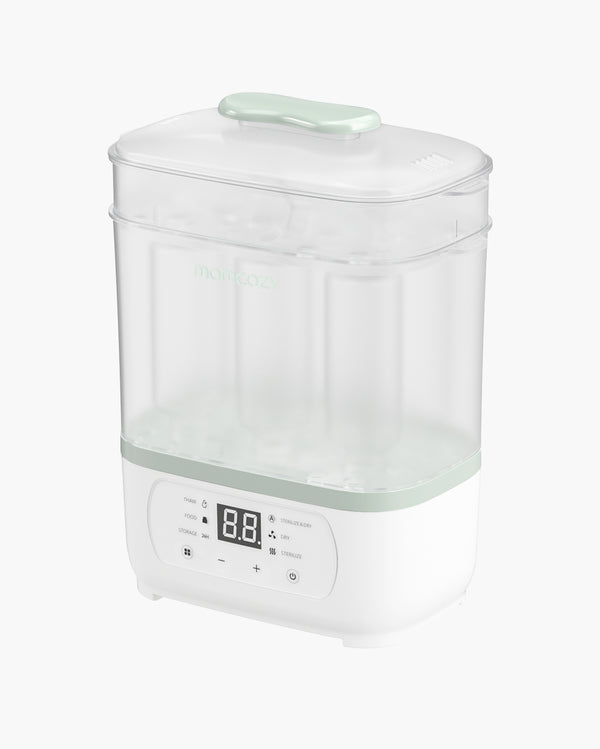
A baby wipe warmer is an electric container that keeps diaper wipes warm between changes. For some babies, a warm wipe may feel less startling than a cool one during a middle-of-the-night change. But warm wipes are not a necessity, a treatment for diaper rash, or a solution for night waking.
The practical question is simpler: will this small comfort feature make frequent overnight changes easy enough to justify another plugged-in item for refilling, cleaning, and maintenance? For many families, regular room-temperature wipes work perfectly well. A calmer, prepared overnight-changing setup is the more useful baseline, either way.
What a Wipe Warmer Does—and What It Cannot Promise
Most wipe warmers hold a stack or pack of compatible wipes and gently warm them while the unit is plugged in. Some designs also offer convenience features such as a nightlight, a one-handed lid, or touch-free dispensing.

Those features can be useful when you are holding a baby at 2 a.m. and trying not to switch on a bright room light. Still, a wipe warmer is best understood as a convenience device—not a sleep tool.
A Wipe Warmer May Help With |
A Wipe Warmer Cannot Guarantee |
|---|---|
Making cool wipes feel less abrupt for a baby who objects to them |
That your baby will stay asleep during a change |
Making wipes easier to reach in a prepared changing station |
Fewer night wakings or less crying overall |
Reducing one small source of discomfort during a necessary stool-diaper change |
Prevention or treatment of diaper rash |
Giving a caregiver a one-handed, low-light option, depending on the model |
That wipes will be ready immediately after loading |
Warm-up performance varies. Some units can take a substantial amount of time to warm a full pack, especially when wipes remain in their original packaging. That means a warmer is not usually something to plug in only when a nighttime change begins; it needs to be part of an ongoing setup.
Do You Really Need One?
Most families can reasonably treat a wipe warmer as optional. Consider it if it solves a repeated, specific problem—not because it appears on a newborn checklist.
A Wipe Warmer May Be Worth Trying If
- Your baby consistently seems upset by cool wipes during nighttime changes.
- You are doing frequent overnight changes and want one less disruptive step.
- You have a stable place near the unit's changing station and access to an outlet.
- You are comfortable following the unit’s loading, cleaning, drying, and replacement instructions.
- A nightlight or one-handed dispensing feature would genuinely simplify your routine.
- You are willing to keep an eye on whether wipes are drying out or dispensing poorly.

It is Reasonable to Skip One If
- Your baby tolerates room-temperature wipes without a noticeable issue.
- You prefer fewer items to plug in, clean, and keep stocked.
- Counter or changing-station space is limited.
- You do not want a device with model-specific maintenance needs.
- You expect to load wipes right before each change; some warmers need time for the wipes to reach their intended temperature.
There can also be a tradeoff between warming speed and moisture retention. Designs differ, and faster warming does not automatically mean better performance for your household. Rather than assuming one style is best, check whether the exact unit fits the wipes you use and whether its refill routine is realistic for you.
If you are unsure, test the simpler option first: use your usual wipes at room temperature for several nights while improving the changing setup. If cool wipes repeatedly seem to be the sticking point, a warmer may be a useful upgrade.
Make the Overnight Diaper Decision First
The warmer matters only when a change is actually needed. Avoiding unnecessary stimulation may be more helpful than warming wipes.
A sleeping baby generally does not need to be awakened for a wet diaper unless it is very wet, while a soiled diaper should be changed. This is general guidance; a baby with active skin irritation, a medical condition, or clinician-specific instructions may need a different routine. See this overnight diaper-changing guidance for the wet-versus-soiled distinction.
A Low-Stimulation Overnight Flow
- Assess before turning the change into a full routine. If you suspect stool or find a very wet diaper, change it. Do not leave a soiled diaper on to avoid waking your baby.
- Use the least disruptive approach that still meets the need. Keep supplies within reach: diapers, wipes, a clean cloth, any diaper cream you already use, and a spare sleep layer if needed. Use low light, brief interaction, and a quiet pace.
- Treat urine-only and stool diapers differently. For a urine-only diaper, wipes may not always be necessary; the skin can be gently patted dry if you do change the diaper. For stool, clean the diaper area thoroughly, including skin folds, then pat dry before applying any cream or ointment.
- Resettle rather than restart the day. Keep conversation, bright light, and extra activity to a minimum. This will not guarantee sleep, but it avoids adding stimulation to a necessary task.
A warm wipe can fit into this routine, but it is not the factor that determines whether a change was necessary or handled gently.
If You Use One, Follow the Manual
A wipe warmer contains warm, moist wipes, so upkeep is not optional. The exact requirements vary by model, including compatible wipe types, refill limits, cleaning methods, replacement parts, and whether water is used.
Do
- Read the instructions for your exact unit before loading it.
- Use only compatible wipes and follow the stated refill method.
- Keep the lid closed when the warmer is not in use to help limit drying and air exposure.
- Unplug the unit before cleaning it or replacing any component.
- Let the unit dry completely between wipe restocks when the manufacturer’s directions call for that approach.
- Replace a sponge, pad, or similar insert according to the manufacturer’s schedule.
- Discard wipes that have an unusual odor, discoloration, or visible contamination.

Do Not Improvise
- Do not add water unless your device instructions specifically require it. Some models use water to help maintain wipe moisture; others do not. Use only the stated amount and method.
- Do not assume every wipe brand, bulk pack, or wipe format will fit or dispense correctly.
- Do not create your own cleaning interval or use cleaning agents that conflict with the manual.
- Do not treat a drying, odor, or dispensing problem as something to ignore. Empty and inspect the unit according to its instructions before reloading.
If that routine feels like a burden, regular wipes in a clean, easy-to-reach container may be the better fit.
Warmth is Not a Skin-Care Treatment
Wipe temperature and wipe formulation are separate issues. Warming a wipe does not treat sensitive skin or diaper rash.
For babies with sensitive skin, alcohol-free and fragrance-free wipes are commonly recommended. Timely changes also matter because prolonged moisture and contact with urine or stool can contribute to diaper rash. Learn more from this diaper-rash care guidance.
Contact a healthcare provider for a newborn with diaper rash, or if a rash worsens or does not improve after two to three days of treatment. Seek prompt medical advice for concerning symptoms such as bleeding, blisters, pus-filled sores, rash spreading beyond the diaper area, fever with rash, severe pain, or a suspected yeast infection.
Choose the Setup That Reduces Friction
Your Situation |
Best-Fit Choice |
|---|---|
Cool wipes repeatedly upset your baby, nighttime changes are frequent, and you can maintain the unit exactly as directed |
Consider a wipe warmer |
Your baby is fine with regular wipes, or space and upkeep are already stretched |
Skip the warmer |
You are unsure whether wipe temperature is the problem |
Improve the overnight station first, then test your baby’s response before buying |
A ready-to-use, dim, quiet changing station is the higher-value investment for nearly every family. If warmed wipes would make that routine easier and you can keep the device maintained correctly, a wipe warmer may earn its place. Otherwise, regular wipes and a well-prepared setup are enough. For more practical support, explore Momcozy’s newborn routine and nursery-setup resources.