


Medically Reviewed By:Krupa Playforth & Brittian Robinson


When your baby is congested, it can feel bigger than "just a stuffy nose." At night, you may hear them breathing noisily through a stuffy nose — they fall asleep for a bit, then wake up again. During feeds, they may pull off after a few sucks just to catch a breath, little face flushed.
Then you reach for the nasal aspirator to help, and the routine somehow gets harder. The tip gets anywhere near their face and they twist away, swat at your hand, and cry. The more you rush, the more they fight. You end up with a stuffy baby, a nose that still sounds full of mucus, and the sinking feeling that you might be doing something wrong.
If you've been there, you're not alone. And in many cases, crying or pulling away does not always mean you are hurting your baby. This guide walks through why babies push back against nasal suction, when suction may actually be needed, and six ways to make the process gentler for both of you.
Quick Answer
Babies fight nasal aspirators for a few common reasons: touching the nose can trigger a protective response, sudden movement or motor sounds can set off the Moro reflex, and long suction sessions can stack small stresses until crying escalates. Crying during suction does not necessarily mean your baby is in pain. Many babies cry because the sensation is unfamiliar or uncomfortable, because touching the nose can trigger protective reflexes, or simply because they dislike being restrained. Not every stuffy nose needs suction, either — save the aspirator for mucus that is clearly disrupting comfort (feeding, sleep, or breathing). Six things may make suction easier: (1) soften mucus with **saline** first, (2) let your baby preview the device before you use it, (3) suction before feeds, not after, (4) keep the tip shallow — for bulb syringes, some pediatric instructions describe about 1/4 to 1/2 inch; for electric or mouth-operated aspirators, follow the product instructions and avoid pushing the tip deep into the nose, (5) gently steady your baby's body to shorten the session, and (6) consider a tool that reduces switching, repeated nose contact, and sudden noise.
Why Is My Baby So Upset When I Suction?
Reason 1: Touching the nose can trigger a built-in defense reflex
To an adult, bringing a small tip up to a nostril may feel like nothing. To a baby, it may be perceived as something interfering with normal breathing, and their body may respond automatically. Because babies are obligate or preferential nasal breathers in early infancy, touching or partially blocking the nose may trigger protective responses and distress.
Stanford Medicine's guide to newborn neurological reflexes describes how gently covering a newborn's eyes and nose — or blocking nasal breathing — can make them arch, squirm, and push the object away. It is a protective reflex [1].
So when your baby twists their head, swats at your hand, or tries to pull away as the aspirator gets close, it is not surprising. A protective reflex is one possible explanation for this response, particularly in younger infants.
Reason 2: The sudden approach or motor sound can trigger the startle reflex
Babies also have the Moro reflex, often called the "startle" reflex. It is especially noticeable in the early months and usually fades by around 6 months. A sudden noise, movement, or shift in position can make a baby fling their arms out, tense up, or cry [2].
Now picture a typical suction session from your baby's point of view: a device moves toward their face, a tip touches their nose, and — if you are using an electric aspirator — a motor suddenly turns on nearby.
Several sudden things happen at once. For a young baby, that can be enough to trigger crying and resistance.
Reason 3: A long session stacks small stimuli into bigger distress
Suctioning is not one action; it is a chain of them. Position the baby. Hold their head still. Drip or spray saline. Wait for it to soften the mucus. Line up the aspirator. Suction. Reposition if it does not work.
Those steps may not be painful, but they can still feel uncomfortable — especially when your baby is already congested and upset. Repeated nose contact, repositioning, waiting, and lining up the aspirator again can quickly make the crying worse.
A randomized controlled study of infants aged 1-12 months with nasal congestion found that while saline plus nasal aspiration helped improve nasal patency, it also led to longer crying time and longer total procedure time compared with saline alone. The researchers also noted that placing the syringe and aspirator at the nostril, and saline entering the nasal cavity, may cause discomfort [3].
In plain terms: As the routine becomes longer and involves repeated handling, many babies become increasingly distressed, making it harder to complete the suction comfortably.
That is why the six strategies below all point in the same direction: less surprise, less repeated contact, less time.

How Do I Make Nasal Suction Easier on My Baby?
Before You Start: Not Every Stuffy Nose Needs Suction
One important thing first: not every stuffy nose calls for the aspirator.
Newborn and young-infant congestion is common and often not a sign anything is wrong. While congestion alone does not always require suction, if your baby is breathing rapidly, working hard to breathe, feeding poorly, or seems unusually sleepy, they should be evaluated by a healthcare professional rather than relying on suction alone.
Some times an aspirator may be useful:
- Thick mucus is clearly blocking the nose, and you can hear noisy nasal breathing.
- Feeding is disrupted — your baby latches, sucks a few times, then pulls off to breathe.
- Sleep is repeatedly broken by congestion, or breathing sounds clearly blocked because of mucus [5].
If any of those describe your night, the tips below may help make suction gentler and faster.
Tips 1: Soften the Mucus First — Don't Suction Dry
The rule of thumb: use saline first, then suction gently and briefly. HealthyChildren.org, from the American Academy of Pediatrics, recommends placing two drops of plain saline in each nostril to loosen congestion before gentle suction [6]. Children's Healthcare of Atlanta gives similar instructions: place two drops of saline in one nostril, wait about one minute, then suction that side before repeating on the other side [7].
If mucus is dry and sticky, going straight to suction usually does not work well. Nothing comes out, so you try again. And again. Each attempt is another chance to irritate a very sensitive nasal lining — and another chance for your baby to get more upset.
One simple strategy is to use saline first. Saline helps loosen and thin the mucus, so suction may be shorter and easier instead of turning into several frustrating tries.

Tips 2: Make the Aspirator Predictable
Short version: introduce the device during calm moments, turn on the motor from farther away first, and use simple distraction or comfort techniques during the routine.
A lot of the crying starts before the aspirator even touches the nose. The motor starts suddenly. A tip appears near their face. Something touches their nostril. Several surprises stack up quickly.
The workaround: give your baby a chance to recognize the aspirator before it goes anywhere near their nose.
- Let them see it during calm moments. Place the aspirator where your baby can look at it when nobody is congested. For older babies, you can let them touch it with supervision.
- Turn on the motor from a short distance away first, so the sound is already part of the environment before you bring the device closer.
- Demo it on yourself. Hold the tip near your own nose so they see you doing it first.
- Distract while you work. Sing, offer a favorite toy, make an exaggerated face, or hand them a comfort object. The Canadian Paediatric Society's guidance on children's medical procedures specifically calls out gentle touch, familiar objects, and playful distraction as ways to help a child cope with a small procedure [8].
You are not tricking your baby. You are removing some of the "sudden" from a situation that would otherwise feel sudden. If your baby becomes very upset, it's okay to pause, comfort them, and try again a few minutes later.
Tips 3: Pick the Right Moment — Before a Feed, Not After
Short version: right before a feed is often a better window. Children's Healthcare of Atlanta and Children's Mercy both recommend clearing the nose before feeding and warn against suctioning immediately after a feed because it may trigger vomiting or spit-up [7][9].
If your baby is already screaming, thrashing, and turning their head in every direction, forcing a suction session is usually going to be harder for both of you. You may not be able to line up the tip cleanly, and the whole thing can take much longer.
A calmer window works much better. Right before a feed is often the best time: a clearer nose may make feeding easier, and the feed itself can become the comfort that follows.
Other possible windows: just after your baby wakes up, after a diaper change, or after a warm bath when their body is already more relaxed.
Tips 4: Keep It Gentle, Shallow, and Short
Short version: rest the tip at the nostril opening or place it only slightly inside the nostril. For bulb syringes, pediatric instructions commonly describe about 1/4 to 1/2 inch — not deep [5][7].
Baby nostrils are tiny, and the biggest mistake is trying to get everything done in one long session. You push a little deeper. You hold the tip in a little longer. You try again from a different angle.
Every one of those "just a little more" moves can add irritation on top of an already unhappy baby.
Insert the tip only as directed by the manufacturer. For bulb syringes, some pediatric instructions describe placing the tip only slightly inside the nostril (approximately ¼ inch) [5][7], while many other aspirators are designed to rest at the nostril opening rather than being inserted deeply. Children's Mercy also advises pointing the nozzle straight back, not up toward the eyes, rather than deep into the nose [9].
Whether you are using a bulb, a mouth-operated aspirator, or an electric one, the same principle applies: seal or rest at the nostril opening, do not push deep into the nose, and keep the session brief.
You also do not have to get everything out. Clearing enough mucus to help your baby breathe, feed, and sleep more comfortably is the goal — not a perfectly empty nose.
Repeated or overly vigorous suction can irritate the nasal lining and make future attempts harder. Use suction only when it is helping your baby feed, sleep, or breathe more comfortably, and follow your healthcare professional's recommendations if your child needs frequent suctioning. Several pediatric instructions advise limiting suction to about 3 times per day unless your child's healthcare professional gives different guidance [7][9].
Never insert the tip into the nostril forcefully.
Tips 5: Steady Their Body So the Session Ends Faster
A lot of the chaos during suction is not caused by the aspirator itself. It happens when a baby suddenly turns their head while the tip is already near the nose.
If your baby is small and squirmy, a quick, gentle assist can shorten the routine:
- For a young infant, gently holding their arms close to their body or having another caregiver provide calm, supportive stabilization may make the process quicker and safer.
The point is not to pin your baby down. It is to prevent sudden head movements that could make the tip poke the nostril, cheek, or eye area — and to get the whole routine over with faster.
The Meg Foundation, which develops comfort strategies for pediatric procedures, describes this as comfort positioning: warm contact, a caregiver's steady presence, and light-to-moderate support that keeps a child safe and stable during medical care [10].

Tips 6: If It Is Always a Fight, the Tool Might Be Part of the Problem
The first five tips are about how you use the aspirator. But if you have tried the right timing, saline first, gentle depth, and a calmer approach — and your baby is still crying hard through every session — it may not be your technique alone.
Sometimes the tool itself can quietly make the whole routine harder.
Different aspirator types can work well for different families, but each format has limits that may matter when a baby already dislikes nasal suction.
- Bulb syringes: Simple and widely used, but they may be harder to manage with thick or sticky mucus. If little comes out, parents often try again and again. Each extra attempt means another round of nose contact.
- Mouth-suction aspirators: These can give parents more control than a bulb syringe, but saline and suction are still two separate steps. After you use saline, you have to pick up a different tool, line it up again, and bring it back toward your baby's face. That gap is often when a baby starts turning away or crying.
- Standard electric aspirators: Powered suction can make the job easier for parents, but some babies are sensitive to the motor sound, especially if it starts suddenly near their face. For younger babies, that sudden sound can add to the startle factor.
Technique can only compensate for so much. If you are stuck in the cycle of spray saline → soothe → switch tools → baby starts crying again → aspirate, a tool that shortens or combines those steps may make the routine easier to manage.
A Tool That Cuts Suction Down to Fewer Steps
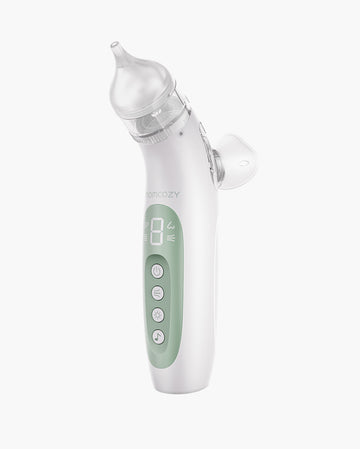
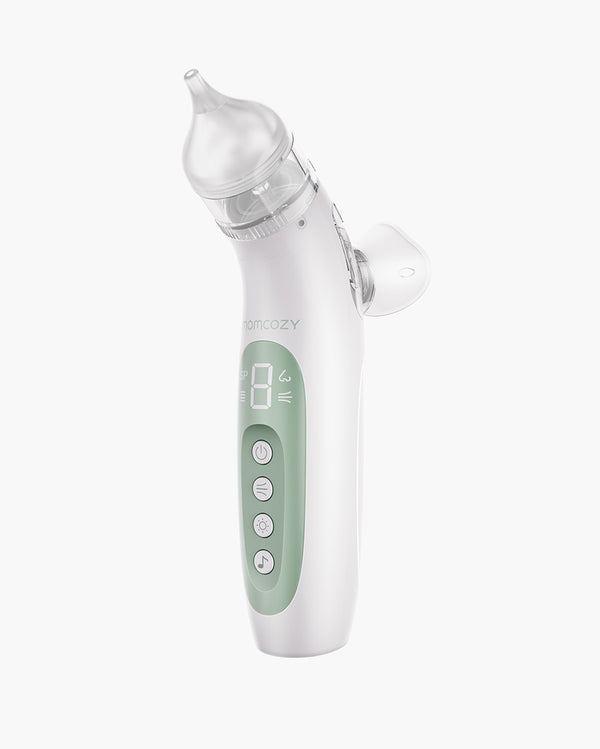
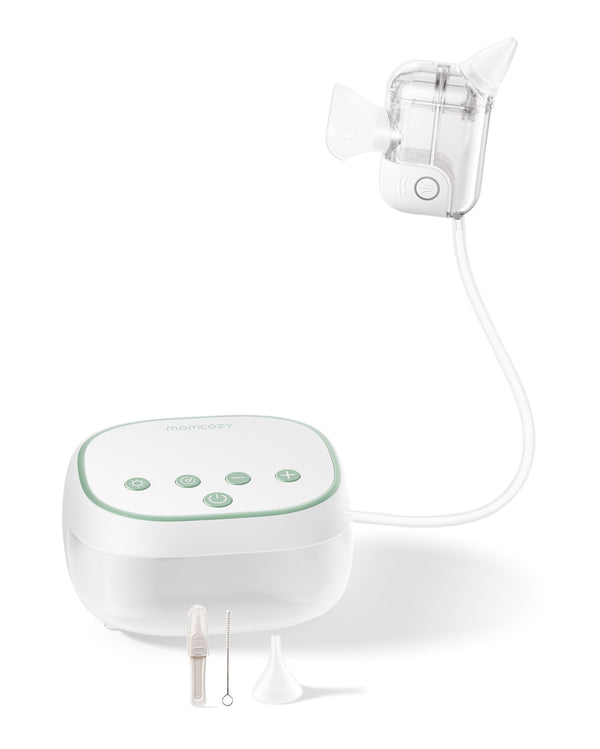
Momcozy BreezyClear™ 2-in-1 Spray & Suction Electric Nasal Aspirator
The biggest difference between BreezyClear™ and a traditional nasal aspirator is that it combines two key steps --- saline misting and mucus suction --- in one device.
Instead of using saline separately, waiting, switching tools, and approaching your baby's face again, BreezyClear™ is designed to mist first and then switch to suction in the same routine. The goal is a shorter, more streamlined process with fewer tool switches and less repeated nose contact.
Member price
€93,99
Every baby is different, so no tool can guarantee a perfectly calm suction session. But if your current routine feels too long or too broken up, a 2-in-1 setup may make nasal care easier to manage.
BreezyClear™ may be a good fit if:
- Your baby often has dry, sticky, or crusted mucus that needs moistening before suction.
- You usually use saline before suction and want those steps in one device.
- You want fewer separate items to manage during nighttime congestion care.
- You prefer an electric aspirator with adjustable suction levels.
- You would rather not use a mouth-operated aspirator.
- You want detachable parts that are simple to clean after use.
Earlier, we focused on three practical goals for nasal suction: make the routine more predictable, reduce repeated nose contact, and keep the process brief. BreezyClear™ combines saline misting and suction in one device, an approach intended to address those goals.
Two functions, one device --- fewer tool switches
Nasal suction is often easier to manage when the routine is brief, predictable, and simple to set up --- especially during nighttime congestion care.
BreezyClear™ is designed to shorten the process: the fine mist helps loosen mucus, one button switches the device to suction mode, and suction helps remove the loosened mucus. You do not need to put one tool down, pick up another, or come back to your baby's face with a second device.
For your baby, that may mean fewer separate moments of nose contact. For you at 3 a.m., it may mean fewer things to find, hold, and clean in the dark.
Soft mask and fine mist --- less inserted-tip contact during misting
For many babies, nose contact is one of the hardest parts of nasal care, and that contact can start before suction begins.
Some saline sprays and droppers use firm tips that need to be placed at or near the nostril. BreezyClear™ approaches the softening step differently: the saline side uses a soft silicone mask that rests against the outside of the nostril instead of requiring a hard tip to go into the nose for misting.
The mist itself is around 10 microns, closer to a fine vapor than larger droplets from a squeeze spray. It is designed to help moisten and loosen dry or sticky mucus before suction. When mucus is better softened first, it may be easier to remove with a shorter suction attempt, which may help reduce the need to keep retrying although this has not been directly studied.
The mist also stops automatically after about 6 seconds, helping keep the softening step brief and controlled.

Adjustable suction --- so you can match the moment
For routine nasal care, the useful feature is not simply the highest suction level --- it is control.
BreezyClear™ offers 4 suction levels, with a max suction level of 65 kPa. Parents can start low for shallow or runny mucus, then increase gradually if thicker mucus has already been softened by mist. This gives you more room to match the setting to the moment instead of relying on a single suction strength.
Quieter design and easier cleaning
Sound and cleanup both affect how manageable suction feels, especially at night.
BreezyClear™ runs at about 43 dB, roughly the background hum of a refrigerator. It is not silent, but some babies may be less bothered by a quieter motor (although individual responses vary). One suggestion is to turn the device on before bringing it close to your baby's face. The soft light and quiet melodies are distraction features, not a guarantee that your baby will stay calm.
After use, BreezyClear™ is designed to come apart with fewer detachable pieces. You can remove the collection cup and tip, rinse them, and set them to dry with fewer steps. It does not remove the need to clean after each use, but it can make aftercare more straightforward.

One More Thing
Baby congestion can look like a small thing from the outside. But any parent who has been through it knows what it actually costs: sleep at night, patience during the day, and that repeated question — am I doing this right?
No one is born knowing how to do this. Feeling unsure is normal. What matters is not doing every suction session perfectly. It is learning what your baby needs, using suction only when it is actually useful, and keeping the process as gentle and brief as you can.
If you are the kind of parent reading a long guide because you want to do a small thing more gently, that already says a lot.
Frequently Asked Questions
How often can I use a nasal aspirator on my baby?
Several pediatric instructions advise limiting suction to about 3 times per day unless your child's healthcare professional gives different guidance [7][9]. Doing it more often may irritate the nasal lining and make babies more resistant to future sessions. If your baby seems to need it constantly for more than a few days, check in with your pediatrician.
When should I not use a nasal aspirator?
You may not need suction when mucus is shallow and easy to wipe away, or when your baby is breathing, feeding, and sleeping normally despite a little congestion [4][7]. Avoid suctioning immediately after feeding because it may trigger spit-up or vomiting [7][9].
Why does my baby cry when I use the nasal aspirator?
Crying is common during nasal suction and does not always mean your baby is in pain. Many babies dislike the sensation or the restraint involved, even when suction is being performed gently. Something touching a baby's nose can trigger a protective response [1], and sudden movement or motor sound can trigger the Moro reflex [2]. Introducing the device during calm times and using saline first may reduce some of that resistance.
What is the difference between a bulb syringe, a mouth-suction aspirator, and an electric aspirator?
Bulb syringes are simple but may require repeated attempts for thicker mucus. Mouth-suction aspirators offer parent-controlled suction but still rely on a separate saline step. Electric aspirators provide powered suction without parent effort, though the motor sound can startle some babies unless the device is designed to run quietly.
When should I call the doctor about my baby's congestion?
Call your pediatrician if your baby is breathing rapidly or with visible effort, has bluish lips or face, is unusually sleepy or hard to rouse, is fussier than normal or difficult to console, is feeding significantly less than usual, is making fewer wet diapers than usual, or if you have any gut feeling that something is not right. Call 911 if your baby is struggling for each breath [6][7][9]. Babies younger than 3 months who show signs of any illness (even without a fever) need to be evaluated promptly, even if congestion seems mild.
A quick note on what a nasal aspirator is (and isn't):
A nasal aspirator can temporarily improve comfort by clearing mucus, but it does not treat the underlying illness. If your baby is breathing rapidly or with visible effort, has bluish lips or face, is unusually sleepy or hard to rouse, is fussier than normal or difficult to console, is feeding significantly less than usual, is making fewer wet diapers than usual, or if you have any gut feeling that something is not right. Any signs of illness under 3 months should be evaluated by a healthcare professional promptly. Always read the manual before use.
Momcozy BreezyClear™ 2-in-1 Electric Nasal Aspirator is made with BPA-free silicone and is designed for the everyday nasal care of babies and children.
Medical Disclaimer: This article is for general informational and educational purposes only and should not be used as a substitute for professional medical advice, diagnosis, or treatment. While tools like a nasal aspirator can temporarily improve your baby's comfort by clearing mucus, they do not treat underlying illnesses. Always consult your pediatrician with any questions or concerns about your baby's health, or before starting new home treatments. You should seek immediate medical evaluation if your baby is breathing rapidly or with visible effort, has bluish lips, is unusually sleepy, is feeding significantly less than usual, or if you simply have a gut feeling that something is wrong. Additionally, any signs of illness in babies under three months old require prompt professional evaluation. Always read the manufacturer's manual carefully before using any medical device on your child.
References
[1] Stanford Medicine. (n.d.). Newborn nursery: Neuro/reflexes. Stanford Medicine. https://med.stanford.edu/newborns/professional-education/photo-gallery/neuro-reflexes.html
[2] Cleveland Clinic. (2025, January 16). Moro reflex. https://my.clevelandclinic.org/health/articles/moro-reflex
[3] Bulbul, F., & Yildiz, S. (2023). Effect of nasal aspirator use on physiologic parameters, crying and procedure duration in nasal congestion in infants: A randomized controlled study. International Journal of Caring Sciences, 16(1), 438-450. https://www.internationaljournalofcaringsciences.org/docs/42.bulbul.pdf
[4] Mayo Clinic. (2019). Caring for your newborn (MC5354). https://mcforms.mayo.edu/mc5300-mc5399/mc5354.pdf
[5] Boston Children's Hospital. (2017). Using a bulb suction aspirator on your baby. https://extapps.childrenshospital.org/EFPEC/Home/Sheet/227
[6] Moon, R. Y. (2025, December 16). My baby has a stuffy nose: How can I help them sleep safely? HealthyChildren.org. American Academy of Pediatrics. https://www.healthychildren.org/English/tips-tools/ask-the-pediatrician/Pages/my-baby-has-a-stuffy-nose-how-can-i-help-them-sleep-safely.aspx
[7] Children's Healthcare of Atlanta. (2023). Bulb suctioning [Patient teaching sheet]. https://www.choa.org/-/media/Files/Childrens/teaching-sheets/bulb-suctioning.pdf
[8] Trottier, E. D., Doré-Bergeron, M.-J., Chauvin-Kimoff, L., Baerg, K., & Ali, S. (2025, March 20). Managing pain and distress in children undergoing brief diagnostic and therapeutic procedures. Canadian Paediatric Society. https://cps.ca/en/documents/position/managing-pain-and-distress
[9] Children's Mercy Kansas City. (2020). How to use a manual nasal aspirator. https://www.childrensmercy.org/siteassets/media-documents-for-depts-section/documents-for-health-care-providers/evidence-based-practice/clinical-practice-guidelines--care-process-models/manual-nasal-aspirator.pdf
[10] Child Life On Call & Meg Foundation for Pain. (2023). Comfort positions: A guide for parents and healthcare professionals. https://www.megfoundationforpain.org/wp-content/uploads/2023/03/MegFoundation_ChildLifeOnCall_Comfort_Positions.pdf








