


MEDICALLY REVIEWED BY

Zola Zhang, MD, IBCLC, Breast Surgeon, Mother
Breast Surgeon | International Board Certified Lactation Consultant | Mother
As a dedicated Breast Surgeon and International Board Certified Lactation Consultant (IBCLC) with 21 years of clinical experience, my work is rooted in both medical expertise and the lived reality of motherhood—because I’m not just a clinician, but also a mother who exclusively breastfed my own child for two years. This dual perspective shapes every interaction, allowing me to blend scientific rigor with deep empathy for the joys and challenges of breastfeeding.
Consistent swing motion can help some babies settle because the rhythm feels predictable, but it works best as a short, supervised soothing tool rather than a sleep solution or a replacement for your touch.
Is your baby calm for three minutes, then suddenly upset again when the swing speed changes or the room gets noisy? That kind of start-stop soothing is common, and many parents notice that a steady, gentle rhythm helps their baby stay calmer long enough to feed, burp, or ease into a nap routine. Here’s how swing consistency can support self-soothing cues, where its limits are, and how to use it safely without creating a motion habit that does all the work for your baby.
Why Consistent Motion Feels Calming to Many Babies
Babies often respond better to motion that is slow, steady, and predictable. A swing that speeds up, slows down, or changes rhythm too often can feel more stimulating than soothing, especially for a young baby who is already tired or fussy.

Gentle, consistent rocking can mimic familiar womb-like movement and may help reduce fussiness while a baby drifts toward calm gentle, consistent rocking. That does not mean the swing is “teaching” self-soothing all by itself. It means the motion may lower the intensity of the moment so your baby has a better chance to find their own calm cues, like relaxing their hands, turning their head, sucking, or settling their breathing.
What “consistent” really means
Consistent swing motion is about rhythm, not intensity. For most babies, that means a low setting, smooth back-and-forth movement, and no sudden changes unless your baby is clearly asking for something different.
A helpful real-life test is simple: if the motion makes you feel like you need to watch it closely, it is probably too much. You want the swing to feel boring in the best way, like a steady rocking chair, not like entertainment.
Does Swing Motion Build Self-Soothing or Just Pause the Crying?
A swing can support self-soothing, but it usually does not create the skill on its own. Self-soothing grows through repeated experiences where your baby feels safe, regulated, and gradually able to settle with less help over time.
The consistent motion may act like a bridge. If your baby goes from crying hard to softly fussing, then starts sucking their hand or looking away from stimulation, that is useful information. You are not ignoring them; you are giving them a calmer setting while still staying nearby and responsive.

Watch for your baby’s cues
A baby who is benefiting from the swing may soften their body, unclench their fists, blink more slowly, or become quietly alert. Those are good signs that the motion is helping them organize their senses.
A baby who arches, stiffens, cries harder, hiccups repeatedly, looks startled, or seems “wired” may be overstimulated. In that case, stop the swing, pick them up, check the basics, and try a quieter reset: feeding, burping, a diaper change, skin-to-skin, or a dark room with gentle holding.
The Safest Swing Settings for Calming
For soothing, gentle motion usually matters more than a fancy pattern. A slow back-and-forth rhythm gives your baby predictability, while high speeds or dramatic angles can make it harder for them to settle.
Baby swing use is generally best kept to short supervised sessions, often around 20 to 30 minutes, because swings are meant to be a temporary soothing tool rather than a long stretch of container time 20 to 30 minutes. That window is usually enough time to calm a fussy spell, give your arms a break, or help you finish pumping, preparing a bottle, or grabbing a quick snack while your baby stays within sight.

A simple calming setup
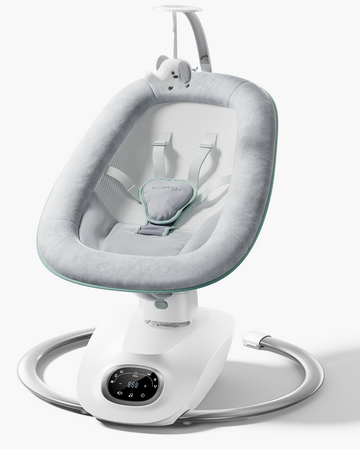
Start with the most reclined safe position if your baby is very young, especially under 4 months. A swing with adjustable speeds, such as the Momcozy baby swing, can be set to a gentle, consistent rhythm while your baby is awake and supervised.
Keep the swing on a flat floor, away from blankets, loose toys, cords, furniture edges, and anything your baby could grab. Choose the lowest motion setting first, then give it a few minutes before deciding whether your baby needs more support. Many babies do better with less motion than parents expect.
When Age and Development Matter
A newborn’s needs are different from a baby who can sit, roll, or push up strongly. Motion that feels soothing for one stage can become unsafe or unhelpful at another stage.
For outdoor playground swings, swinging is suggested when a baby can sit up and hold their head up independently, and gentle back-and-forth movement can support motor and sensory development sit up and hold. That is a different situation from an infant swing used at home, but the principle is the same: your baby’s head control, posture, and stage of movement matter.
Signs the swing phase may be ending
Once your baby can roll, sit up unassisted, lean forward strongly, or try to climb out, a baby swing may no longer be safe even if your baby is still under the listed weight limit. Many swings are designed for babies up to about 25 to 30 lb, but a company’s limit and your baby’s behavior both matter.
A practical rule I like: if you are starting to think, “They look too active in there,” trust that thought. At that point, floor play, tummy time, a play mat, or being held usually fits your baby’s development better than more swing time.
Why Too Much Motion Can Backfire
Motion is powerful because it works quickly for some babies. That is also why it can become the only thing a baby expects when they are tired, especially if every nap begins and ends in the swing.
If your baby only settles with movement, try slowly adding other calming cues alongside the swing. Use the same short song, dim the lights, offer a pacifier if you use one, or place a hand gently on their belly while they are awake and supervised. Over time, those other cues can become familiar too.
Avoid turning the swing into the sleep place
If your baby falls asleep in a swing, move them to a crib or bassinet because swings are not designed as safe sleep surfaces falls asleep in a swing. This can feel frustrating when you finally got a tired baby calm, but it protects the boundary between “the swing helps us settle” and “the swing is where sleep happens.”

A steady routine helps here. You might use the swing for 10 to 15 minutes while your baby is fussy, then transfer to feeding, burping, a diaper check, and the crib or bassinet when they are drowsy but still supervised and safe. It does not have to be perfect every time; consistency comes from the overall pattern.
How to Use Motion Without Overdoing It
The goal is not to avoid swings completely. The goal is to use motion as one tool in a bigger soothing routine that includes holding, feeding support, tummy time, floor play, and calm interaction.
A good rhythm for many families is: check hunger, diaper, gas, temperature, and tiredness first; then try a short swing session if your baby still seems unsettled. This keeps the swing from masking a need your baby is trying to communicate.
Keep the motion gentle
More speed is not always more soothing. In fact, strong movement can become risky, especially as babies and young children grow and use larger swings. Young children can be pushed high enough to risk neck strain or more serious injury, partly because their heads are proportionally large and their neck and shoulder muscles are still developing risk neck strain.
For baby care at home, this points back to the same practical habit: gentle, steady, supervised motion. If you are using a baby swing, choose the calmest setting that works. If you are at a park with an older baby who can sit well, keep the swing low and slow, make sure they are secure, and stop while they are still enjoying it.
Practical Next Steps
Use consistent swing motion as a calming support, not as the whole soothing plan. Start low and slow, secure the harness, stay nearby, and keep sessions short. If your baby calms, watch for their own settling cues instead of automatically increasing speed or time.
If the swing becomes the only way your baby can settle, gently widen the routine. Add your voice, touch, dim lighting, a feeding or burping rhythm, and safe crib or bassinet transfers when sleep is coming. The long-term win is not a baby who needs perfect motion every time; it is a baby who learns, little by little, that calm can come from several familiar, safe cues.








