


MEDICALLY REVIEWED BY

Zola Zhang, MD, IBCLC, Breast Surgeon, Mother
Breast Surgeon | International Board Certified Lactation Consultant | Mother
As a dedicated Breast Surgeon and International Board Certified Lactation Consultant (IBCLC) with 21 years of clinical experience, my work is rooted in both medical expertise and the lived reality of motherhood—because I’m not just a clinician, but also a mother who exclusively breastfed my own child for two years. This dual perspective shapes every interaction, allowing me to blend scientific rigor with deep empathy for the joys and challenges of breastfeeding.
For premature babies, the safest swing choice is usually the gentlest, slowest motion in the most reclined position, not a specific fancy motion pattern. Simple front-to-back or side-to-side motion is usually easier to tolerate than bouncing, figure-8, or strong multi-directional movement.
When your baby came early, even a regular newborn product can feel like a bigger decision than expected. The practical safety checks matter more than the motion label: recline, head position, harness fit, supervision, and short sessions are what make the biggest difference. Here’s how to choose and use a baby swing in a way that feels calm, careful, and realistic for life with a tiny baby.
The Short Answer: Gentle and Simple Is Best
There is no official safety standard that says one swing motion type is safest for premature babies. The current infant swing rules focus on things like seat angle, stability, restraint systems, labeling, and structural safety, and safety guidance covers swings that move or glide in different directions rather than naming one best motion.
So if you are choosing between motion types, think “least stimulating” first. A slow, steady front-to-back or side-to-side sway is usually the most sensible place to start for a preemie, especially if your baby is still small, easily startled, or working on head and neck control.
The motions I would be most cautious with are strong bouncing, fast rocking, figure-8 motion, or dramatic 3D movement. Those may be fine for some older babies, but for a premature newborn, they can be too much too soon.
Why Premature Babies Need Extra Care in a Swing
Premature babies often need more support with the basics: keeping their head in a safe position, staying organized with movement, and handling stimulation without getting overwhelmed. That does not mean a swing is always off-limits, but it does mean you want to be more careful than you might be with a full-term older infant.

One safety concern is the head falling forward or sideways. For young babies without good head control, swing safety rules emphasize recline; federal warning requirements say to use the most reclined position until a baby is at least 4 months old and can hold up their head without help, and the infant swing standard also notes extra restraint requirements for steeper seat angles.
That matters even more for a premature baby because “4 months old” may not tell the whole story. If your baby was born 8 weeks early, their head and trunk control may look more like a younger baby’s for a while, so it is worth asking your pediatrician or NICU follow-up team what they recommend based on your baby’s corrected age, weight, muscle tone, and breathing history.
Watch the Chin-to-Chest Position
The position you are trying to avoid is the chin slumping down toward the chest. That curled-forward posture can make breathing harder for little babies, especially when they are very young or sleepy.
A safety agency reviewed infant swing incident reports from January 1, 2002 to May 18, 2011, including 15 deaths, and several were described as slump-over deaths with positional asphyxia listed in four cases in the public safety record. That is why recline and supervision are not small details.

A helpful real-life check: after you buckle your baby in, look from the side. You should be able to see that their chin is not tucked tightly to their chest, their face is visible, and their head is not flopping forward or pressed into padding.
Front-to-Back vs. Side-to-Side: Which Is Safer?
For a premature baby, front-to-back and side-to-side motions can both be reasonable if they are slow, smooth, and paired with a reclined seat. The evidence notes do not show that one of these two basic motions is clearly safer than the other for preemies.
What usually matters more is how your baby responds. Some babies settle with a front-to-back cradle-like motion, while others relax with a side-to-side sway that feels more like being rocked in someone’s arms.
If your swing offers both, start with the lowest speed and one simple motion. General baby swing guidance recommends beginning at the lowest setting because newborns often need only gentle stimulation, and safe swing setup advice suggests waiting a couple of minutes before increasing speed if the baby is still fussy.
How to Tell the Motion Is Too Much
A swing should make your baby look more settled, not more stressed. If your preemie stiffens, splays their fingers, hiccups repeatedly, turns red, looks panicked, spits up more, or seems unable to settle after a minute or two, the motion may be too stimulating.
I would stop the swing, pick your baby up, and try a simpler soothing routine: upright holding against your chest, a pacifier if your care team has okayed it, soft shushing, or a feeding check if it is close to time. Sometimes a preemie does not need “more motion”; they need less input.
For babies who are very sensitive, even the lowest swing setting can be too much on some days. That is normal, and it does not mean you chose the wrong product.
Recline and Fit Matter More Than the Motion Pattern
If you remember only one safety rule, make it this: a premature baby needs secure support and an open airway before motion matters. The swing should hold your baby’s body in a stable, reclined position without letting them curl into a ball.

For newborns, baby swing safety guidance often prioritizes recline and support over any single motion type, and newborn swing safety advice specifically points to the most reclined position to reduce the chance of the head falling forward. That is especially important for babies under 4 months who cannot hold their heads up on their own.
Use the harness every time, even for a 5-minute break while you fold laundry or pump. A five-point harness is generally the most secure because it helps keep the shoulders, hips, and lower body positioned instead of letting a tiny baby slide down into a slumped posture.
A Quick Fit Check Before Every Session
Before turning the swing on, take 30 seconds to check the fit:
- The harness is snug enough that your baby cannot slide downward.
- The shoulder straps sit correctly and do not press into the neck.
- Your baby’s chin is off the chest.
- The head is supported without being pushed forward by thick padding.
- The swing is on the floor, never on a bed, couch, counter, or table.
- The motion is on the lowest speed.
- You can see your baby’s face the whole time.
Avoid adding extra pillows, rolled blankets, nursing pillows, or aftermarket inserts unless your baby’s clinician specifically tells you to and the swing manufacturer allows it. Extra padding can change the angle and fit in ways that look cozy but are not necessarily safer.
Best Swing Settings for a Premature Infant
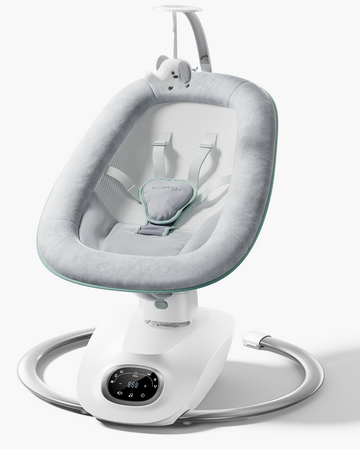
For most premature babies who have been cleared to use a swing, the safest starting setup is boring in the best way: lowest speed, most reclined seat, simple motion, and your eyes nearby. A basic adjustable swing like the Momcozy 2-in-1 Electric Baby Swing is the kind of setup I mean, as long as you keep it on the lowest speed, use the most reclined setting, buckle the harness, and stay nearby while your baby is awake.
Many baby swings are intended from birth, but that still depends on the product’s minimum weight requirement and your baby’s health. Some preemies come home under the weight listed in a swing manual, so check the label carefully before using it.
The safety guidance describes infant swings as products for babies from birth until they can sit unassisted, while cradle swings are designed for babies lying flat and have their own requirements under infant and cradle swing rules. If your baby is very small or has limited head control, a flatter cradle-style position may sound appealing, but you still need to follow the exact product instructions and your care team’s advice.
A Practical First Try
Try the swing after a diaper change and a feeding burp, when your baby is awake but not overtired. Place them in the most reclined setting, buckle the harness, start with the lowest speed, and stay close.
Give it about 2 minutes. If your baby softens their body, looks calm, and stays well positioned, you can continue for a short session. If they fuss harder, slump, or look overstimulated, stop and switch to holding.
For a tiny baby, I would treat the swing as a 10- to 15-minute tool at first, even though many general sources say sessions should stay under 20 to 30 minutes. You can always build up carefully, but you do not need to use the full time just because the swing can run that long.
When a Premature Baby Should Avoid the Swing
Some babies should skip the swing unless their pediatrician or NICU team says it is okay. This is especially true if your baby has had breathing pauses, oxygen needs, reflux that worsens with positioning, poor weight gain, low muscle tone, feeding fatigue, or trouble keeping their head midline.

A swing is also not a safe sleep space. If your baby falls asleep in the swing, move them to a firm, flat crib or bassinet as soon as you can, because safe swing use treats swings as short-term soothing tools rather than crib substitutes.
This can feel frustrating when your baby finally drifts off after a hard morning. But swings hold babies at an angle, and that angled position is exactly why sleep in a swing needs extra caution, especially for a preemie.
Stop Using the Swing as Your Baby Gets Stronger
Swing use is not forever. Stop using it when your baby reaches the manufacturer’s weight limit, starts rolling in ways that change their position, attempts to sit up, pushes up, or tries to climb out.
Many infant swings list limits around 25 to 30 lb, but behavior matters as much as weight. A smaller baby who is trying to escape the harness or twist sideways may be done with the swing before they hit the weight limit.
For a baby born early, check milestones based on both actual development and corrected age. The safest guide is what your baby can do in the seat today, not only what the age range on the box says.
How to Choose a Swing for a Preemie-Friendly Setup
If you are buying or borrowing a swing for a premature baby, choose one that gives you control. You want a stable base, a clear recline range, low-speed settings, a secure harness, and easy visibility so you can watch your baby’s face and body position.
The safest-feeling features are usually practical ones: a seat that reclines well, a five-point harness, several gentle speed options, and a motion setting that can stay simple. A swing that does 10 different patterns is not automatically better for a preemie.
If you already have a swing, read the manual before using it. Check the minimum weight, maximum weight, recline instructions, harness routing, and whether the model is meant for seated swing use, cradle swing use, or both.
Keep the Setup Plain
Place the swing on a flat floor where it cannot be bumped by pets, siblings, or a busy hallway path. Do not place it on a counter while you prep bottles, on the bed while you sort baby clothes, or on the couch while you pump.
Keep blankets, burp cloths, pacifier clips, toys, and loose straps away from your baby’s face. If your baby needs warmth, dress them in a sleep-and-play or wearable layer instead of tucking a blanket around them in the swing.
Also, stay close enough to respond right away. “Supervised” means you can see your baby’s face, hear their breathing and fussing, and notice if their body position changes.
Practical Next Steps
The safest swing motion for a premature baby is gentle, slow, and simple. Choose front-to-back or side-to-side over intense bouncing or complex multi-directional motion, and start with the lowest speed every time.
Before each session, check the basics: your baby meets the product’s minimum weight, the seat is in the most reclined safe position, the harness is snug, the chin is not tucked, and you are staying nearby. Keep sessions short, around 10 to 15 minutes at first, and avoid going past 20 to 30 minutes.
Most importantly, treat the swing as a brief soothing tool, not a sleep spot or a way to stretch your baby’s limits. If your preemie looks slumped, overstimulated, sleepy, or uncomfortable, the safest choice is to stop the motion and hold them close.








