


MEDICALLY REVIEWED BY

Mary Bicknell, MSN, BSN, RNC, ANLC
Mary Bicknell comes with over 30 years of experience as an RN in the NICU. Educating mothers on the importance of healthy breastfeeding is important to her. It can be challenging to maintain successful breastfeeding through many difficult situations and long hospitalizations. Mary is committed to helping families define what successful breastfeeding means to them; and to assist them to obtain their goal. After leaving the bedside, Mary became a nurse leader and continued to make sure that breastfeeding education and support was always available to the families in her unit.
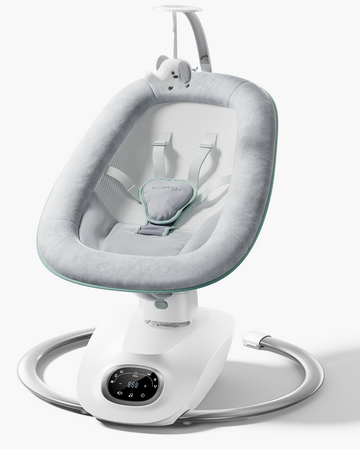
Start with the swing’s sewn-in care label and model manual. They determine whether the seat cover can be removed, machine-washed, spot-cleaned, or dried in a dryer. Remove loose hair while the fabric is dry, and clean only by the method approved in the manual.
Removing visible fur is useful, but it does not guarantee that all pet allergens are gone. Allergens can come from pet dander, saliva, and urine—not hair alone. Learn more about indoor pet allergens.
Check the Manual Before Removing the Cover
A cover that looks detachable is not necessarily intended to be removed for laundering. Before unfastening anything:
- Find the model number and the swing’s current instruction manual.
- Read the sewn-in care label on the cover.
- Confirm whether the cover is removable and which washing, drying, or spot-cleaning instructions apply.
- Identify the difference between the fabric cover and the restraint system: straps, harness webbing, buckles, padding, and attachment points may have separate care requirements.
- Take clear photos of the cover tabs, harness-slot routing, padding placement, and fasteners before removal.

Photos can help you remember the order of disassembly, but they do not replace the manufacturer’s reassembly instructions. If you cannot tell how a part comes off or goes back on, leave it in place and contact the manufacturer rather than forcing it.
Do not assume that harness webbing, buckles, foam, electronics, or moving swing components can be removed, sprayed, soaked, or machine-washed just because the fabric cover can be cleaned.
Lift Off Dry Hair First
Dry removal is the lowest-risk starting point because it reduces the amount of hair that reaches the washer or becomes embedded in damp fabric.
Work methodically from the broad seat panels toward creases, seams, and the fabric edges around harness openings.
- Use a lint roller or low-tack masking tape on the cover where the care instructions do not prohibit it. Press and lift rather than rubbing aggressively.
- Use a lint brush or static-charged cloth only if it seems compatible with the cover fabric and does not catch on stitching or padded areas.
- Vacuum a non-removable cover only if the manual permits it. Keep the tool focused on the cover fabric rather than the harness, buckle mechanism, foam, or moving parts.
- Treat seams and harness slots gently. Lift hair from the fabric around the opening; do not pull, scrape, or probe inside a buckle or along restraint webbing.

Lint rollers and masking tape are commonly used to remove pet hair before laundering, and removing hair first can reduce the amount that enters the washing machine. Pet hair can clump when wet, stick to fabrics and the washer drum, and potentially affect the machine’s drain system. Consumer Reports’ pet-hair laundry guidance supports removing as much loose hair as possible before washing.
Avoid wetting the cover simply to make fur easier to collect. Also avoid aggressive tools or repeated scraping that could roughen fabric, loosen stitching, or distort padding.
Choose the Cleaning Path the Label Allows
The correct method depends on whether the cover is removable and whether the manual permits machine washing.
If your cover is… |
Use this approach |
Removable and approved for machine washing |
Remove dry hair first. Wash the cover according to its label and manual, including the permitted cycle, water temperature, detergent, and drying method. |
Non-removable or not approved for machine washing |
Remove dry hair, then use only the manual-approved spot-cleaning method. Do not saturate the cover, padding, or areas around the restraint system unless the instructions explicitly allow it. |
Missing a label or manual |
Do not guess. Use dry hair removal only where it does not conflict with the product’s condition, then contact the manufacturer for care instructions. |
If the manufacturer permits machine washing, follow its detergent directions. Do not substitute a universal “gentle,” “cold,” or “extra-rinse” routine when the cover’s label says otherwise.
Be cautious with added products. Fragrances, optical brighteners, and fabric softeners may be potential irritants for some babies, especially those with sensitive skin or eczema. The safest choice is to follow the cover’s label and avoid adding products the manufacturer does not approve.
After a hair-heavy load, clean the washer according to the washer manufacturer’s instructions. Hair may remain on the drum, door, gasket, or filter area.
Keep Restraint and Swing Parts Separate From Cover Care
A clean fabric cover does not mean every part of the swing should be cleaned the same way.
Fabric cover
Follow the care label and manual. This is the component most likely to be removable or washable, but only when the model’s instructions say so.
Harness, straps, buckles, and webbing
Treat these as safety components and follow the swing manufacturer’s instructions for cleaning. Do not use any method unless the manual expressly permits it.

Remove visible hair from the surrounding fabric without pulling at the webbing or inserting tools into buckle openings. If hair is trapped inside a buckle or you are unsure how to clean it, consult the model manual or contact the manufacturer.
Foam and padding
Do not assume foam can be saturated, washed, or dried with heat. Follow the manual’s directions for the specific padding in your swing.
Plastic and metal parts
For plastic or metal parts that the manufacturer permits you to clean, a cloth with mild soap, followed by thorough rinsing and towel drying, is a common approach. This does not apply automatically to electronics, controls, motors, mechanisms, straps, buckles, or foam.
Dry Completely, Then Refit the Cover
Drying is part of the safety check, not an afterthought. Reinstall the cover only when it is fully dry by the method specified on its label.
A dryer is not automatically safe—even on a no-heat setting. If the label explicitly permits dryer use, a no-heat air-fluff cycle may be an option for loosening pet hair before washing. Clean the lint filter afterward. If dryer use is not allowed, use only the approved drying method.
When refitting the cover:
- Match each tab, fastener, and attachment point to the manual.
- Route the harness through the correct cover openings.
- Make sure the cover lies flat and fits securely, without bunching around the baby’s seating area or restraint points.
- Check that padding is in its intended position.
- Test that buckles latch and release properly.
- Look for tears, fraying, loose stitching, distorted foam, missing fasteners, damaged webbing, or a cover that no longer fits correctly.

Do not use the swing if you cannot reinstall the cover confidently, the harness is twisted or incorrectly routed, a buckle does not work properly, or any safety-related component appears damaged. Cleaning cannot correct a damaged part; the swing manufacturer should guide the next step.
Ready for Baby Checklist
Before placing your baby in the swing, confirm that:
- The manual and sewn-in care label were checked.
- Loose pet hair has been removed from the cover and surrounding fabric areas.
- The approved washing or spot-cleaning method was used.
- No cleaning-product residue or moisture remains.
- The cover is fully dry and fitted securely.
- The harness is routed correctly and is not twisted.
- Buckles function properly.
- No cover fasteners, padding, straps, attachment points, or other parts are damaged or missing.
If any point is uncertain, the next step is not another cleaning product. Follow the swing maker’s instructions or contact the manufacturer before your baby uses the swing.








