Choosing a baby carrier for dad isn’t really about finding a “men’s” carrier. It’s about carrying a newborn with confidence, without retying fabric or second-guessing every adjustment. So the first question isn’t style or which carrier is “best.” It’s whether the carrier is approved for your baby right now, and whether you can repeat a high, close, face-visible fit on your own.
This guide walks through what to check before that first carry, including newborn eligibility, a setup you can repeat, and when to stop and reset. Once you know what to verify, you can look at our newborn carriers with a clear checklist in hand.
Key Takeaways
- A dad can carry a newborn confidently when the specific carrier is approved for the baby now and the fit stays high, close, supported, and face-visible.
- Choose a setup you can reproduce correctly; “for dads” styling, tactical details, or a buckle system do not by themselves prove newborn suitability.
- Newborn head support comes from a stable overall position and correct fit, not from rigidly pinning the baby’s head in place.
- Hands-free carrying can help during light daily tasks, but a newborn still needs frequent visual, breathing, and position checks throughout the carry.
- When caregivers share one carrier, reset the adult settings and repeat the baby fit check every time the carrier changes wearers.
- Stop and readjust if the baby sinks, slumps, becomes hard to see, moves chin-to-chest, or if the carrier feels unstable or painful for the wearer.
Before the First Carry: Is Your Newborn Carrier Ready?

“Newborn carrier” is a marketing label, not proof. Before your baby goes in, make sure this specific model’s current instructions cover a baby of your baby’s size right now. The product name, the photos, and another dad’s good experience can’t tell you that.
What “Newborn-Ready” Should Mean in Practice
Start with the current manual or product page, and look for:
- Minimum weight and size requirements for this model
- The approved newborn setup, whether that’s built-in adjustment, a model-specific insert, or another approved method
- Approved positions and accessories, used only the way the manual allows
- Every closure: you should know how to secure each buckle, tie, and adjustment before your baby goes in. If something in the instructions isn’t clear, reach out to the manufacturer or a qualified babywearing educator first.
Why a Minimum Weight Number is Not the Whole Answer
A carrier can meet a number on paper and still not suit a particular newborn. Check that the panel and seat fit your baby without pushing the legs wider than the instructions allow, and without letting the body slump. If the fit isn’t right, it’s fine to wait or choose a setup that is.
If your baby was born prematurely, has a low birth weight, has a medical condition, or is a NICU graduate, talk with a healthcare professional before babywearing. That’s a decision a general article can’t make for you.
Choose a Setup You Can Repeat Without Help
The best first setup is the one you can get right every time without another adult retying or re-threading it for you. If you’re spending more energy fiddling than feeling confident, take that as useful information.
Repeatability Matters More than “For Dads” Branding
Neither format is better for everyone, but they do feel different when it comes to repeating the setup:
- Buckle or structured-style setups often feel easier to recreate, because the steps and settings are clear.
- Wraps and fabric-tension systems can fit many bodies very well once you’ve learned them, though they usually take more practice to tie the same way each time.
- Every format takes some learning and a fit check.
Look for closures you can reach, clear adjustment instructions or markers, and a short list of steps. And follow the manufacturer’s instructions for the approved newborn setup.
When a Simpler Setup can Reduce Decision Friction
Take your time on the first try, and ask your partner to check your work or use a mirror. Then repeat the same sequence until you land on the same fit each time. It helps to keep the instructions nearby for your first few attempts. If you’re still weighing formats, our baby carrier types comparison goes into more depth.

Set the Carrier for the Dad Before the Baby Goes In
Set the carrier to your body first, then bring your baby in. That way you’re not making big strap or waistband changes while you’re supporting a newborn with one arm.
A 30-second “Reset Before Loading” Routine
- Position the waistband or body section and secure it according to the product instructions.
- Loosen or pre-set the shoulder straps enough to load your baby without fighting the carrier.
- Check your buckle reach. You should be able to fasten and release every required closure without twisting in a way that feels unsafe.
- Confirm the settings are yours, not left over from the last person who wore it.
- Then load your baby, following the approved newborn setup.
Why Shared Carriers Need Wearer-specific Settings
One carrier can work for different adults, but the settings don’t carry over. Even if the fit was right yesterday, it was right for a different body. That’s especially true if you’re taller or broader than the last wearer.
If you have a very long torso or broad shoulders, check the carrier’s adjustment range, and see our guide to baby carrier fit for dads for the bigger picture.
The First-Carry Fit Check: Face, Airway and Support
Before moving around, pause for a deliberate fit check. This is an important part of first-time dad babywearing because a carrier can feel secure to the wearer while the baby’s position still needs adjusting.
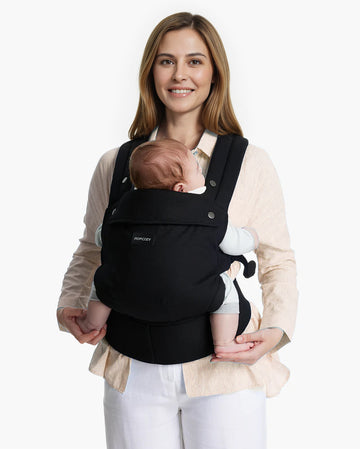
- Check the face. You should be able to see the baby's face without having to open the carrier or get into an awkward position with your body. The face (nose and mouth) should be fully visible with the fabric, your clothing and the baby's position all allowing for that.
- Check the airway. Make sure the baby's chin isn't being pressed down towards the chest. The head and neck should be supported in accordance with the carrier instructions (without of course rigidly fixing the head in place). Newborns require a great deal of attention in this respect as they have very limited head and neck control.
- Check the height and closeness. Your baby should sit high and close enough for you to monitor them easily. If they are positioned too low, slumped, or moving away from your chest, stop and readjust.
- Check the body support. Make sure the carrier is being used in its approved newborn configuration and is supporting your baby as directed. Look for any twisting of the fabric, loose straps, unsecured buckles or an uneven fit.
- Check your own comfort. The carrier should be comfortable without causing any significant pain and you shouldn't have to lean back or forward to achieve a comfortable position. Discomfort will make it much harder to maintain a good position.
Repeat the check after tightening straps, changing your posture or noticing any movement. If you cannot achieve a secure, visible and supported position, take your baby out rather than attempting to correct a poor fit while continuing the carry.
What Hands-Free Babywearing Means for New Dads
A properly fitted carrier can free both hands for light daily tasks, but with a newborn it’s never “set it and forget it.” You’re still watching your baby the whole time.
That’s worth knowing going in, especially if you’re covering a shift while the other parent rests and you’re hoping to get a few things done.
Hands-free vs. Hands-off
The carrier gives you your hands back. It doesn’t give you a break from paying attention. Think of it as a way to do small, easy things, like tidying a counter or folding a few clothes, while your baby stays close and in view. Anything that makes it harder to see your baby’s face, or that you’d have to rush through, isn’t worth it.
Keep checking as you go. Glance down at your baby’s face and breathing every so often, and look again after you walk, bend, or feel the straps settle. If your baby shifts or the carrier moves, put a hand under them for support. You’ll quickly get a feel for when that’s needed.
Why Newborn Fit can Shift After Movement
Fabric and straps settle as you move, and a newborn’s position can change with them. If your baby has slumped, the carrier has shifted, or you’ve become distracted, stop and readjust before carrying on. For your first time, start with a short, slow carry indoors, then reassess.
Do a Movement Test Before a Longer Carry
A fit that looks fine while you’re standing still should be checked again after a few minutes of gentle walking, because straps and fabric can settle once you start moving.
The 2 to 5 Minute Test
- Walk slowly for 2 to 5 minutes in a controlled setting, such as inside your home. Skip sudden movements and bouncing.
- Stop and look down. Is your baby’s face still visible? Still high and close? Still well supported?
- Notice how the carrier feels. Is it pulling away from your body, slipping lower, or putting pressure on you that makes you compensate with your posture?
- If anything has shifted in a meaningful way, stop and reset. Don’t tighten things at random while you’re walking.
- Extend the carry only once the fit stays stable through the short test.
Why a Stationary Fit Is Only the First Checkpoint
Some settling is normal. But persistent slipping, slumping, or strain means the setup needs correcting, not that you should push through it.
How to Reset a Shared Carrier Between Caregivers

Treat every handoff as a new fitting: reset the carrier for the person wearing it, load the baby again, and repeat the newborn fit check. It’s easy to assume the previous caregiver’s settings can stay put, but even if the fit was right a minute ago, it was right for a different body.
The Handoff Reset Checklist
- Reset the waistband or body section for the current wearer, following the manufacturer’s instructions.
- Readjust the shoulder straps and closures rather than making do with the other person’s fit.
- Confirm every fastener is secure.
- Recheck your baby once the carrier is on you: high and close, face visible, airway clear, body well supported.
- If the product allows it, use simple visual markers, or build a quick household routine so each person can find their own settings fast.
Why the Same Carrier Can Fit Differently on Different Bodies
Height, torso length, and body shape all change how a carrier sits, and the same baby can ride higher or lower, snugger or looser, depending on who’s wearing it. A short “reset, load, check” habit is more dependable than trusting that it looked right last time. For more on adult fit, see our guide to baby carrier fit for dads.
Stop and Readjust If You See These Signs
Stop the carry and reset if your baby sinks lower, their face becomes hard to see, their chin drops toward their chest, their body slumps, the carrier loosens, or you can’t keep a stable, comfortable posture. If you’re asking yourself whether a “slightly off” fit is good enough, stop and check. Don’t try to fix it while you’re still walking or doing something else.
Stop Triggers for the Baby
- Your baby drops lower after a few minutes.
- Their face turns into the fabric or becomes hard to see, or fabric covers their nose or mouth.
- Their chin is pressed toward their chest, or they slump noticeably.
- The carrier pulls away from you, or feels looser, twisted, or unstable as you go.
- Your baby looks poorly supported, or the carrier isn’t fitting as the instructions describe.
Stop Triggers for the Caregiver
- You feel sharp pain or numbness, or you’re leaning unnaturally to keep the carrier in place.
- A buckle or closure isn’t secured correctly, or you can’t reach it safely.

Usually, no. A “dad” label matters much less than newborn compatibility, adult adjustment range, closures you can reach, a setup you can repeat, and a fit you’ll actually use. Search for a newborn carrier for dad and you’ll find plenty of tactical, “for men,” and dad-branded options. None of that branding makes a carrier better for your baby.
What a “Dad Carrier” Label May Signal
Mostly styling: the colors, the look, a design some dads feel more comfortable wearing. That counts for something, because a carrier you like putting on is one you’ll actually use.
What the Label Cannot Prove
It can’t tell you whether the carrier is approved for your newborn or whether it fits your body. Broad shoulders or a long torso can change how a carrier sits, but that’s an adult-fit question, not a reason to assume every man needs a special carrier.
|
What the label may signal |
What it cannot prove |
|
Styling some dads prefer |
Newborn readiness |
|
A design aimed at larger frames |
A fit that works for your body |
|
A target audience |
A setup you can repeat |
Start with newborn readiness and fit, and let style be the tiebreaker. For the full selection picture, see our guide to baby carrier fit for dads.
Frequently Asked Questions
Can a dad use the same newborn carrier as another carer?
Yes, if the carrier is approved for the baby and can be adjusted to suit each adult. Reset the wearer's settings and carry out the baby fit check at every handover.
What if dad prefers a buckle carrier but the other caregiver prefers a wrap?
Carers often have their own preferences when it comes to carrier design. Choose the one that suits your newborn best, and make sure everyone who uses it knows how to set it up and position your baby safely.
Should a newborn carrier physically hold the baby’s head in place?
The carrier should provide the support as per its approved instructions but the baby's head should not be jammed into position. Their face must be visible, their airway must be clear and their chin must not be tucked in towards their chest.
Can dad sit down while wearing a newborn?
Follow the manufacturer's guidance on sitting and getting up. If sitting is allowed then do so with care and keep a constant eye on your baby's face, airway and position at all times. Don't just assume that every carrier and every position is suitable in every circumstance.
How often should a newborn carrier fit be rechecked?
Check the fit before every carry and after any adjustment, any movement or change in position. You need to be checking the fit throughout the carry rather than just at the outset.
What if my baby meets the minimum weight but still looks too small?
Meeting the minimum weight does not necessarily mean you have the correct fit. If your baby is unable to be positioned as you're asked or appears to be 'sinking' into the carrier then stop and get advice before you attempt it again.
Conclusion
Preparing for your first carry is about much more than just finding an easy newborn carrier for dad. You need to check that the carrier is actually approved for your baby's current size, you need to know how to set it up correctly and you need to make sure your newborn is high, close, well supported and face visible. You have to test them before you move around, you have to keep an eye on your baby during the carry and you have to be prepared to reset the carrier whenever another caregiver takes over.
If the carrier feels unstable or your baby’s position changes, stop and reassess rather than pushing through. To explore options, visit Momcozy Newborn Carrier collection and review the manufacturer’s instructions before your first carry.