


Key Takeaways
Normal household life does not have to stop every time your baby sleeps. To mask household noise for baby sleep, start by reducing or separating the source, then use gentle background sound only if it is still helpful. Families exploring baby sound machines should think of them as one part of the routine rather than a way to overpower a noisy room.
- Keep a safe infant sleep space as the first priority, then address the source of the noise.
- When masking is useful, keep the sound source well away from the baby and use the lowest effective volume.
- Reduce sudden peaks from TVs, doors, pets, siblings, appliances, or outside traffic before adding more sound.
- If white noise has to become louder and louder to work, reassess the environment instead of continuing to increase it.
- Use masking only as long as it serves a clear purpose.

Why Household Noise Can Feel So Disruptive at Naptime and Bedtime
A home rarely becomes completely quiet when a baby sleeps. Older children play, doors close, adults talk, dishes clatter, pets bark, laundry runs, and cars pass outside.
The hardest sounds to manage are often the ones that change suddenly. A steady, low background hum may fade into the room, while a dropped toy, barking dog, loud TV scene, or slammed cabinet creates a noticeable peak.
That does not mean your family needs to organize the whole day around complete silence. A more practical goal is to reduce the sharpest and most predictable interruptions while keeping normal activities manageable.
For newborn-specific questions about how background sound fits into early sleep routines, white noise during newborn sleep is a separate consideration from solving household-noise problems.
Masking Noise Is Not the Same as Eliminating Noise
Sound masking adds a gentle, steady background sound that can make occasional changes less noticeable. Sound reduction works on the original source by lowering it, moving it farther away, closing a barrier, or softening the way it travels through the room.
Both can be useful, but source control should come first.
If the television can be turned down, the answer is usually not louder white noise. If the dog barks at the doorbell, changing that trigger may help more than increasing a nursery speaker. If a washing machine has a loud spin cycle, changing when it runs adds no extra sound exposure at all.
White noise can still be useful after those adjustments. Its role is gentle masking of ordinary background changes. Broader ways white noise may fit into a baby’s routine are best considered separately from the question of how much household noise to cover.
Very loud or persistent environmental noise needs attention at the source rather than stronger masking.
Start With the Noise Source: A Four-Step Decision Process
Before changing a sound-machine setting, work through the source in this order.
|
Step |
Parent Action |
Example |
Why It Comes Before Louder Sound |
|---|---|---|---|
|
1. Identify |
Notice whether the issue is sudden, recurring, or continuous. |
Door slams vs. next-door construction |
Different sources need different fixes. |
|
2. Reduce |
Turn down, pause, maintain, or relocate the source. |
Lower the TV; use a quieter appliance cycle. |
Reduces exposure without adding more sound. |
|
3. Separate or soften |
Close an interior door, add soft furnishings, or move family activity away from the sleep area. |
Move playtime to the other side of the home. |
May reduce sound peaks before a machine is needed. |
|
4. Mask gently |
Add a low, steady background sound only after the earlier steps. |
Use a low setting from well away from the sleep space. |
Helps avoid increasing volume simply to overpower another sound. |
This order also makes troubleshooting easier. If the room suddenly becomes harder to manage, you can identify what changed instead of automatically turning up the sound machine.
What to Do About Siblings, TV, Pets, and Everyday Chores
Different household sounds respond to different fixes.
Siblings: Aim for “quiet but normal” rather than expecting children to whisper throughout every nap. A designated play area farther from the baby’s room can help, especially for louder toys or active games.
TV and conversations: Lower the volume before bedtime or naps, close an interior door when practical, and keep televisions or speakers away from a wall shared with the baby’s room.
Kitchen and laundry: If an appliance has a particularly loud cycle, schedule that part outside the first settling period when possible. A sound machine should not be expected to cover every blender, vacuum, or washer spin cycle.
Pets: Look for predictable triggers. Moving a pet away from the front door during delivery times or changing a feeding routine can reduce barking without changing the nursery sound level.
The same principle applies across all four situations: lower the peak first, then decide whether gentle masking still adds value.

Noisy Neighbors, Traffic, and Apartment Living
Apartment noise can be harder to manage because the source may be outside your home and beyond your direct control.
Address as much of the original noise as practical. Close windows when traffic is loud, choose the quieter room for sleep when the layout allows, use suitable door seals, and keep the crib away from walls that regularly carry sound. For recurring neighbor noise, a polite conversation or help from building management may reduce the disruption.
After these steps, low, steady background sound may make minor remaining changes, such as an occasional distant door closing, less noticeable. It should not be expected to block hallway activity, persistent traffic, loud music, or construction. If outside noise remains clearly loud in the sleep area, continue addressing the source or room setup. Do not keep increasing the sound-machine volume to compete with it.
How to Use White Noise Without Turning It Up Too Loud
Place the sound machine outside the crib or bassinet, well away from your baby’s head, with the device and cords completely out of reach. Begin at the lowest level that provides useful masking and judge the sound from where your baby sleeps rather than from beside the speaker.
Avoid relying on a percentage such as 20%, 40%, or 60%. Different machines can produce different outputs at the same displayed percentage.
If the TV becomes louder, a dog starts barking, or siblings become active, go back to the source instead of immediately increasing the sound machine. Volume that keeps creeping upward is a sign that the masking setup needs another look.
Quick safety check: detailed questions about how loud, how far away, and how long to use a machine belong to the dedicated guidance on white-noise volume, placement, and duration for infant sleep. General baby sound-machine setup and use can help with broader routine questions.
When White Noise Is Not the Right Fix
Reassess the setup when masking only seems effective after repeated volume increases or after moving the machine closer to the sleep space.
White noise is also a poor match for noise that is unusually loud, continuous, or still clearly audible throughout the sleep area after practical source-control steps. Construction next door, an alarm, persistent heavy machinery, or severe neighbor noise calls for environmental action rather than stronger nursery sound.
Stop using a setup where the machine, power cord, or another accessory can reach the crib or bassinet.
Individual guidance also becomes more important when your baby was born prematurely or has known or suspected hearing, speech, developmental, or complex medical concerns. In those situations, decisions about longer or higher sound exposure should be discussed with the appropriate clinician.
Using the Momcozy App-Controlled Sound Machine for a Lower-Interruption Routine
Once the main household noise has been reduced or separated, remote controls can make small changes easier without changing the physical setup.
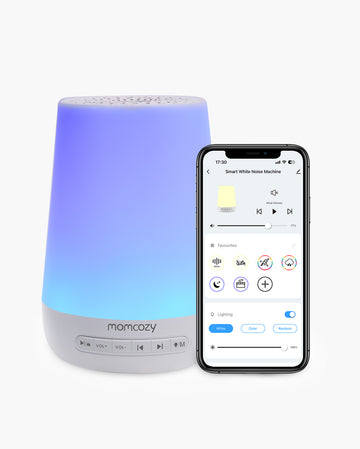
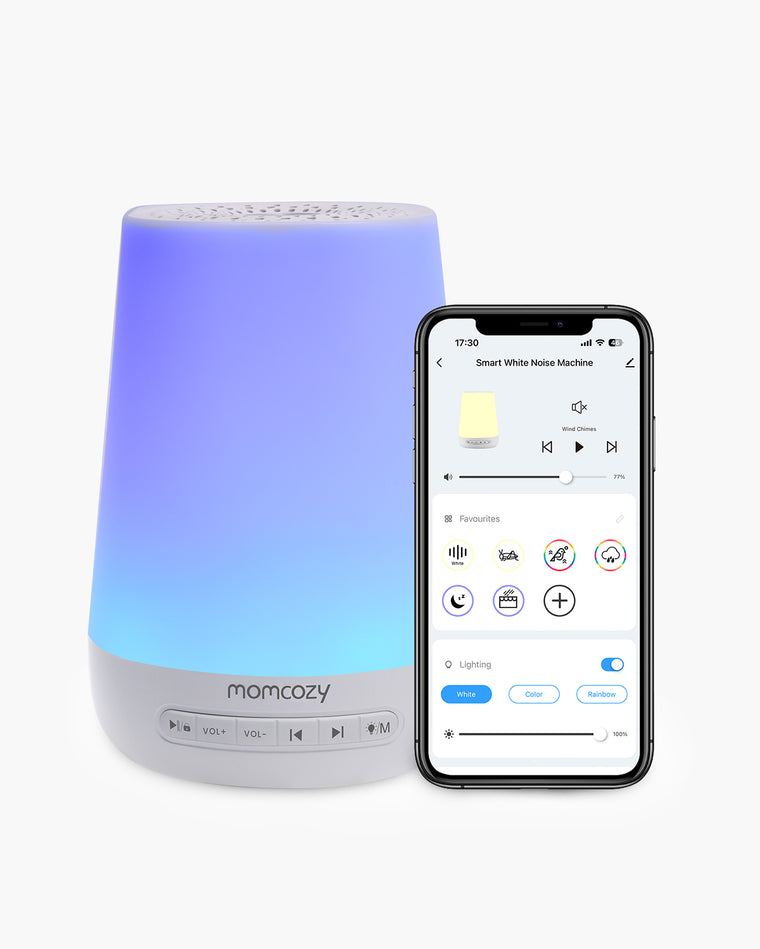
The Momcozy Smart Baby Sound Machine with App Remote Control offers 34 sounds, app remote control, touch control, adjustable light settings, customizable sound and volume controls, and a Sleep-Wake Routine. Through the app, you can make small sound or light adjustments without entering the nursery or moving the machine closer to the sleep space.
For household-noise masking, that matters most in a simple situation: the machine is already placed well away from the sleep space, and you want to make a small adjustment without walking into the nursery or moving the device closer.
For example, if evening activity becomes quieter after siblings go to bed, you can adjust the sound from outside the room while leaving the machine in its original position. App control adds convenience to that routine; careful placement and sound choices still matter.
If you are deciding between different control styles or sound-machine formats, comparing Momcozy sound machine models can help after you have identified the household problem you need the device to solve.
A Nap and Bedtime Routine That Does Not Require a Silent House
A workable routine can stay consistent without requiring everyone else in the home to stop normal activities whenever the baby sleeps.
Try this sequence:
- Prepare the baby’s usual sleep space.
- Choose where normal family activity will happen during the nap or bedtime period.
- Reduce predictable peaks, such as loud TV scenes, door slams, noisy toys, or a dishwasher cycle.
- Close or soften barriers between the activity zone and sleep area when practical.
- Add gentle background masking only if the remaining changes are still noticeable.
- Reassess the setup if the masking sound starts creeping louder.
The goal is a manageable household sound environment. Parents can still talk, siblings can still play in another area, and ordinary chores can continue with some planning.
Consistency comes from a routine that the household can realistically maintain, not from trying to remove every possible sound.
What Research and Pediatric Guidance Say About Sound Exposure
Household masking should stay gentle because infant sleep machines can produce much more sound than parents may expect at close range.
For infant sleep machines, AAP parent guidance recommends keeping the device as far from the baby’s head as possible and using it for a short time.
The importance of distance is also clear in device measurements. A 2014 Pediatrics study of 14 infant sleep machines tested maximum output at 30, 100, and 200 centimeters. At 30 centimeters, every device exceeded 50 A-weighted decibels, and three exceeded 85 dBA. The 50 dBA value in that study was a hospital-nursery comparison point, not a universal home-use safety line.
Questions about duration remain less settled. A 2024 scoping review of continuous white-noise exposure during sleep supported limiting maximum intensity and duration while finding that optimal exposure parameters for children still need more research.
Together, these findings support the same practical approach used throughout this article: control the household source first, keep masking gentle, maintain distance, and avoid increasing exposure simply because another part of the home becomes louder.
When to Ask a Pediatrician or Pediatric Audiologist
Ask for individualized guidance if your baby was born prematurely, has known or suspected hearing or speech concerns, has developmental or complex medical needs, or has already been given a specific care plan.
Professional advice is also appropriate if your family is considering longer or louder sound exposure because ordinary low-level masking is not solving the problem.
A phone sound-level app should not be used to diagnose hearing or decide whether a baby has experienced hearing damage. It can offer a rough environmental check, but it is not the same as a calibrated professional measurement or a hearing assessment.

Frequently Asked Questions
Can I Make Normal Household Noise While My Baby Sleeps?
Yes. Families do not need to stop all normal activity whenever a baby naps or goes to bed. Reducing sudden, avoidable peaks such as slamming doors or loud TV is usually more practical than trying to keep the entire home silent.
Will White Noise Block Siblings or a Noisy Neighbor?
White noise may make some intermittent sounds less noticeable, but it cannot remove the original noise. Start by moving louder activities farther from the sleep area, lowering controllable sources, or addressing recurring neighbor noise where possible. Use background masking gently after those steps.
Should I Turn the White Noise Louder if the TV or Dog Is Noisy?
Start with the TV, pet trigger, or other source instead. Repeatedly raising white-noise volume to compete with another sound can lead to volume creep. Lowering or separating the original source keeps you from adding unnecessary sound to the room.
How Loud Should White Noise Be for a Baby?
Use the lowest effective level that serves the masking purpose. Avoid relying on one universal machine percentage or a single decibel number as a guarantee for every baby and device. Distance, room layout, speaker output, and duration also matter.
Can I Use White Noise for Naps in an Apartment?
Yes, gentle masking may be useful for ordinary hallway sounds, passing traffic, footsteps, or occasional neighbor activity. Persistent construction, alarms, or severe external noise should be addressed through the environment, building management, or another appropriate route instead of stronger masking.
Is White Noise Safer Than Soundproofing a Nursery?
They solve different problems. White noise adds background sound, while sound reduction changes how much outside or household noise reaches the room. Simple measures such as closing a door, changing room placement, or softening hard surfaces can reduce the amount of masking needed.
Can I Adjust a Sound Machine From Outside the Nursery?
An app-controlled model can allow compatible settings to be changed without entering the room. This can be convenient when the machine is already positioned appropriately and only a small change is needed. Remote control does not measure sound exposure or replace careful placement and volume decisions.
Better Sleep Without Absolute Silence
Treat the household noise source first, then use gentle masking only where it adds value. Normal family life can continue through naps and bedtime without trying to overpower every sound with white noise.
Families exploring their options can compare baby sound machines based on the controls that fit their home and routine. For remote adjustments after the room setup is already in place, explore the Momcozy Smart Baby Sound Machine with App Remote Control.








