


Medically Reviewed By:Krupa Playforth & Brittian Robinson


It's the middle of the night. Your baby has a stuffy nose and cough but no fever — every temperature check comes back normal, yet the congestion and coughing won't stop. That can be confusing: if there's no fever, is it still something to worry about?
Quick Answer
"When your baby has a stuffy nose and cough but no fever — whether they're a 3-month-old, 6-month-old, or older — the right next step depends on age, breathing, feeding and wet diapers, and overall behavior."
One thing to keep in mind at any age: in infants, what starts as a stuffy nose and cough can sometimes develop into bronchiolitis — most often caused by RSV — which can cause more significant breathing difficulty, especially in babies under 6 months. That is why breathing is very important to watch, even when symptoms look mild at first.[2]
If your baby is under 3 months old, call your pediatrician at the first sign of illness, even if there is no fever.[1]
If your baby is over 3 months old and has mild symptoms — such as breathing comfortably, feeding normally, having regular wet diapers, and acting like themselves — it's never wrong to check in with your pediatrician, and in most cases they will recommend supportive care at home while you continue to watch closely.[1][2] Most mild congestion and cough are caused by common cold viruses, which typically improve gradually within 7–10 days, though coughs can last longer.[1][4]
Seek medical care right away anytime you are concerned about your baby. Some examples include if your baby has trouble breathing, blue lips or fingernails, unusual sleepiness, unusual fussiness / is difficult to console, persistent fever, poor feeding, fewer wet diapers, or symptoms that are getting worse instead of better.[1][2][3]
But there is one important exception.

If Your Baby Is Under 3 Months Old, Call the Pediatrician — Even Without a Fever
For babies 3 months old or younger, the American Academy of Pediatrics recommends calling the pediatrician at the first sign of illness. That includes symptoms like a stuffy nose, runny nose, or cough, even if your baby does not have a fever.[1]
At this age, it can be harder to tell when a baby is seriously ill. Symptoms can be subtle, and young babies have less reserve, so even a mild illness can become serious quickly. Colds can also become more serious problems, such as bronchiolitis, croup, or pneumonia.[1][2]
If your baby is under 3 months old and has a rectal temperature of 100.4°F (38°C) or higher, seek medical care right away. Do not wait to see if it passes.[1][2]
If Your Baby Is Over 3 Months Old, Watch These 4 Things
For babies older than 3 months, the decision usually comes down to four things: breathing, alertness, feeding and wet diapers, and how long symptoms last.[1][2][3]
1. Breathing: Get Medical Help Right Away
Breathing changes are the most urgent warning signs. At any age, seek emergency medical care immediately if your baby has any of the following:
- Nostrils flaring with each breath
- Skin pulling in around the ribs or breastbone (retractions)
- Breathing that is much faster, harder or more difficult than usual
- Blue, gray, pale, or unusually colored lips, skin, or fingernails
- Head bobbing with each breath
- Grunting with each breath
These are signs that your baby is working too hard to breathe and needs immediate medical evaluation. Remember, if you are worried that your baby is struggling to breathe, trust your instincts and seek emergency care, even if you're not sure whether these signs are present.
2. Alertness: Watch for Unusual Sleepiness or Extreme Fussiness
Babies can't tell you what feels wrong, so changes in their behavior can be an important clue that something isn't right.
Seek medical care if your baby:
- Is much sleepier than usual, difficult to wake, or has trouble staying awake to feed or interact
- Seems unusually fussy or irritable
- Cries for a prolonged period and cannot be comforted despite your usual soothing measures
- Is behaving very differently from their usual self
3. Feeding and Wet Diapers: Call the Doctor if Intake Drops
Feeding is not just about calories. For babies, it is also closely tied to hydration.
Call your pediatrician if your baby:
- Refuses to nurse, take a bottle, or drink fluids
- Is feeding much less than usual
- Has significantly fewer wet diapers than usual or shows other signs of dehydration (such as a dry mouth, no tears when crying, or unusual sleepiness)
Fewer wet diapers may be a sign that your baby is becoming dehydrated. Dehydration can make babies much sicker and should be evaluated promptly.
4. Duration: Call if Symptoms Last Too Long or Get Worse
Most colds improve gradually within 7–10 days. Cough can sometimes last longer than the runny nose or congestion, often up to 2–3 weeks.[1][4]
Call your pediatrician if:
- Cold or cough symptoms last more than 10 days without improvement or improve and then worsen again.
- Runny nose or nasal congestion lasts more than 10–14 days without improvement.
- Your baby has a persistent [5]
- Your baby develops a barky, seal-like cough, a hoarse voice or unusual sounds when they breathe which may suggest croup
- Your baby develops wheezing or noisy breathing.
- Coughing spells that repeatedly cause vomiting
- Any coughing episode that causes your baby to turn blue, gray, or pale (seek emergency care immediately).
If your baby develops a barky, seal-like cough or a hoarse voice, seek advice from a clinician immediately — even in the middle of the night. Croup can progress quickly, so this is not something to wait until morning for. If they have noisy breathing (stridor) at rest, are working hard to breathe, or develop blue or gray lips or skin, seek emergency medical care immediately. Cool, humid air may offer brief comfort, but it is not a substitute for medical advice.
Yellow or green mucus by itself does not mean your baby needs antibiotics. During a viral cold, nasal mucus commonly becomes thicker and changes color. Your pediatrician will consider the whole picture, including your baby's age, fever, breathing, feeding, energy level, how long they've been sick, and whether they're getting better or worse in determining how likely it is that the cause of symptoms is a bacterial infection. Remember, antibiotics cannot treat viral infections!
These warning signs are meant to help guide your next steps, but they are not a complete list. If your baby seems to be getting worse, something feels wrong, or you are worried, contact your pediatrician. If you think your baby is having trouble breathing or is difficult to wake, seek emergency medical care immediately.

How to Help a Baby With a Stuffy Nose and Cough at Home
First, it helps to know what home care can and cannot do.
There is no cure for the common cold. Antibiotics only work against bacterial infections, not viruses, and colds are almost always caused by viruses.[5][6] So the goal is not to "cure" the cold faster. The goal is to help your baby breathe, feed, and sleep more comfortably, and to avoid dehydration, while their immune system clears the virus.
If your baby is having trouble breathing, is difficult to wake, or is feeding very poorly, home care is not enough. Seek medical care right away.
1. Use Saline Drops or Spray to Loosen Mucus
A few drops or sprays of saline in each nostril can help loosen thick or dried mucus, making it easier to clear.
A simple way to do it:
- Lay your baby on their back with the head slightly tilted back.
- Put 2–3 saline drops or sprays into each nostril.
- Wait about a minute to let the saline loosen the mucus.
- If needed, gently suction the loosened mucus.
Do not use adult nasal sprays, medicated decongestant drops, or any nasal medicine unless your pediatrician specifically recommends it.
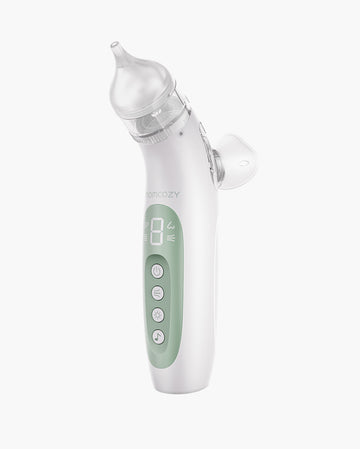
2. Use a Nasal Aspirator After the Mucus Is Softened
Once the mucus is softened, a nasal aspirator can help clear it out. Saline and suction are commonly recommended for congestion, especially before feeding or sleep when a stuffy nose makes it harder for babies to eat or rest.[8]
How to use it safely:
- Squeeze the air out of the aspirator first.
- Place the tip gently at the opening of the nostril. Do not insert it deeply.
- Slowly release to suction out the mucus.
- Wash the aspirator thoroughly with warm, soapy water after each use.
Use suction only when congestion is clearly bothering your baby, especially before feeds or sleep. Avoid frequent or repeated suctioning in a short period of time — too much suctioning can irritate the delicate lining inside your baby's nose and make congestion feel worse.
3. Keep Your Baby Sleeping Safely — Even When They're Congested
It can be tempting to prop your baby up to help them breathe, but this is not safe — inclined positioning can kink the airway and increase the risk of SIDS. Your baby may seem more comfortable when held upright while awake, but they should always be placed flat on their back for sleep. Always place your baby on their back to sleep on a firm, flat surface, even when they are sick and congested. Do not raise the head of the crib mattress, use a wedge or pillow, or place anything under your baby's head or mattress to elevate them. If congestion is making sleep hard, use saline and gentle suction before bedtime instead.
4. Use a Cool-Mist Humidifier
Dry air can make nasal mucus thicker, stickier, and harder to clear. A cool-mist humidifier can add moisture to the air and may help ease nasal congestion and coughing.[8][9][10]
Place the humidifier near your baby's sleep area, but keep it safely out of reach. Clean it regularly according to the manufacturer's instructions to prevent mold or bacteria growth.[9]
Note: Use only a cool-mist humidifier. Hot-water vaporizers can cause burns if tipped over.
5. Keep Your Baby Well Hydrated
Fluids help thin mucus, which can make it easier for your baby to cough or clear the nose.[8][9]
For babies under 6 months, continue breastfeeding or formula feeding on demand. Do not give extra water unless your pediatrician tells you to.
Once your baby is around 6 months old, small amounts of water can be offered with meals, but breast milk and/or formula should remain their main source of fluids, both when they are well and during illness. Ask your pediatrician about the right amount for your baby's age.
6. For Cough: Know What Is Safe and What Is Not
For babies, coughing is often tied to nasal congestion. Mucus from the nose can drip down the throat and trigger coughing, especially when your baby is lying down — this is one common reason a baby's cough may sound worse at night, though not every nighttime cough is caused by postnasal drip.
That means the same steps that help congestion — saline, gentle suction, humidified air, and enough fluids — can often help the cough too.[8][9]
There are a few important safety rules:
- Do not give over-the-counter cough or cold medicines to babies and young toddlers. These medicines have not been shown to help young children and can cause serious side effects. The FDA advises against their use in children younger than 2 years, manufacturers label them for children 4 years and older, and the American Academy of Pediatrics does not recommend them for children under 4 years of age.[7][8]
- Do not give honey to babies under 1 year old. Honey can contain bacteria that may cause infant botulism, a serious illness.[8][11]
- For children over 1 year old, honey may help ease nighttime coughing. The American Academy of Pediatrics suggests 2–5 mL (about ½–1 teaspoon) as needed for children over 1 year old, and notes that research has shown honey can reduce how often and how badly children cough at night.[8] Remember to brush their teeth afterward.
When to Call the Pediatrician for Infant Congestion: A Simple Checklist
The situations below summarize the most common patterns described above — they can't cover every possible scenario. If you're ever unsure, you should always call your pediatrician.
|
Call Your Pediatrician If... |
Seek Emergency Care Right Away If... |
|
Your baby is under 3 months old and shows any sign of illness — call the same day, even without a fever. |
Your baby is under 3 months old with a rectal temperature of 100.4°F (38°C) or higher. |
|
Your baby's symptoms are getting worse instead of gradually improving, or symptoms improve and then worsen again. |
Your baby is struggling to breathe — e.g., ribs pulling in, nostrils flaring, breathing much faster/harder than usual, or if you notice any color change in your baby's skin (such as turning blue, gray, pale). |
|
Your baby is feeding less than usual. |
Your baby is making fewer wet diapers than usual or is showing other signs of dehydration. |
|
Symptoms last longer than 7-10 days without improvement. |
Your baby seems suddenly much sicker. |
|
You feel something isn't right — trust your instincts and check in, even if your baby has already been seen for this illness. |
Your baby is very sleepy, difficult to wake, or difficult to console. |
This checklist is a quick-reference summary of some of the information covered above, but it is not a comprehensive list. If your baby is showing symptoms that don't fit neatly into either column, or you're simply not sure, always seek medical advice.
Taking care of a sick baby is hard. Many parents aren't confused because they "don't know enough." They worry because they care so much — so they keep checking the temperature, listening to every breath, and searching for every symptom.
You don't have to diagnose every symptom yourself. Start by looking for the warning signs above. Help your baby stay comfortable. And if your gut says something isn't right, call your pediatrician.
With babies, being cautious is not overreacting.

Frequently Asked Questions
Can a baby have a stuffy nose and cough but no fever?
Yes. A baby can have a stuffy nose and cough without a fever, especially if the cause is a common cold virus. For babies over 3 months old who are breathing comfortably, feeding well, having regular wet diapers, and acting like themselves, mild cold symptoms can often be managed at home, but asking your pediatrician for guidance (and to help you know exactly when they should be seen) is never wrong. If your baby is under 3 months old, contact your pediatrician at the first sign of illness, even if there is no fever.
Should I take my baby to the doctor for congestion but no fever?
It depends on age and symptoms. If your baby is under 3 months old, call your pediatrician. If your baby is older than 3 months and has mild congestion but normal breathing, normal feeding, regular wet diapers, and normal alertness, home care is usually enough. Call your pediatrician if symptoms are getting worse, last longer than expected, or you're concerned about your baby's condition.
When is baby congestion an emergency?
Seek emergency medical care immediately if your baby has trouble breathing, fast or labored breathing, ribs pulling in with each breath (retractions), nostril flaring, blue or gray lips or skin, is difficult to wake, is difficult to console, is feeding poorly or making fewer wet diapers, or is not responding normally.
Can I use a nasal aspirator every day?
Use a nasal aspirator only when congestion is making it difficult for your baby to feed, sleep, or breathe comfortably. Saline drops or spray can help loosen mucus first, and gentle suction can then help clear the nose.[8] Avoid frequent or deep suctioning, which may irritate your baby's nasal lining.
Can I give my baby cough medicine?
Do not give over-the-counter cough or cold medicines to babies or children unless your pediatrician specifically recommends them. These medicines have not been shown to help young children and can cause serious side effects.[7][8][10]
Can I give honey to a coughing baby?
Do not give honey to babies under 1 year old because of the risk of infant botulism. For children over 1 year old, honey may help ease nighttime coughing.[8][11]
Medical Disclaimer : This article is intended for general educational purposes only and is not a substitute for professional medical advice, diagnosis, or treatment. Always consult your pediatrician regarding any concerns you have about your baby's health or before starting any home remedies. You should seek emergency medical care or call 911 (in the U.S.) immediately if you believe your baby is experiencing a medical emergency, such as struggling to breathe, showing blue or gray changes in skin color, or being unusually difficult to wake or console. Furthermore, if your baby is under three months old, you should contact your pediatrician at the first sign of any illness, even if they do not have a fever.
References
- American Academy of Pediatrics. (2025, January 27). Children & colds (upper respiratory infections). HealthyChildren.org. https://www.healthychildren.org/English/health-issues/conditions/ear-nose-throat/Pages/Children-and-Colds.aspx
- Mayo Clinic Staff. (2025, April 11). Common cold in babies: Symptoms & causes. Mayo Clinic. https://www.mayoclinic.org/diseases-conditions/common-cold-in-babies/symptoms-causes/syc-20351651
- Cleveland Clinic. (2023, February 7). Common cold (rhinovirus): Symptoms, causes & treatment. Cleveland Clinic. https://my.clevelandclinic.org/health/diseases/12342-common-cold
- Covenant Care Pediatrics. (2019, December 28). Colds in infants and toddlers. https://www.covenantcarepediatrics.com/colds-in-infants-and-toddlers/
- American Academy of Pediatrics Section on Infectious Diseases. (2022, November 1). Antibiotics for children: 10 common questions answered. HealthyChildren.org. https://www.healthychildren.org/English/safety-prevention/at-home/medication-safety/Pages/Antibiotic-Prescriptions-for-Children.aspx
- American Academy of Pediatrics. (2023, September 14). How to care for your child's cold. HealthyChildren.org. https://www.healthychildren.org/English/health-issues/conditions/flu/Pages/caring-for-Your-childs-cold-or-flu.aspx
- U.S. Food and Drug Administration. (2024, November 7). Should you give kids medicine for coughs and colds? https://www.fda.gov/consumers/consumer-updates/should-you-give-kids-medicine-coughs-and-colds
- American Academy of Pediatrics. (2022, December 2). Coughs and colds: Medicines or home remedies? HealthyChildren.org. https://www.healthychildren.org/English/health-issues/conditions/chest-lungs/Pages/Coughs-and-Colds-Medicines-or-Home-Remedies.aspx
- Mayo Clinic Staff. (2024, October 24). Cold medicines for kids: What's the risk? Mayo Clinic. https://www.mayoclinic.org/healthy-lifestyle/childrens-health/in-depth/cold-medicines/art-20047855
- Nationwide Children's Hospital. (2022, May). Cough and cold medicines. https://www.nationwidechildrens.org/family-resources-education/health-wellness-and-safety-resources/helping-hands/cough-and-cold-medicine-over-the-counter-otc
- Centers for Disease Control and Prevention. (2026, April 14). Foods and drinks to avoid or limit. https://www.cdc.gov/infant-toddler-nutrition/foods-and-drinks/foods-and-drinks-to-avoid-or-limit.html
- American Academy of Pediatrics. (2024, May 10). Croup in young children. HealthyChildren.org. https://www.healthychildren.org/English/health-issues/conditions/chest-lungs/Pages/Croup-Treatment.aspx








