


MEDICALLY REVIEWED BY

Zola Zhang, MD, IBCLC, Breast Surgeon, Mother
Breast Surgeon | International Board Certified Lactation Consultant | Mother
As a dedicated Breast Surgeon and International Board Certified Lactation Consultant (IBCLC) with 21 years of clinical experience, my work is rooted in both medical expertise and the lived reality of motherhood—because I’m not just a clinician, but also a mother who exclusively breastfed my own child for two years. This dual perspective shapes every interaction, allowing me to blend scientific rigor with deep empathy for the joys and challenges of breastfeeding.
No diaper-pail mechanism can be called universally quietest from the available evidence. A soft-close lid may reduce closing noise, but that does not establish that diaper insertion, sealing, pedal return, or bag maintenance will be quiet. For overnight changes, choose the setup with the fewest abrupt actions in your room, then test the lid, seal, and placement before relying on it beside a sleeping baby.
The useful question is not “Does it have a foot pedal?” or “Does it say soft-close?” It is: What must I do, hear, and touch from the moment the diaper comes off until the pail is closed again?
Judge the whole disposal sequence, not one feature
A pail can be easy to open yet still have a noticeable closing action, inner flap, seal, or bag-handling step. Conversely, a manual lid may have fewer moving parts but require a hand when you are holding the baby or managing a messy change.

When comparing pails, walk through this five-part sequence:
- Opening: Does it use a pedal, lift lid, slide, button, or lock?
- Insertion: Must you push the diaper through a flap, chute, or sealing opening?
- Closing: Does the lid settle gently, require manual closing, or snap into place?
- Sealing: Is there a rotating, twisting, clamping, or inner-door action?
- Maintenance: Will bag changes, cutting, advancing, or emptying interrupt the overnight routine?
A foot pedal provides hands-free opening, but it is not proof that the full operation is quiet. The available evidence does not include decibel tests or comparisons of pedal return, final lid closure, or sealing sounds.
Similarly, the Munchkin STEP is described as having a soft-closing lid that reduces nighttime-change noise. That is useful qualitative information, but it does not confirm what happens at the final seal or during its self-sealing operation. Treat “soft-close” as a feature worth testing, not a guarantee of silence.
What different mechanisms ask you to do at night
The table below is not a noise ranking. It is a way to identify the actions that could matter most when the baby sleeps nearby.
Mechanism |
Required nighttime action |
What is documented |
What still needs a real-world check |
Foot-pedal lid |
Step to open; dispose of diaper; allow or guide lid to close |
Hands-free operation reduces contamination risk |
Pedal movement, return action, lid settling, and final contact sound |
Soft-close lid |
Open, insert diaper, let lid close |
Some products are described as reducing closing noise |
Whether the final seal clicks, thuds, or requires manual closure |
Sliding lid |
Slide open, insert, slide closed; possibly operate a lock |
Ubbi Steel uses a sliding lid, childproof lock, and rubber seal |
Sliding resistance, lock sound, and whether it suits one-handed use |
Push flap or top flap |
Press a button or push the diaper through an opening |
The Safety 1st Easy Saver is described as using a top button that opens a flap |
The sound and feel of the button, flap, and closure |
Trapdoor or spring-loaded opening |
Push through an inner door or chute |
These designs exist as odor-control approaches |
There is no documented nighttime noise comparison for spring-loaded or trapdoor-style pails |
Twist-and-seal system |
Insert diaper and use the system’s sealing process |
Munchkin STEP is described as self-twisting/self-sealing and proprietary-liner based |
The sound of twisting, sealing, liner advancement, and bag cutting |
Rotating hopper |
Insert diaper, then return the hopper to its odor-control position |
L.A. BABY Magic requires the hopper to be rotated back |
How the rotation sounds in a quiet room |

The quietest-feeling option for a particular family may be the one that removes an awkward extra step. For example, a sliding lid may suit a parent who prefers a controlled hand movement; a pedal may suit someone who needs both hands free. Neither preference establishes a universal sound advantage.
A practical store or at-home test
If possible, operate the empty pail in a quiet room and listen for the entire sequence:
- the opening action;
- contact between the lid and its seal;
- inner flap or chute movement;
- the sound of a lock engaging;
- how it behaves when you close it slowly rather than quickly.
Repeat the test while standing where you expect to change diapers. A pail that feels unobtrusive across the room can be more noticeable next to a bassinet.
Keep maintenance out of the overnight routine when possible
Normal disposal and periodic maintenance are different jobs. A pail may be simple for each diaper yet more involved when its liner needs changing; a more elaborate sealing system may offer odor-control benefits while requiring proprietary liners or more bag-management steps.
The available evidence does not show that refilling, cutting, or advancing a bag must happen after every overnight diaper. Whether those tasks can wait depends on the pail’s capacity, fill level, and manufacturer instructions. Still, it is sensible to start the evening with enough liner available and an uncrowded pail, rather than discovering a full bag at 3 a.m.

One test summary found meaningful differences in bag-change difficulty across designs, with proprietary and sealing systems tending to be harder to change than simpler reusable-bag systems. That is not a noise comparison—but it is relevant when deciding how much maintenance complexity you want in a shared sleep space.
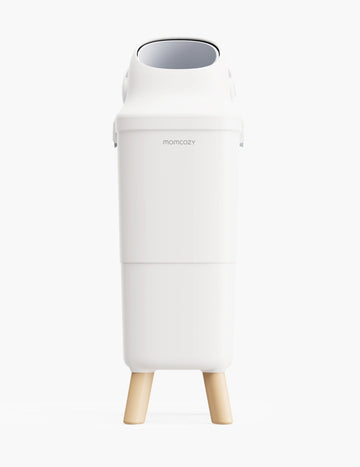
Pails that accept standard bags can avoid proprietary-refill handling and recurring refill purchases. For example, the Momcozy Triple-Seal is specified for standard 13-gallon bags and has a 22 L capacity with a clamp bag seal and hands-free wide opening. Those are design specifications, not evidence of quieter operation.
For guidance on capacity, liners, cleaning, and emptying considerations, see how to choose a diaper pail for a fresher nursery.
A covered trash can: reasonable for some newborn routines
A regular covered bin can be a practical low-mechanism option during the newborn stage if it is emptied frequently. It may suit families who want a straightforward lid and do not expect diapers to remain in the room for long.
But it is not automatically the quieter or more odor-controlled solution. Opening a conventional lidded bin can release odor, and the odor challenge may increase after solid foods are introduced. Overfilling and debris around a seal can also reduce odor-control performance in specialized pails.
For the newborn-stage trade-off in more detail, read whether you really need a diaper pail.
Build a low-stimulation nighttime change station
The pail is only one part of newborn nighttime care. A calm routine reduces the chances that a small mechanical sound becomes the moment that fully wakes everyone up.
- Stage supplies before bedtime. Keep diapers, wipes, cream, a clean sleep layer, and the pail within easy reach. Avoid opening drawers, searching for liners, or moving furniture during a change.

- Use low, warm light. Nighttime guidance recommends dim red or amber lighting and avoiding bright white or blue light, including phone screens. Keep interaction minimal and move slowly.
- Dispose of the diaper in one controlled sequence. Open the pail once, place the diaper inside, and close or reseal it deliberately.
- Change bowel movements promptly. For other changes, changing before a night feeding may be helpful when possible because the baby is already awake; bowel movements should be changed right away.
- Place the pail for safety as well as convenience. Use a stable spot beside—but not in—the walking path to the bassinet or changing surface. A childproof lock can help prevent toddler access, though it also adds an operating step and is not evidence of quietness.
- Re-test over time. Before the first weeks at home, and again if the operation starts to feel different, open and close the pail in the dark at normal nighttime speed. Check that the lid closes fully, the seal is clear of debris, and the bin is not overfilled. Also listen for any new squeaks, hard contact, or changes in how the lid or pedal moves—these can indicate wear that may increase noise over time.
Choose the mechanism with the fewest disruptive actions for your own overnight routine, then confirm that its odor control and maintenance demands are manageable. A well-placed, familiar pail is more useful than a promising feature label. From there, build the rest of the station around the same goal: low light, easy reach, and fewer reasons to fully wake the room.








