


MEDICALLY REVIEWED BY

Zola Zhang, MD, IBCLC, Breast Surgeon, Mother
Breast Surgeon | International Board Certified Lactation Consultant | Mother
As a dedicated Breast Surgeon and International Board Certified Lactation Consultant (IBCLC) with 21 years of clinical experience, my work is rooted in both medical expertise and the lived reality of motherhood—because I’m not just a clinician, but also a mother who exclusively breastfed my own child for two years. This dual perspective shapes every interaction, allowing me to blend scientific rigor with deep empathy for the joys and challenges of breastfeeding.
A high weight limit measures how much weight a product can support in its specified use—not whether the seat has enough room, the restraint fits correctly, the tray clears your child comfortably, or the footrest supports their legs in the mode you are using.
That is why a toddler can be well below a chair’s headline limit and still look cramped, slump forward, push against the tray, or have dangling feet. The right question is not, “How many pounds are left?” It is, “Does my child fit this exact configuration safely and comfortably according to the manufacturer’s instructions?”

Weight capacity and usable fit are different things
Convertible chairs are designed to serve more than one stage. A product may have baby, toddler, learning-chair, table-chair, or adult-chair modes, rather than one identical seat setup that works the same way throughout childhood.
The prominent maximum capacity can describe the product’s overall lifespan or a later configuration. It does not automatically tell you:
- how wide or deep the toddler seat feels to your child;
- how much room exists between the seat and tray;
- whether the harness still routes and adjusts correctly;
- whether the footrest reaches the right height for your toddler’s legs;
- whether the tray-off configuration is approved for dining-table use; or
- which limits and instructions apply to the mode currently assembled.
A child may be light for their age but have a long torso, broad hips, long legs, or a body shape that does not work well with a fixed seat, tray, or footrest position. Another child of the same age and weight may fit the same chair differently.

So a chair can be within its stated capacity and still be the wrong fit in its high-chair configuration. That is not a parenting mistake, and it does not necessarily mean the chair is defective. It may simply mean the available geometry and adjustment range no longer match your child.
Do a seated fit check, not a label check
Start with the chair assembled in the exact mode your child is using. Review the manual first, then seat your toddler with the restraint fitted as instructed.
Check posture and restraint fit first
Look for a child who can sit upright without being forced forward by the tray, seat shape, or restraint position. The harness should be correctly routed and adjusted for that model and mode—not loose, twisted, improvised, or substituted with an aftermarket restraint.
Then observe the basics of usable posture:
- Back and torso: Your child can sit back in the seat rather than perching at the edge or leaning forward to reach food.
- Hips and knees: Their hips and knees can bend naturally rather than being tightly bunched or stretched out.
- Feet: Their feet have support from the approved footrest, rather than hanging without support.
- Arms and shoulders: They can reach the tray or eating surface without constantly raising their shoulders, hunching, or leaning forward.
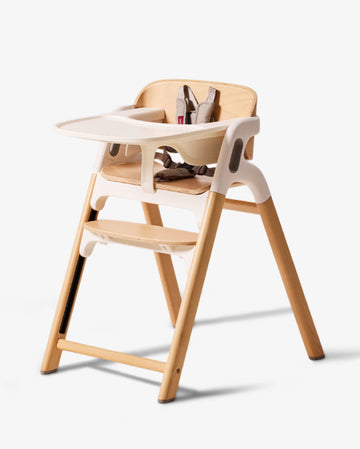
- Tray clearance: The tray does not press into their body or leave them struggling to move comfortably within the seat.
- Usable seat space: Their hips and thighs are not visibly crowded by the sides, crotch restraint, or tray position.

These observations are practical fit checks, not a replacement for a product’s safety instructions. Still, they help explain why age and weight alone are poor predictors. Children grow at different rates, and their torso-to-leg proportions can vary substantially.
Pay special attention to foot support
Foot support is easy to overlook because a child may technically remain within the chair’s weight range while their legs have outgrown the footrest position.
For a practical posture check, look for supported feet and roughly bent hips and knees. If the footrest is too low, feet may hang; if it is too high, the knees may be overly bent and crowded. Either situation can make the chair feel awkward even when the seat itself seems large enough.
A fixed footrest may work for one stage and not the next. An adjustable footrest can offer more room to respond to changing leg length—but only if the available positions fit your child and the manual permits that adjustment in the current mode.
Rule out an approved setup adjustment
Before deciding a chair is too small, check whether an approved adjustment has been missed. Some convertible models provide separate seat-depth and footrest settings, which is important because those features are independent of the chair’s headline weight capacity.
Work through this short setup audit:
- Confirm the mode. Identify whether the chair is currently in its baby, toddler, table, learning, or another configuration. Do not assume the instructions for one mode apply to another.
- Read the current instructions. Look for mode-specific age, height, weight, developmental, restraint, tray, and accessory guidance. Use the current manual for your exact model.
- Check permitted seat-depth settings. If the chair offers more than one seat-depth position, use only the position approved for your child’s mode. The goal is enough room for your toddler to sit back without being pushed forward or left unsupported.
- Adjust the footrest only as instructed. If there is an approved height setting, choose the position that gives your child supported feet without sharply crowding the knees.
- Recheck the tray and harness. Make sure the tray is installed as directed, and confirm that the harness fits according to the manual after any seat adjustment.
- Assess the result, not just the adjustment. If the chair remains cramped, the harness does not fit correctly, or the child cannot maintain upright supported posture, the available adjustment range may not be enough for this child.
Do not solve a fit problem with added cushions, an improvised footrest, altered tray position, replacement straps, or other modifications not approved by the manufacturer. An adjustment can improve fit only within the limits of the design and its instructions.
Tray-off use does not automatically mean table use
Removing a tray may make a chair look more like a dining chair, but it does not automatically establish that it fits your table or that the configuration is approved for pull-up table use.
Check the manufacturer’s instructions for the tray-off mode specifically. If table use is permitted, follow any measurement guidance and verify clearance at your own table. Table height, apron depth, leg placement, and the chair’s tray or arm height can all affect whether the child can sit close enough to eat comfortably and safely.
A toddler who pushes against the table, cannot get close enough to the eating surface, or is forced into a forward lean may not have a workable table setup—even if the tray has been removed.
Make the keep, return, or transition decision
After checking the manual and approved adjustments, the decision is usually clearer.
Keep using the current configuration if
- the mode is approved for your child;
- the restraint fits and is used as instructed;
- your toddler can sit upright with supported posture;
- the seat and tray provide usable room; and
- approved adjustments solve the footrest, seat-depth, or positioning issue.
Consider returning or replacing the chair if
- the seating area or tray is consistently too tight;
- the harness cannot be correctly fitted in the approved configuration;
- your child cannot sit upright without leaning, hunching, or being pushed forward;
- their feet cannot be supported using the chair’s approved settings; or
- the manual does not permit the mode, accessory combination, or adjustment you would need to make it work.
Consider a different approved seating stage if
Your child still falls within a high chair’s stated limits but no longer fits that high-chair setup well. A move to another seating arrangement is a fit-and-readiness decision, not an automatic birthday or weight milestone.
If you choose a booster, follow that booster’s instructions rather than treating it as a simple extension of the old high chair. In particular, it should be secured to a stable, flat-seated dining chair before use, as outlined in this guidance on moving from a high chair to a booster seat.
If your toddler cannot sit upright with correctly fitted restraints, lacks supported posture, is cramped by the tray or seat, or falls outside the instructions for that mode, unused weight capacity is not a reason to continue. Recheck the approved adjustments and your manual, then move to a seating option whose instructions and fit genuinely match your child now.








