


MEDICALLY REVIEWED BY

Zola Zhang, MD, IBCLC, Breast Surgeon, Mother
Breast Surgeon | International Board Certified Lactation Consultant | Mother
As a dedicated Breast Surgeon and International Board Certified Lactation Consultant (IBCLC) with 21 years of clinical experience, my work is rooted in both medical expertise and the lived reality of motherhood—because I’m not just a clinician, but also a mother who exclusively breastfed my own child for two years. This dual perspective shapes every interaction, allowing me to blend scientific rigor with deep empathy for the joys and challenges of breastfeeding.
A three-inch growth spurt does not automatically mean your toddler needs a new high chair. It does mean it is time to reassess the fit. Use your exact chair model’s manual to adjust the footrest only as instructed, aim for stable flat-foot support and upright sitting, and then recheck the harness and crotch restraint.
If you cannot achieve a secure, comfortable fit using an approved adjustment—or if the chair is damaged, unstable, recalled, or outside its stated limits—pause use and contact the manufacturer or move to an appropriate seat.
Start With a Seated-Fit Check
Standing height is not the measurement that determines whether a high chair still fits. What matters is how your child fits while seated: their leg length, foot contact, restraint fit, and whether they can remain upright in the chair.

Before changing anything, seat your toddler for a brief fit check. Look for:
- Back support: Your child can sit upright with their back supported by the seat.
- Foot contact: Both feet can rest steadily on the chair’s built-in footrest in its current position. Tiptoe contact is not the same as stable support.
- Secure restraint fit: The harness and crotch restraint can still be fastened correctly according to the manual.
You may see “90-90-90” used as a supported-eating posture reference: hips, knees, and feet at approximately 90 degrees. Treat that as a general positioning guide, not a universal rule or a target that overrides your chair’s instructions. There is no single footrest height that works for every toddler or high chair.
The practical goal is simpler: upright sitting, comfortable bent legs, and both feet resting stably rather than dangling or reaching.
Children should sit upright while eating and use a high chair or another safe eating location, according to CDC choking-prevention guidance.
Adjust Only What Your Chair Manual Allows
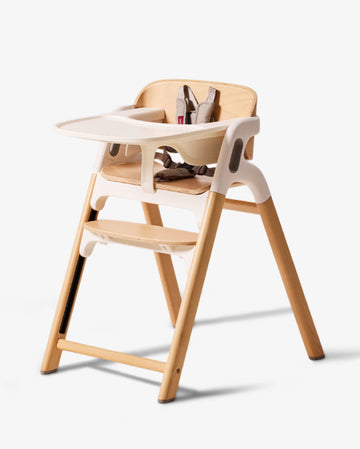
High-chair footrests do not all work alike. Some are fixed. Others may have several height or angle positions, but the release mechanism, available positions, and locking checks are specific to the model. Do not copy a button sequence, pin arrangement, or “click” check from another chair.

Before you adjust
- Find the exact model number. Check the label on the chair, frame, or manual.
- Locate the manufacturer’s instructions. Use the manual for that model—not a similar-looking chair.
- Confirm that the footrest is adjustable. A fixed footrest should not be forced, drilled, taped, clamped, or otherwise modified.
- Inspect the footrest and its attachment points. Stop if anything is loose, cracked, bent, missing, or damaged.
During the adjustment
Follow the manual’s stated process exactly. It should tell you:
- Which footrest positions are permitted
- How to release and move the footrest
- How the footrest must lock or engage
- Whether any parts must be removed or reinstalled
- Whether replacement parts or accessories are approved for that chair
Once adjusted, confirm that the footrest is fully seated and secured as the manual requires. A chair should not be used unless its components are correctly fitted and adjusted.
Do not assume an aftermarket footrest extender is safe because it fits physically. Some high-chair manuals prohibit third-party accessories. A generic add-on, homemade platform, or improvised attachment may change the chair’s intended setup without evidence that it is compatible with your model.
Reseat Your Toddler and Check the Whole Setup
Moving the footrest can improve foot contact, but it does not replace the rest of the chair’s safety setup. Reseat your child and treat this as a full fit check, not just a footrest check.

Use this after-adjustment checklist
- Fasten every restraint. Use the full harness and crotch restraint as directed by the chair manual.
- Confirm the child is upright. The footrest should support the feet without pulling the child forward or causing them to slump.
- Look for stable foot contact. Both feet should rest on the approved footrest rather than balancing on toes or pushing against nearby furniture.
- Check the chair’s stability. Make sure it is on a flat, stable surface and cannot be easily tipped.
- Check the folding lock, if applicable. A folding chair’s mechanism should be locked each time it is set up.
- Move the chair away from tables and counters. A child may push against nearby surfaces, which can create a tipping risk.
- Stay with your child during meals. Children should be strapped in and watched while eating; CDC mealtime guidance specifically advises both.
Do not loosen, remove, or bypass the harness or crotch restraint to make room for a growing child. The tray is not a substitute for the restraint system. Children should not stand in the high chair; high-chair safety guidance also emphasizes using all safety straps, including the crotch strap.
When the Footrest Cannot Reach—or the Chair No Longer Fits
A footrest that no longer reaches your child’s feet is a reason to reassess, not a reason to improvise. First, check whether the chair has an approved adjustment range or manufacturer-approved replacement part. If the manual is missing or unclear, contact the manufacturer before using an accessory or attempting a modification.

Height alone does not determine whether a high chair is outgrown. Age ranges, weight limits, restraint requirements, and adjustment ranges vary by model. Check the limits printed in your chair’s instructions rather than relying on a general age, height, or weight guideline.
Pause use and seek manufacturer guidance if:
- The footrest cannot be adjusted to provide stable support using an approved position.
- You cannot fasten the harness and crotch restraint correctly.
- Your child cannot sit upright securely.
- The chair rocks, tips, has a loose footrest, or will not lock as intended.
- Any component is broken, damaged, or missing.
- You do not have the manual and cannot verify the adjustment method or stated limits.
- You are considering a third-party accessory but cannot confirm that your chair manufacturer permits and documents its compatibility.
- You find a recall notice or have reason to question whether your chair is affected.
A Simple Next-Step Decision Tree
If your toddler can sit upright, the harness and crotch restraint fit correctly, both feet rest stably on the footrest, and the footrest is secured using the manual-approved adjustment, continue using the chair and recheck fit as your child grows.
If the footrest cannot be adjusted, the chair is unstable, parts are missing or damaged, or the restraints no longer fit correctly, pause use. Contact the manufacturer for the exact manual, support, approved parts, and current recall information—or choose the next seating option when a high chair is outgrown.








