


MEDICALLY REVIEWED BY

Mary Bicknell, MSN, BSN, RNC, ANLC
Mary Bicknell comes with over 30 years of experience as an RN in the NICU. Educating mothers on the importance of healthy breastfeeding is important to her. It can be challenging to maintain successful breastfeeding through many difficult situations and long hospitalizations. Mary is committed to helping families define what successful breastfeeding means to them; and to assist them to obtain their goal. After leaving the bedside, Mary became a nurse leader and continued to make sure that breastfeeding education and support was always available to the families in her unit.
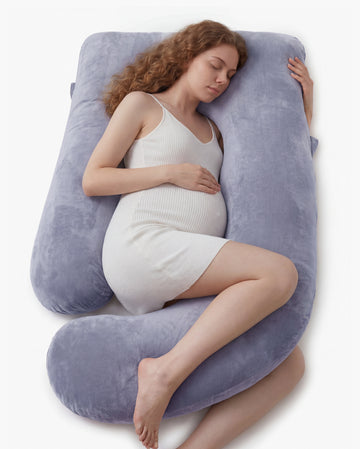
A C-shaped pillow can support your head, bump, back, hips, and legs without taking over the bed. The right setup can also ease hip pain, reflux, and restless turning.
Are you waking up at 2:00 AM with one hip throbbing, your belly feeling heavy, and no regular pillow staying put for more than a few minutes? More than half of pregnant women deal with sleep problems, and many need a few nights before a new pillow setup starts to feel natural. With time you will find C-shaped positions that make side sleeping morestable. There will be small adjustments that will help when back pain, heartburn, or swelling make sleep harder.This guide is general information, not a substitute for personal medical advice. If you have questions, consult your birth support person or medical team.
What a C-shaped pillow actually does
A more space-efficient full-body option supports the head, neck, back, bump, hips, and legs without taking over the whole bed the way many U-shaped pillows do. That middle-ground design works especially well for side sleepers who want substantial support but still need room for a partner, bedding, or an easy path out of bed for nighttime bathroom trips.
The pillow’s real job is not to force you into a perfect pose. It is to make side sleeping easy enough that your muscles stop bracing. Keeping the pillow between your thighs and knees usually matters most. Once the top leg is supported, the hips stay more level and the lower back has less twisting.
How to position it for full-body support
For the core C-shaped setup, lie on your side with the top curve under your head and neck, the center curve touching either your back or your bump, and the lower section tucked between your knees. If your pillow is long enough, let that lower section continue toward your ankles so your entire top leg is supported instead of just the knee.
Body area |
Best placement |
What it should feel like |
Head and neck |
Upper curve under the head, supporting the neck without pushing the chin down |
Level and relaxed, not propped too high |
Back |
Middle curve lightly touching from ribs to lower back for best rear support |
A gentle barrier, not a hard shove |
Belly |
Open curve cradling the bump, or the pillow hugged in front for front support |
Held, not squeezed |
Knees and ankles |
Lower curve between both knees and ideally down to the ankles |
Hips stacked instead of twisting forward |

If your top knee keeps sliding onto the mattress, the pillow is sitting too low. Pull the lower arm higher between the thighs first, then smooth the rest toward the ankles. If your shoulder feels cramped, flatten the top curve a little so your neck stays long and your ear is not pushed toward your shoulder.
Most people do best starting on the left side, especially later in pregnancy, because left side sleeping supports circulation. This makes it easier to stay off your back. The right side is also generally considered safe, so comfort matters.If your right hip feels better one night, use the same C-shaped setup on the right instead of forcing a position that leaves you tense.
When to place the curve behind you or in front of you
When back support matters more
Using the curve behind your back is usually the better choice when low-back pain, rib tension, or rolling onto your back is the main problem. Let your back settle into the inner curve, keep your head on the upper section, and anchor the lower arm between your knees. This is often the most stabilizing setup in the middle of pregnancy, when turning over starts to take real effort.
When belly support matters more
Placing the curve in front of your body works better when the bump feels heavy, your lower belly feels tugged, or round-ligament pain is more noticeable than back pain. Hug the middle section, let the bump rest into the open space, and drape the top leg over the lower curve so the pillow carries some of that forward weight. At bedtime, you may notice the difference right away: the belly stops hanging, and the abdominal wall no longer does all the work.

A C- or F-shaped pillow can provide targeted full-body support in a smaller bed, but it usually does not cushion both the front and back as fully as a U-shaped pillow. That is the main tradeoff. If you change sides constantly, expect to reposition the pillow with you; if you stay on one side for long stretches, a C-shape often feels less bulky and easier to manage.
Small adjustments that make a big difference
For hip and pelvic pressure
Keeping full support between the knees and ankles is one of the simplest ways to reduce hip and pelvic strain. Support between the knees alone helps, but when the ankle hangs unsupported, your top leg can still rotate forward and pull your hip. If you wake with one-sided soreness, slide the lower curve slightly higher so it supports more of your thigh, and check that your ankles are not dangling off the end.
For back pain that shows up by morning
Targeting hip and lower-back pain usually works better than adding more height under the head. The goal is a gentle fill behind the waist so your trunk does not roll backward while your knee and hip roll forward. In practice, this usually means rotating the middle curve snugly into the low back and leaving the head section only high enough to keep your neck neutral.
For heartburn or reflux
Slightly elevating the head and upper body can help more than cushioning the belly alone when heartburn keeps interrupting sleep. With a C-shaped pillow, aim for a reclined side-lying position by propping the pillow behind the shoulders and head while keeping your body turned to one side. If you stack support only under your head, your neck may bend sharply and the rest ofyour body may slide down. This may feel worse after an hour or two.

For leg swelling and hot sleep
Placing support under your legs can ease evening swelling, especially later in pregnancy when your ankles and calves are often the first areas to feel tight. If your pillow also feels too warm, moisture-wicking, washable fabrics matter just as much as shape. A common fix is to keep the C-shaped pillow for support but switch to a cooler cover or lighter sleepwear before deciding the pillow itself is the problem.
For a shared bed and frequent bathroom trips
A lighter, easier-to-move shape is one reason many couples prefer a C-shaped pillow over a U-shaped pillow in a queen bed. If you get up several times a night, keep the open side facing the edge of the bed so you can slide out instead of climbing over the pillow. That small orientation change can save a surprising amount of effort at 3:00 AM.
When to start using one, and when to change the setup
Most people start using a pregnancy pillow between 12 and 20 weeks, but comfort is a better guide than the calendar. If you are already building a pillow fort, waking with hip pain, or feeling awkward on your side, it is time to consider a pregnancy pillow. If it takes three to seven nights to stop feeling strange, that is normal; your body has to learn a new resting pattern.
The second trimester, which runs from weeks 14 to 26 often brings more energy, but it can still come with back pain, leg cramps, abdominal discomfort, and heartburn. That is why the best C-shaped setup at 18 weeks may not be the best one at 30 weeks. Early on, a simple knee-and-belly setup may be enough. Later, you may want fuller leg support, firmer back contact, or a slightly reclined angle for reflux.

Pros and cons of a C-shaped pillow for pregnancy side sleeping
A targeted full-body pillow works best when your goal is comfort, alignment, and reasonable bed space all at once. There are both strengths and limits.
Where it helps |
Where it falls short |
Supports the head, neck, bump, hips, and legs in one piece |
Usually supports either the front or the back best, not both equally at once |
Easier to manage in smaller or shared beds than many U-shaped pillows |
Needs repositioning if you switch sides often |
Good for sleeping, reading, and resting on the couch |
Still bulky compared with a wedge or standard body pillow |
Often useful after birth for recovery and feeding support |
Never safe as a sleep surface for a baby |
After birth, the same pillow can still help with feeding support and recovery rest, but it should not be used for infant sleep or bed-sharing. That postpartum versatility is one reason many families feel a good pregnancy pillow earns its space.
Getting the fit right over time
A machine-washable cover and breathable fabric are not small details when you use the pillow every night. If the cover gets sweaty, the fill flattens under your top leg, or the neck section no longer holds its shape, the pillow may still look fine while performing poorly. The simplest test is this: if you keep waking with the same hip drop, back twist, or belly pull even after adjusting the position, the support may have worn down or the setup needs to be changed.
The best C-shaped setup is the one that makes your side-sleeping position feel supported instead of managed. When your head stays level, your bump feels gently supported, and your top knee no longer drops forward, your whole body gets the message that it can finally rest.








