


White noise sounds brighter and hissier, pink noise tends to sound softer and more balanced, and brown noise has a deeper rumble. But there is no single noise color proven best for every baby. The practical choice depends on what sound you want to mask and which steady background sound your baby tolerates comfortably. Many baby sound machines offer several sound options, so comparing the three by sound character, evidence, and routine can be more useful than choosing one based on a viral claim.
Key Takeaways
- White, pink, and brown noise distribute sound energy differently across frequencies, which changes whether they sound brighter, softer, or deeper.
- White noise often provides broad masking, while pink and brown noise place less emphasis on higher frequencies and may sound less hissy.
- Infant-specific evidence does not show that pink or brown noise is better than white noise for babies.
- The practical choice is a quiet, steady sound your baby tolerates and that fits the household noise you want to mask.
- Noise color does not replace careful attention to sound level, placement, duration, cords, or safe-sleep setup.
White vs. Pink vs. Brown Noise for Babies at a Glance
| Dimension | White Noise | Pink Noise | Brown Noise |
|---|---|---|---|
| Frequency profile | Equal power per unit frequency | Less power at higher frequencies; equal energy per octave | Stronger low-frequency emphasis |
| Typical impression | Brighter / hissier | Softer / more balanced | Deeper / rumbling |
| Common approximations | Static, fan-like hiss | Steady rain, wind, rustling leaves | Waterfall, distant thunder, low surf |
| Possible selection reason | Broad sound masking | White noise feels too sharp | Family prefers a lower tone |
| Infant evidence | Some infant studies; still limited/mixed | Very limited infant-specific evidence | Very limited infant-specific evidence |
| Editorial conclusion | An option, not the default winner | An option, not proven better | An option, not proven better |
Try them by sound character and use case, not by claims that one color is automatically best for babies.
The nature sounds in this table are only listening comparisons. A recording of rain is not automatically true pink noise, and a waterfall track is not automatically brown noise. Its actual frequency pattern depends on the recording. Perceived loudness also cannot be determined from the color label alone.

What Do the “Colors” of Noise Mean?
White, pink, and brown are names for different ways sound energy is spread across frequencies. They are not volume settings, sleep stages, or medical categories.
White noise has a flat power spectrum, meaning its power is constant across frequency. Because many frequencies are present with the same power per unit frequency, it can sound bright or hissy.
Pink noise reduces power as frequency rises. Its power spectrum is roughly proportional to 1/f, giving approximately equal energy in each octave and putting more emphasis on lower frequencies than white noise.
Brown noise, also called Brownian noise, drops even more sharply as frequency increases. Its power spectrum is roughly proportional to 1/f², so low-frequency energy is more prominent. The name comes from Brownian motion, not from the color brown.
Those acoustic differences explain why the three can feel very different even when played through the same speaker.
What Does White Noise Sound Like to a Baby?
White noise usually has a steady hiss or “shhh” quality, similar to fan-like static. Because it spreads sound energy across a broad range of frequencies, it can help make changing household sounds such as voices, doors, or activity in another room less noticeable.
Some families like that consistent sound, while others may find the higher-frequency hiss too sharp. If white noise does not feel comfortable for your routine, you can try another steady sound at the same gentle level rather than simply turning the volume up.
For newborn-specific questions about how white noise fits into sleep routines, white noise for newborn sleep covers that context separately.
What Is Pink Noise for Babies?
Pink noise still contains a wide range of frequencies, but higher frequencies receive less emphasis than they do in white noise. The result often sounds softer and more balanced. Rainfall, wind, or rustling leaves can sometimes give a similar listening impression, although those recordings are not automatically true pink noise.
This softer character is one reason parents may consider pink noise for babies when white noise feels too hissy.
The important limit is the evidence. Much of the research involving pink noise comes from adults, and some studies use precisely timed acoustic stimulation linked to sleep stages rather than continuous nursery playback. A systematic review of auditory stimulation included white- and pink-noise studies, but the interventions, populations, timing, and study quality varied substantially.
So it would be inaccurate to claim that pink noise gives babies deeper sleep, improves memory, or supports brain development.
For baby use, think of pink noise as another sound option, not an upgraded form of white noise.

What Is Brown Noise for Babies?
Brown noise puts even more acoustic energy toward lower frequencies, creating a deeper and more rumbling sound. Distant thunder, a strong waterfall, or low surf are common listening comparisons.
Some families simply prefer that deeper sound because it has less of the high-frequency hiss associated with white noise. Nationwide Children’s also describes brown noise as lower and deeper than white noise.
That preference should not be confused with evidence of better infant sleep.
The search results around brown noise for babies contain many audio tracks, playlists, products, and videos, while infant-specific comparative trials are limited. The broader research literature also does not establish brown noise as superior for babies.
Brown noise should therefore remain a preference-based option. Claims about ADHD, anxiety treatment, sensory regulation, or neurodivergence do not belong in a baby sleep comparison like this, especially since research in those areas involves different populations and outcomes.
Which Noise Color Is Best for Baby Sleep?
There is no single best noise color for every baby. White noise sounds brighter and offers broad masking, pink noise reduces high-frequency emphasis and often sounds softer, and brown noise emphasizes lower frequencies for a deeper sound. Infant research does not establish pink or brown noise as better than white noise, so preference and masking needs are more useful starting points.
A practical way to choose is to think about both the sound and the environment.
If doors closing, voices, or other varied household sounds are the main issue, white or pink noise may be worth trying because both cover a broad range of frequencies.
If your family dislikes a higher, hissier sound, pink or brown noise may feel more comfortable because their high-frequency emphasis is lower.
If your baby already sleeps comfortably without background sound, silence is also a valid option. A sound machine does not need to become part of every sleep routine.
What We Know
- The three noise colors have different frequency profiles and therefore sound different.
- White noise has some infant-specific research, although results and study methods vary.
- Individual preference and the sound being masked can influence which option feels most useful.
What We Do Not Know
- We do not have strong infant head-to-head evidence showing one color is universally best.
- Adult pink-noise studies cannot automatically be applied to babies.
- Limited brown-noise infant research cannot be used to claim better or worse sleep outcomes.
The broader evidence behind the benefits and limits of white noise for babies is also more mixed than many simple sleep claims suggest.
How to Test White, Pink, and Brown Noise With Your Baby
Keep the comparison simple so you are actually changing the sound rather than several parts of the routine at once.
- Use the same room and device. Different speakers can make the same noise color sound noticeably different.
- Keep placement the same. Moving the device changes what your baby actually hears.
- Start at the same gentle level. Do not make one sound louder to make it seem more effective.
- Try one steady sound during a familiar wind-down period. Avoid rapidly switching among sounds when your baby is already upset.
- Watch practical cues. Notice whether your baby appears comfortable, remains settled, or seems startled or bothered by the sound.
One nap does not prove that a sound “works,” and a difficult nap does not prove that a particular color caused the problem.
The goal is to find a steady sound that fits your routine. Keep the setup consistent, give your baby time to respond, and avoid raising the volume simply to make one option seem more effective.
What Does the Research Actually Say?
Research on noise and sleep needs to be separated by population, noise type, and intervention. Results from one type of sound or one age group cannot automatically be applied to another.
A 2020 systematic review of continuous white noise and similar broadband noise found very low-quality evidence overall, with substantial differences in study methods, populations, sound exposure, and sleep outcomes. The evidence was too inconsistent to treat broadband noise as a proven sleep aid.
More recent research has not removed that uncertainty. A systematic review and meta-analysis of randomized trials examining white noise across different age groups reported mixed outcomes and substantial differences between the included studies. For babies and young children, those limitations make a simple claim such as “white noise improves sleep” too broad.
Pink noise needs an additional population check. A systematic review of auditory stimulation and sleep included white- and pink-noise research, but much of the evidence involved adults and intervention methods that differ from ordinary continuous nursery playback. Adult or timed-stimulation findings therefore should not be treated as evidence that pink noise improves infant sleep.
Infant-specific comparative evidence for brown noise is even more limited. That means there is insufficient evidence to rank brown noise as better or worse for infant sleep, rather than evidence proving that it has no effect.
For parents, the research supports a careful trial based on sound preference and the noise being masked. It does not support ranking white, pink, and brown noise from best to worst.
Safe Use Matters More Than Noise Color
A softer-sounding color does not make a loud setting safer. For infant use, keep the sound at the lowest effective level, place the sound source as far from the baby as practical, and avoid longer exposure than needed. The device should stay on a stable surface outside the crib or bassinet, with cords and electronics kept out of reach. The American Academy of Pediatrics emphasizes reducing excessive noise exposure beginning in infancy.
Noise color also does not change standard safe-sleep requirements.
Questions about exact volume, distance, overnight use, and other setup details need more context, so those belong in the dedicated information on sleeping with a baby sound machine safely.
How to Choose a Baby Sound Machine With the Sounds You Want
Start with the sound library. A product called a “white noise machine” may include several types of background sounds, so check the published sound list when a particular noise color matters to you.
Then compare the controls you are likely to use in your routine:
- clear sound labels that make favorite tracks easy to find;
- fine volume adjustment;
- timer or routine controls;
- physical controls for quick changes;
- app control if remote adjustments are useful;
- portability if the machine moves between rooms;
- an adjustable night light if you want sound and lighting in one device.
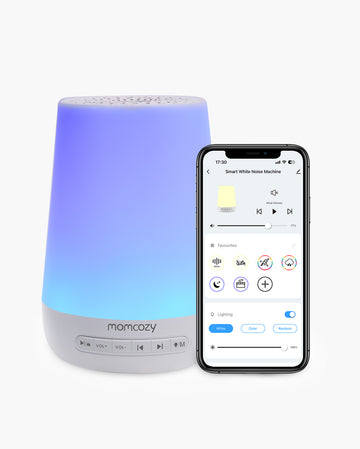
Families who want more room to compare different sound styles may prefer a machine with a broader sound library. The Momcozy Smart Baby Sound Machine with App Remote Control includes 34 sound options across white-noise, lullaby, and nature-sound categories, while app and touch controls make switching between sounds and adjusting volume straightforward. If a particular noise color matters to you, check the specific sound list before choosing.
For broader differences in controls and features, the Momcozy sound machine comparison guide can help you compare models without turning noise color into a product-ranking question.

FAQs About White, Pink and Brown Noise for Babies
Is Pink Noise Better Than White Noise for Babies?
There is not enough infant-specific head-to-head evidence to say pink noise is better. Pink noise often sounds softer because higher frequencies are less prominent, which some families may prefer. Choose based on comfort and masking needs rather than assuming it has stronger sleep benefits.
Is Brown Noise Safe for Babies?
Brown noise is not automatically safer or less safe because of its color. Sound level, placement, exposure duration, and device setup still matter. A deep sound can still be played too loudly, so follow the same gentle-use principles as with other background sounds.
Which Noise Color Is the Softest?
Pink noise is often described as softer or more balanced than white noise, while brown noise usually sounds deeper. This describes sound character, not actual loudness. Speaker design, recording, room acoustics, and volume settings can change how each one sounds.
Is Rain Sound White Noise or Pink Noise?
Not automatically. Rain may sound similar to pink noise because it can have a softer, balanced character, but a nature recording is only true pink noise if its actual frequency spectrum matches the definition. The same caution applies to fans, waterfalls, and ocean tracks.
Can I Switch Between White, Pink, and Brown Noise?
Yes, if you want to compare them. Keep the room, device, placement, and sound level similar so you are mainly changing the sound character. Avoid repeatedly switching sounds while your baby is distressed, and stop if a sound seems uncomfortable.
Does Brown Noise Help Babies Sleep Longer?
There is not enough infant-specific evidence to make that claim. Brown noise may be preferred by families who like a deeper, less hissy sound, but preference is different from proven longer sleep or fewer wakings.
Should Newborns Sleep With Noise All Night?
That question involves duration, volume, placement, and individual circumstances rather than noise color alone. This comparison should not set a universal all-night rule. Follow current product instructions and appropriately reviewed guidance for your baby’s setup.
What if My Baby Sleeps Well Without Background Noise?
You do not need to add noise just because other families use it. If your baby is comfortable and the environment does not need extra masking, silence can remain part of the routine.
Conclusion: Test the Sound, Not the Label
White noise is brighter and hissier, pink noise tends to sound softer and more balanced, and brown noise has a deeper low-frequency character. None is universally best for babies. A gentle, controlled trial can help you learn which sound fits your household and your baby’s response without treating one nap as proof. When choosing among baby sound machines, compare the actual sound library and controls first, then choose the setup that best fits your routine.








