


MEDICALLY REVIEWED BY

Dr Carly Dulabon, MD, IBCLC, NABBLM-C
Dr Carly Dulabon MD, IBCLC, NABBLM-C is medical director of the department of breastfeeding medicine with Akron Children's Hospital. She completed her medical degree at University of Toledo College of medicine, and her pediatrics residency at Children's Hospital of Pittsburgh. Her special interests are in maternal mental health and infant growth.
Do not rely on a swing’s recline to prevent reflux. The available guidance does not directly compare post-feed waiting with a particular swing angle, so it cannot show that one matters more than the other. What it does support is a calmer routine for babies whose clinician has recommended reflux precautions: hold them upright after feeding and avoid putting them straight into a swing or other seated device.
A swing is also not a sleep space. If your baby falls asleep there, move them promptly to a firm, flat crib, bassinet, or play yard, placed on their back.
What to do right after a feed
For a baby with frequent spit-up or clinician-identified reflux concerns, the first post-feed decision is usually simpler than finding the “best” swing setting: hold your baby upright and calm first.

A commonly used reflux-precautions plan is to keep a baby upright for 20–30 minutes after feeding, with holding preferred. This is guidance for infants whose clinician has recommended reflux precautions—not a universal timer every family must follow. It also advises avoiding a swing or car seat immediately after a feed. Read the reflux-precaution guidance.
A practical sequence can look like this:
- Finish the feed at a calm pace.
- Hold your baby upright and settled for the period your clinician recommends.
- Reassess: if your baby is awake and still needs brief soothing, choose an option that allows direct supervision.
- If your baby is sleepy, use the safe sleep space rather than a swing.

The reclined position is not a reflux treatment. Evidence suggests that semi-inclined positioning can worsen reflux, but the available information does not identify a specific swing angle that prevents spit-up or makes reflux safer. See the discussion of semi-inclined positioning and reflux.
In other words, “upright after feeds” generally means being held upright while awake. It does not automatically mean placing a baby upright-ish in a swing, bouncer, or car seat.
A swing may be awake-only soothing—not post-feed sleep
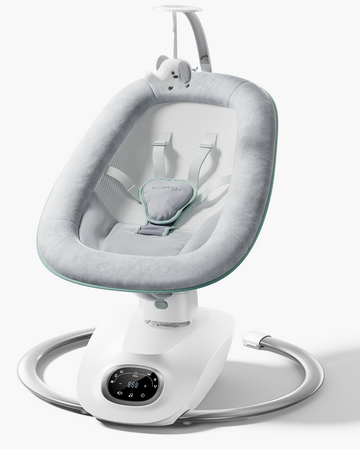
A swing may be used for limited soothing when a baby is awake, directly supervised, and secured with the harness or safety strap as directed. But supervision does not turn a swing into a safe place to sleep.
If your baby is... |
What to do |
Awake and alert |
If you use a swing, stay directly with your baby and use the restraint system correctly. Do not assume the reclined seat will reduce reflux. |
Drowsy or asleep |
Move your baby to a firm, flat crib, bassinet, or play yard. Place them on their back for sleep. |
This distinction matters after feeds because babies often become sleepy while being comforted. The safest next step is not to let the soothing device become the sleep location. Inclined infant sleep products are not considered safe sleep environments; infants should sleep on a firm, flat surface in a crib, bassinet, or play yard. Review the safe-sleep warning for inclined products.

A baby who spits up does not need a different sleep position. Once it is time to sleep, use the usual safe-sleep setup rather than trying to manage reflux with a reclined surface.
Start with feeding adjustments, not equipment
Small amounts of effortless spit-up during or shortly after feeds are common in many young babies. A baby who spits up a little but is otherwise comfortable, feeding well, and growing may not need a complicated positioning routine. Learn what uncomplicated spit-up can look like.
If spit-up is disruptive, focus first on feeding patterns you can discuss with your pediatric clinician:
- Avoid overfeeding.
- Ask whether smaller, more frequent feeds make sense for your baby.
- Follow any individualized feeding or reflux plan your clinician has already provided.
- Keep a simple note of when symptoms occur, how feeds are going, and whether your baby seems uncomfortable.
Do not make formula changes, use thickened feeds, or treat a swing or inclined device as a medical reflux solution without individualized clinical advice.
When to call the pediatric clinician
Positioning changes are not the right response when a baby has symptoms that may need medical evaluation.
Seek urgent or emergency help now if your baby:
- Has trouble breathing or turns blue.
Contact your pediatric clinician promptly for concerns such as:
- Forceful vomiting, especially if an infant younger than 3 months seems hungry again afterward.
- Green vomit, blood in vomit or stool, severe diarrhea, or a swollen-looking abdomen.
- Poor weight gain or weight loss.
- Ongoing refusal to feed or drink.
- Coughing, choking, or gagging during feeds.
- Recurrent respiratory infections.
- Increasing sleepiness, unresponsiveness, or not consistently waking for feeds.

These signs do not diagnose the cause. They are reasons to move beyond home positioning experiments and get professional guidance.
Comfort after a feed can come from a thoughtful routine: avoid overfeeding, use clinician-advised upright holding when appropriate, and keep the environment calm. But when sleep begins, the plan changes—move your baby to a firm, flat sleep surface. For ongoing symptoms or warning signs, speak with your pediatric clinician, and explore Momcozy’s feeding-routine, safe-sleep, and reflux-question resources for practical support.








