


Table of Contents
You fixed the sleep deprivation, survived the newborn phase, and somehow made it through years of raising small humans, but that soft, separated feeling in your core never quite went away. If you are wondering how to fix diastasis recti years later, you are not alone, and you are not too late. Healing is still possible with the right approach, whether it has been two years or ten.
What Is Diastasis Recti?
Diastasis recti is the separation of the rectus abdominis, the muscle running vertically down the center of your abdomen.
During pregnancy, the growing uterus stretches the connective tissue between these muscles (called the linea alba), and in some cases it does not fully return to its original width after birth.
The gap that remains can affect core strength, posture, pelvic floor function, and lower back stability.

What Triggers Diastasis Recti?
Pregnancy is the most common cause, but not the only one.
- Repeated pregnancies with little recovery time between them
- Large babies, twins, or excess amniotic fluid creating extended abdominal pressure
- Chronic intra-abdominal pressure from heavy lifting, chronic coughing, or breath-holding during exercise
- Genetics: some women have more lax connective tissue, which makes the linea alba more vulnerable
Men and infants can also develop diastasis recti, though postpartum women are most commonly affected.
What Can Be Mistaken for Diastasis Recti?
Not every postpartum belly concern is diastasis recti. Conditions that can look or feel similar:
- Umbilical hernia: a bulge near the belly button that requires medical evaluation
- Visceral fat or bloating: general abdominal fullness unrelated to muscle separation
- Weak core without separation: poor core activation can cause doming during movement without an actual gap
- Pelvic organ prolapse: heaviness in the pelvic region that may accompany but is separate from diastasis recti
If you are unsure, a pelvic floor physiotherapist can assess you properly.
Can You Fix Diastasis Recti Even Years Later?
Yes. The window for improvement does not close after six weeks, six months, or even several years. Diastasis recti that was never treated does not become permanent. It becomes undertreated.
Can You Heal Diastasis Recti After 10 Years?
You can make meaningful progress even a decade later. Targeted exercise and rehabilitation can reduce gap width, improve tissue tension, and restore functional core strength regardless of how long the separation has been present.
Diastasis recti before and after without surgery results are well-documented in rehabilitation settings. Many women with moderate separation see noticeable improvement through exercise alone, years after giving birth.
Why It Is Never Too Late to Start Healing Your Core
Healing diastasis recti is not primarily about closing the gap. It is about restoring the tension and function of the linea alba.
A gap with good tension can function well. A gap with poor tension, even if narrow, may still cause symptoms. Starting rehabilitation at any point produces real gains: less lower back pain, better posture, improved pelvic floor function, and a stronger core in daily life.
How Do I Tell If My Diastasis Recti Is Healed?
Healing goes beyond whether you can feel a gap. Signs of improvement include:
- The tissue along your midline feels firmer when you press into it
- Gentle movements like leg lifts no longer cause visible doming or ridging
- Lower back pain and pelvic instability have reduced
- You feel more supported when carrying, lifting, and standing
A pelvic floor physiotherapist can measure gap width and tissue tension and track your progress over time.
How to Fix Diastasis Recti Without Surgery
Non-surgical recovery focuses on managing intra-abdominal pressure, coordinating breath with movement, and gradually reloading the core in ways that support the linea alba.
All six exercises below come from the Momcozy yoga ball program. The Momcozy BirthEase Maternity Exercise Ball Set includes a 65 cm (25.6 in) exercise ball with a pump and non-slip base, designed for prenatal and postnatal use.
1. Pelvic Tilt

Why it helps: Activates the deep abdominals and pelvic floor together without loading the linea alba. A foundational starting point for diastasis recti recovery.
How to do it:
- Sit on the front third of the yoga ball, feet wider than shoulder-width, hands on hips.
- Inhale: tilt the pelvis forward, sit bones pressing gently back into the ball.
- Exhale: tilt the pelvis backward, lift the pubic bone, lower back rounds slightly.
- Move slowly and keep the breath steady.
What to feel: Gentle lower abdominal engagement on the exhale, with no gripping or bearing down.
Avoid: Excessive lower back arch on the forward tilt.
2. Ball-Supported Cat-Cow

Why it helps: Combines spinal mobility with pelvic floor and core activation. The ball provides feedback that helps you find the engagement on each exhale.
How to do it:
- Kneel with the yoga ball behind you, hips pressing lightly back against the ball.
- Exhale: engage the pelvic floor, draw the lower abdomen up, round the spine and tuck the chin.
- Inhale: release, arch the back gently, open the chest, lift the head.
- Move through each segment of the spine, not just the head or lower back.
What to feel: Clear pelvic floor contraction on each exhale, gradual release on each inhale.
Avoid: Losing hip contact with the ball during the movement.
3. Flying Bird Pose

Why it helps: Activates the serratus anterior, pelvic floor, and transverse abdominals together, the muscles that support the linea alba from the inside.
How to do it:
- Kneel with the yoga ball against a wall, hips lightly resting on the ball, hands slightly forward of shoulders.
- Exhale: engage the pelvic floor, draw the lower abdomen up, lift one arm straight overhead until parallel to the floor. Hold 5 seconds.
- Inhale: lower the arm, return hips to the ball.
- Alternate sides.
What to feel: Pelvic floor lifting on each exhale, shoulder opening without tension.
Avoid: Collapsing the lower back during the arm lift.
4. Dead Bug: Basic Version

Why it helps: One of the most effective ways to reload the abdominal wall without stressing the linea alba. The ball drives deep core activation without the downward pressure of crunches.
How to do it:
- Lie on your back, knees at 90 degrees, lower back pressed into the mat.
- Place the yoga ball between your knees and hands, arms straight, palms pressing the ball.
- Exhale: press hands down and knees up into the ball, as if trying to flatten it. Hold briefly.
- Inhale: relax the pressure, keep the ball in place.
What to feel: Lower abdomen drawing upward and inward on the exhale.
Avoid: Watch for doming or ridging along the midline. If it appears, reduce the effort.
5. Dead Bug: Advanced Version

Why it helps: Adds asymmetrical loading, training the linea alba to manage the diagonal forces of daily life.
How to do it:
- Same starting position as the basic version.
- Exhale: keep one arm and the opposite leg still, press the other hand and knee into the ball, lift the remaining foot slightly off the mat.
- Inhale: release and switch sides.
What to feel: Abdominals driving the movement, lower back flat against the mat throughout.
Avoid: Lifting the head or upper back off the mat.
6. Supine Alternating Feet on Ball

Why it helps: Builds the leg and core strength needed for daily movements without abdominal doming.
How to do it:
- Lie on your back facing a wall, both feet on the yoga ball, shoulder-width apart, pressing the ball against the wall.
- Hips and knees at 90 degrees, calves parallel to the floor, arms alongside the body, palms pressing into the mat.
- Exhale: straighten the legs and push the ball upward, feet flexed.
- Inhale: bend the knees and bring the ball back.
What to feel: Lower back in contact with the mat throughout.
Avoid: Lower back lifting off the mat during the leg extension.
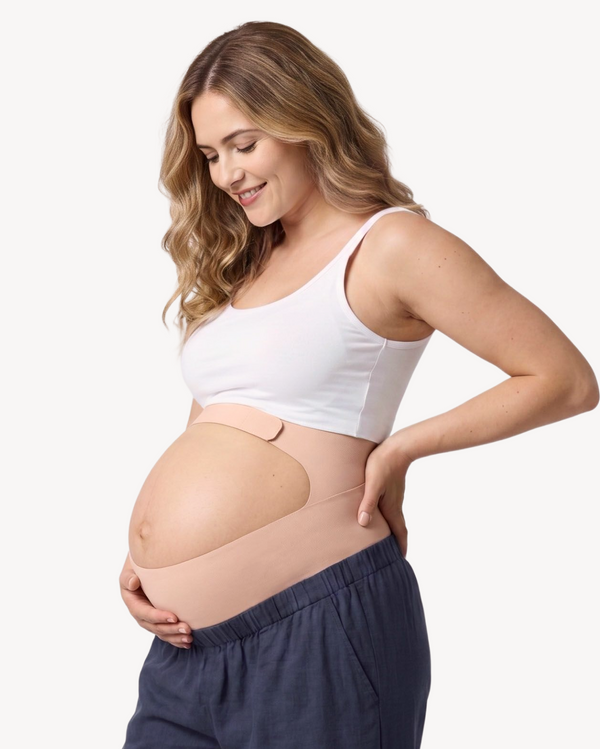
For support between sessions, a pregnancy belt like the Momcozy BumpEase Ergonest Maternity Belly Band provides gentle compression and lift to help manage intra-abdominal pressure during daily activities while your core rebuilds strength.
Schmerzlinderung
Komfort
Effektivität

Is Plank Bad for Diastasis Recti?
A full plank creates high intra-abdominal pressure and can cause the midline to dome if the linea alba lacks sufficient tension. It is best avoided early in recovery.
Safer modifications:
- Wall planks significantly reduce the load
- Forearm planks are lower load than straight-arm planks
- Stop any plank variation the moment you see or feel midline doming
Standard planks can return gradually once you can move through the exercises above without doming.
What Exercises Worsen Diastasis Recti?
Avoid anything that spikes intra-abdominal pressure or creates a downward bearing force:
- Crunches and sit-ups
- Heavy compound lifts before the core is properly rehabilitated
- Double-leg raises
- Any movement that causes visible doming or ridging along the midline
- Breath-holding during exertion
How Bad Does Diastasis Recti Have to Be for Surgery?
Surgery is generally considered when structured rehabilitation over 6 to 12 months has not resolved functional symptoms. Typical criteria include:
- A gap greater than 2.5 cm (approximately 1 inch) that has not responded to rehabilitation
- Persistent pain, hernia, or organ prolapse
- Significant functional limitations affecting daily quality of life
Will Insurance Pay to Fix Diastasis Recti?
Coverage varies by country and insurer. Surgery is more likely to be covered when it is medically necessary, for example, when a hernia is present or functional impairment is documented. Purely cosmetic repairs are usually not covered.
A formal assessment from a physiotherapist and physician helps document functional limitations and strengthens a coverage claim. Confirm with your insurer before proceeding.
What Kind of Doctor Treats Diastasis Recti?
- Pelvic floor physiotherapist: first point of contact for non-surgical rehabilitation
- OB-GYN or midwife: for initial assessment and referral
- General or plastic surgeon: for surgical repair
- Physiatrist: for complex non-surgical cases
FAQs about Diastasis Recti Recovery
Q1: Can I Get a Flat Tummy with Diastasis Recti?
Yes, though the path is different from standard core training. Rehabilitation reduces the midline bulge and improves abdominal tone in ways that crunches cannot. Many women see significant diastasis recti before and after without surgery changes in both function and appearance with consistent exercise.
Q2: Does Diastasis Recti Cause Belly Fat?
Not directly. The rounded appearance often associated with diastasis recti comes from the abdominal contents pressing forward through the weakened midline, not from fat accumulation. Rebuilding core strength helps restore the containment that keeps the abdomen more neutral.
Q3: Is It Fat or Loose Skin Under Diastasis Recti?
It can be either, or both. The forward bulge most linked to diastasis recti comes from the organs pressing through the weakened midline. Loose skin and subcutaneous fat are separate issues that may exist alongside it. A physiotherapist can help identify what is contributing most.
Q4: What Happens If You Never Fix Diastasis Recti?
The core continues to function below its potential, and compensatory movement patterns develop over time. These can contribute to lower back pain, hip discomfort, pelvic floor dysfunction, and poor posture. Starting rehabilitation at any stage consistently improves outcomes.
Start Where You Are
Whether your separation was discovered last month or years ago, the starting point is the same: breath first, then build. Momcozy's yoga ball program offers a structured, postnatal-specific approach you can follow at your own pace. Explore the Momcozy BirthEase Maternity Exercise Ball Set to get started.








