Pumping eats up a lot of a mom’s day. Then there’s the washing. It doesn’t matter if you breast pump at home, at the office, or in a parked car on a road trip: the parts have to be clean before the next session. Your baby’s health is on the line.
Milk gets left behind every single time. It clings to the breast shield, the valves, the membranes, the storage bottles. Leave it, and bacteria move in. From there it can get into your breast milk.
It takes less time than you’d think. You can wash by hand, run the parts through the dishwasher, or use a bottle washer. This guide goes through all three.
Do I Need to Clean My Breast Pump After Every Use?
Yes, every time. The CDC says any part of the pump that touches your milk should be cleaned after each pumping session. That includes the quick one before a meeting.
Leftover milk gives bacteria something to live on, and the longer the parts sit, the greater the chance of contamination. Washing them right away stops that early.
Parts that generally need cleaning include:
- Breast shields or flanges
- Valves and membranes
- Connectors and backflow protector, if applicable
- Milk collection bottles and containers
- Wearable breast pump collection cups
The breast pump motor and electrical parts typically don't have to be cleaned. You should only clean the exterior surfaces of the breast pump motor and electrical parts in accordance with the manufacturer’s directions.
CDC further suggests that you disinfect breast pump on a daily basis, especially if your baby is less than 2 months old, premature, or immunocompromised.
Cleaning is not the same as sanitization. In cleaning, you remove the milk residues and germs. However, in sanitization, you reduce the amount of germs that remain after cleaning. Make sure to clean the components first before sanitizing them.
How to Wash a Breast Pump
Knowing how to wash a breast pump will enable you to remove any traces of milk from the machine while preventing any bacterial growth. Make sure you clean all the components of your breast pump which come into contact with your breast milk after every use according to the instructions given in your breast pump’s instruction manual.
Follow these general steps of after each pumping session:
- Wash your hands. Wash hands for at least 20 seconds with soap and water prior to handling pump.
- Disassemble breast pump. Take apart all the removable parts that will be in contact with the breast milk, including flanges, valves, membranes, connectors, and milk storage containers.
- Remove washable parts. Do not allow electrical parts and any other parts that should not get wet to go near the sink or where you are washing.
- Rinse the breast pump. Rinse the removable parts with running water to eliminate any leftover milk. Do not put it in the sink.
- Clean with soap and warm water. Make use of a washing basin designated for breast pump and also dish soap. Follow the recommendations in case some breast pump require specific cleaning.
- Rinse thoroughly. Rinse the parts of the breast pump using running water.
- Air dry the breast pump. Place them on a proper drying rack or a new paper towel. Do not use a dish towel for drying since it may carry germs to clean breast pump.
- Store once dried. Store the parts in a clean and safe place until you use the parts again.
Once you have disassembled the breast pump and identified its washable parts, the type of cleaning technique suitable for your breast pump will be clear.
Breast Pump Washing by Hand
Hand washing is another simple technique used to clean breast pump equipment when the manufacturer does not recommend using the dishwasher to clean the equipment. Additionally, hand washing allows one to concentrate on the smaller parts, like the valves and membranes.
In order to hand wash your pumping machine, you are required to have a basin designated specifically for cleaning breast pumps and babies' feeding supplies. The basin should be filled with warm water and dish washing soap.
Focus on areas where milk residue can collect, like grooves, holes, and small corners. If the manufacturer permits it, you may want to use a small brush. You should never scrub any fragile parts, according to the manual.
When the washing process is done, rinse each piece under running water. After that, place the pieces on a clean rack to dry or on a clean paper towel to air-dry.
Cleaning your breast pump in a dishwasher
Certain components of the breast pump can be put in the dishwasher. However, this does not mean that all parts of the breast pump can handle the temperature and pressure of the dishwasher.
Assuming that your breast pump can be put in the dishwasher:
- Disassemble your breast pump and sort out the parts that you need to wash.
- Put small parts such as valves and connections in a basket with a lid for your dishwasher to keep track of them.
- Place the parts in accordance with the washing instructions of the manufacturer of your dishwasher. If your breast pump manufacturer recommends it, place them on the upper rack of the dishwasher.
- Wash your breast pump in hot water and heat-dry or heat-sanitize them in the dishwasher.
- Once done, ensure all parts are washed and dried completely before storage.
The breast pump motor, electrical parts, and parts which have been designated for hand washing should not be put into the dishwasher. If you are not sure about the dishwasher-safety of a part, you should hand wash it.
Breast pump washing using bottle washer
If you use your breast pump often, then a bottle washer will be helpful. There are those which can also clean your compatible baby pump, together with bottles and other feeding items.
Before using any of these, check whether your breast pump can withstand heat or if they can work well with the machine. The bottle washer cannot be used to clean your electronic breast pump motors.
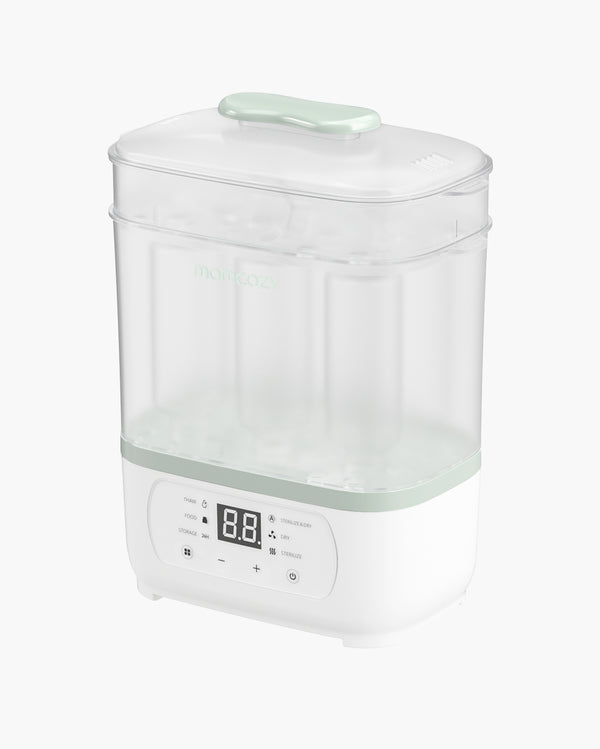
Momcozy has two different bottle washers that might come in handy for you.
- New Momcozy DeepClean Baby Bottle Washer and Sterilizer (D8)
The New Momcozy DeepClean Baby Bottle Washer and Sterilizer (D8) is intended for use in washing baby bottles and other compatible feeding products.
This sterilizer has special racks for breast pumps, which makes it useful for washing compatible breast pump. The functions of washing, steam sterilization, drying, and storage that this device has can save you time.
- Momcozy DeepClean Lite Baby Bottle Washer and Sterilizer
The Momcozy DeepClean Lite Baby Bottle Washer and Sterilizer provides yet another choice for the parents who desire a compact device.
This washing machine is able to clean numerous compatible parts of the breast pump and also wearables from the breast pump as long as the parts are heat-resistant and have no electronic components. The device includes Pump360 breast-pump cleaning adapters.
It is important to read the instructions for your particular breast pump before using a bottle washer. For alternative choices, consider the Momcozy bottle washer collection.
While a bottle washer can simplify cleaning duties, it does not replace the requirement for disassembly and inspection of the breast pump components as per the manufacturer’s instructions.
Do I Need to Clean the Breast Pump Tubing?
Breast pump tubing normally does not touch breast milk and does not require cleaning each time after its use. Nevertheless, you should check it from time to time. If there is any milk, wetness, or mold found inside it, clean it according to the manufacturer's recommendations.
It should be noted that tubing of some Momcozy breast pumps cannot be washed. In case there is any milk inside it, it should be replaced.
In case you see any condensation in the tubing, refer to your breast pump’s manual, as some manufacturers advise pumping the liquid for a while to make the tubing dry. Avoid reconnecting damp tubing unless the manufacturer says it is okay to do so.
The breast pump’s motor or other electrical parts should never come into contact with water.
Can I Use Breast Pump Wipes Instead of Washing?
Breast pump wipes can be handy if you need to breast pump out breast milk while out of your house and have no way to get water and soap. They are made to remove visible residues left on the surface of the breast pump.
Nevertheless, wipes should not take the place of cleaning. According to FDA and CDC recommendations, all components that have been in contact with breast milk need to be washed with dish soap and water.
In case you have to pump out breast milk at work or on the road, it may be worth bringing a mini cleaning kit with a separate basin, brush, and dish soap. Breast pump wipes can be used as a substitute in case washing is unavailable.
Can I Just Rinse breast Pump Between Sessions?
Rinsing can help get rid of some milk, but this does not properly clean the components nor kill all the bacteria.
According to the CDC, breast pump which have had contact with breast milk should be washed after every use. In case it is impossible to wash them immediately, they should be rinsed and cleaned later.
However, rinsing is just a temporary measure and should not be used as a substitute for regular washing using soap and water. It is important not to use the parts again until they are cleaned properly and air dried.
If you breast pump several times daily, it may be easier to have an additional set of breast pump that are already clean.
Can I Reuse a Breast Pump Without Cleaning?
It is not advisable to re-use the dirty breast pump components that come into direct contact with breast milk.
The remnants left on the components provide an environment for bacteria growth, thereby exposing the breast milk to contamination. The breast pump components need to be cleaned and dried properly before being used once more.
When wearing a breast pump, have another set of the components ready for reuse. Cleaning becomes easy when there is no time limitation to wash and dry.
CDC advises on cleaning and sanitizing all the shared breast pump surfaces prior to usage.
FAQs
What about the “fridge hack”?
The CDC does not suggest keeping the old breast pump refrigerated instead of cleaning them between feedings. All breast milk contact parts should be cleaned after each use.
Can you get mastitis from dirty breast pump?
Dirt in the breast pump can promote the growth of microorganisms and result in contamination of breast milk. Cleaning is essential in preventing contamination.
Should I use a brush to scrub breast pump kit parts?
Yes, clean the tiny openings with the help of a soft brush. Make sure that you rinse the parts thoroughly after cleaning.
Are certain kinds of soap more effective in cleaning breast pump?
Normal dish soap can be used to clean your breast pump. It is not necessary to use antibacterial soap.
My manufacturer's instructions say I can't put certain parts of my breast pump in boiling water. Does CDC have any tips on how I can sanitize these parts?
Yes. CDC advises adhering to the manufacturer's instructions as well as sanitizing using an approved procedure. You may sanitize using steam sanitizer or dishwasher sanitizing cycle provided that your parts are compatible with these methods.
Conclusion
Knowing how to clean breast pumps is important as this will help ensure that everything remains safe and hygienic. This involves cleaning the components that come into contact with the milk after each and every session.
Hand washing, dishwashers, or even a bottle washer for compatible components – whichever method you choose to follow, consistency is what really counts. Through effective cleaning and proper use of equipment, you will have less time to think about the hygiene of the pumps and more time for your baby’s requirements.